Numberger M, Dürr I, Kues W, Koenen M, Witzemann V
Max-Planck-Institut für medizinische Forschung, Abteilung Zellphysiologie, Heidelberg, FRG.
EMBO J. 1991 Oct;10(10):2957-64. doi: 10.1002/j.1460-2075.1991.tb07846.x.
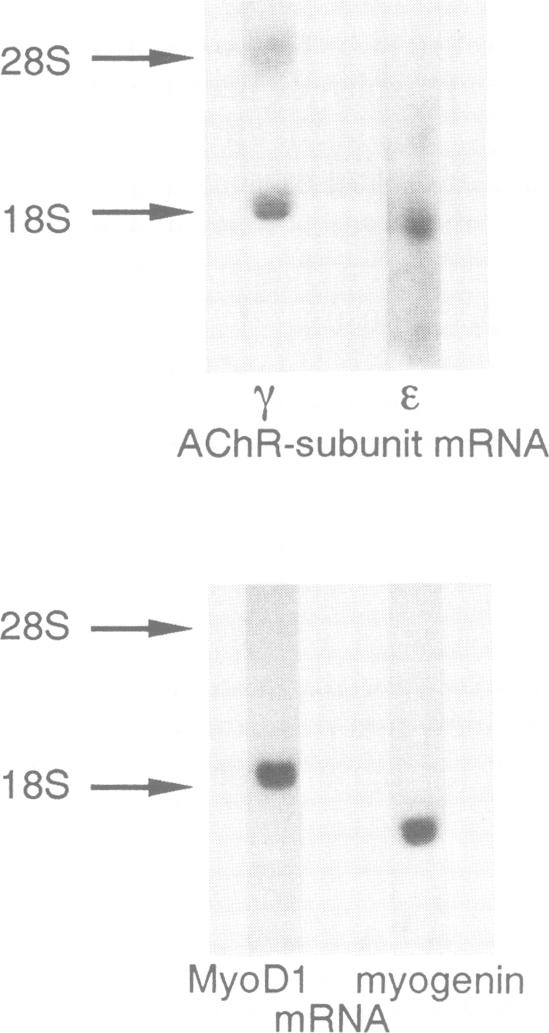
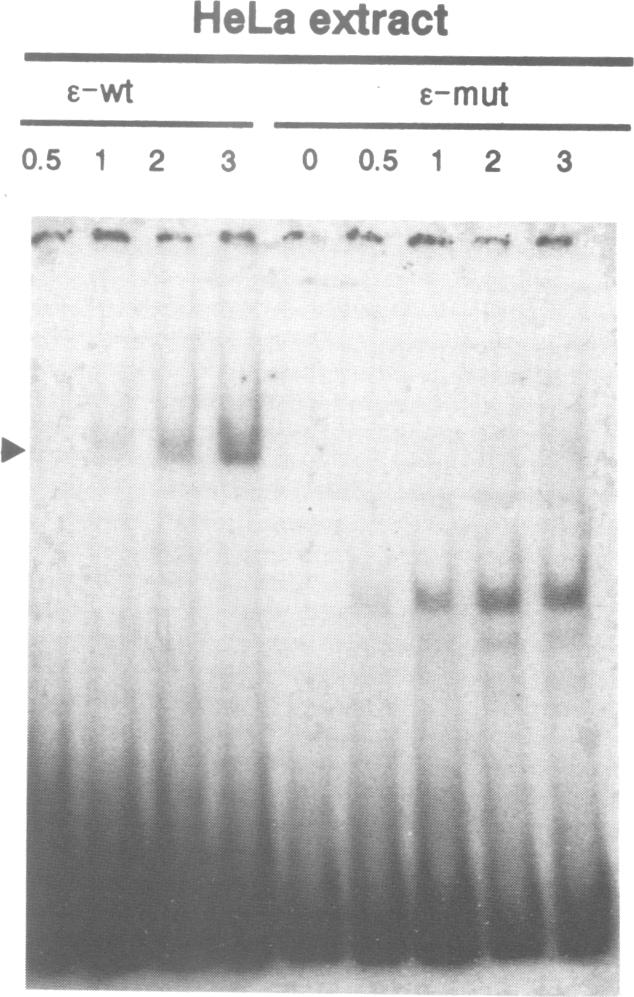
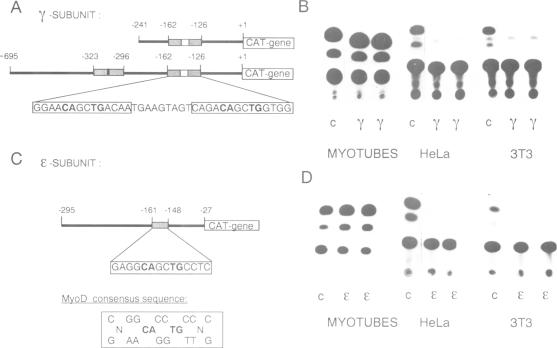
Five different subunits, alpha, beta, gamma, delta and epsilon, constitute the acetylcholine receptors from mammalian skeletal muscle. Their corresponding mRNA levels are regulated differentially. In particular, mRNAs encoding the gamma- and epsilon-subunits, which specify two AChR isoforms, show a reciprocal behaviour during synapse formation and maturation. We have isolated 5' flanking sequences of the gamma- and epsilon-subunit genes that confer muscle-specific expression upon transient transfection of primary cultures of rat muscle cells. The gamma-subunit gene fragment contains two adjacent CANNTG sequence motifs that are essential for muscle-specific transcriptional activity suggesting transactivation by helix-loop-helix proteins. The epsilon-subunit gene fragment carries only a single CANNTG consensus motif which is not required for expression in transfected muscle cells. This sequence motif is, however, necessary to repress transcriptional activity in non-muscle cells and thus may control the muscle-specific expression of the epsilon-subunit gene. The results suggest that CANNTG motifs together with their 3' and 5' flanking nucleotides provide binding sites for both activating as well as repressing trans-acting factors. These elements could thus contribute to the muscle-specific expression of AChR subunit genes.
五种不同的亚基,即α、β、γ、δ和ε,构成了哺乳动物骨骼肌的乙酰胆碱受体。它们相应的mRNA水平受到不同的调节。特别是,编码γ和ε亚基的mRNA,这两种亚基决定了两种乙酰胆碱受体亚型,在突触形成和成熟过程中表现出相反的行为。我们分离出了γ和ε亚基基因的5'侧翼序列,这些序列在原代培养的大鼠肌肉细胞瞬时转染时赋予肌肉特异性表达。γ亚基基因片段包含两个相邻的CANNTG序列基序,它们对于肌肉特异性转录活性至关重要,提示由螺旋-环-螺旋蛋白进行反式激活。ε亚基基因片段仅携带一个单一的CANNTG共有基序,该基序对于转染的肌肉细胞中的表达并非必需。然而,这个序列基序对于抑制非肌肉细胞中的转录活性是必要的,因此可能控制ε亚基基因的肌肉特异性表达。结果表明,CANNTG基序及其3'和5'侧翼核苷酸为激活和抑制反式作用因子提供了结合位点。这些元件因此可能有助于乙酰胆碱受体亚基基因的肌肉特异性表达。