Doong S L, Tsai C H, Schinazi R F, Liotta D C, Cheng Y C
Department of Pharmacology, Yale University School of Medicine, New Haven, CT 06510.
Proc Natl Acad Sci U S A. 1991 Oct 1;88(19):8495-9. doi: 10.1073/pnas.88.19.8495.
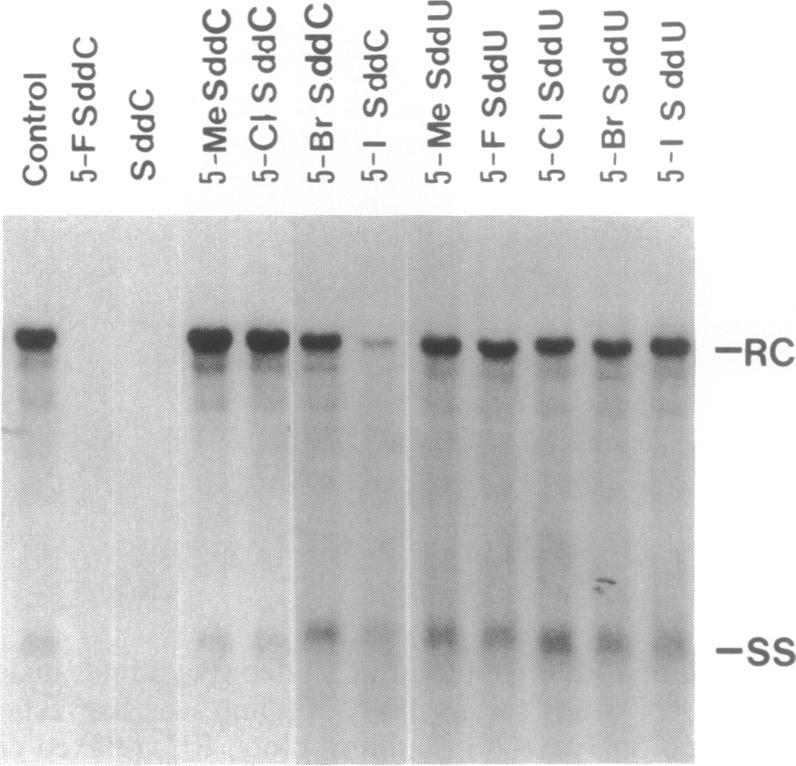
Several 2',3'-dideoxy-3'-thiapyrimidine nucleosides were studied for their ability to inhibit hepatitis B virus (HBV) DNA replication in a HBV-transfected cell line (2.2.15). 2',3'-Dideoxy-3'-thiacytidine (SddC) and 5-fluoro-2',3'-dideoxy-3'-thiacytidine(5-FSddC) were found to be the most potent anti-HBV compounds of those examined. Both compounds resulted in nearly complete cessation of viral DNA replication at 0.5 microM, as monitored by the absence of both intracellular episomal and secreted viral DNAs. The HBV-specific RNAs were not reduced at concentrations that completely blocked HBV DNA replication, suggesting that the inhibitory target is HBV DNA synthesis. The antiviral action of SddC and 5-FSddC was reversible. The concentration of SddC and 5-FSddC required to inhibit 50% of 4-day cell growth in culture was 37 microM and more than 200 microM, respectively. Unlike 2',3'-dideoxycytidine, these two compounds do not affect mitochondrial DNA synthesis in cells at concentrations lower than that required to inhibit cell growth. In view of the potent and selective antiviral activity, both SddC and 5-FSddC should be further evaluated for the treatment of human HBV infection.
研究了几种2',3'-二脱氧-3'-硫代嘧啶核苷抑制乙型肝炎病毒(HBV)转染细胞系(2.2.15)中HBV DNA复制的能力。2',3'-二脱氧-3'-硫代胞苷(SddC)和5-氟-2',3'-二脱氧-3'-硫代胞苷(5-FSddC)被发现是所检测化合物中最有效的抗HBV化合物。通过细胞内游离型和分泌型病毒DNA的缺失监测发现,这两种化合物在0.5 microM时几乎完全停止病毒DNA复制。在完全阻断HBV DNA复制的浓度下,HBV特异性RNA并未减少,这表明抑制靶点是HBV DNA合成。SddC和5-FSddC的抗病毒作用是可逆的。抑制培养中4天细胞生长50%所需的SddC和5-FSddC浓度分别为37 microM和超过200 microM。与2',3'-二脱氧胞苷不同,这两种化合物在低于抑制细胞生长所需浓度时不影响细胞中的线粒体DNA合成。鉴于其强大的选择性抗病毒活性,SddC和5-FSddC都应进一步评估用于治疗人类HBV感染。