Cojean Sandrine, Noël Alain, Garnier Dimitri, Hubert Véronique, Le Bras Jacques, Durand Rémy
Centre National de Référence pour la Chimiosensibilité du Paludisme, APHP, Hôpital Bichat-Claude Bernard, Paris, France.
Malar J. 2006 Mar 28;5:24. doi: 10.1186/1475-2875-5-24.
Plasmodium falciparum drug resistance represents a major health problem in malaria endemic countries. The mechanisms of resistance are not fully elucidated. Recently, an association between putative transporter gene polymorphisms and in vitro response to chloroquine (CQ) and quinine has been reported in culture-adapted, cloned isolates from various geographical origins. However, this was not confirmed in another study performed on isolates from a defined region in Thailand.
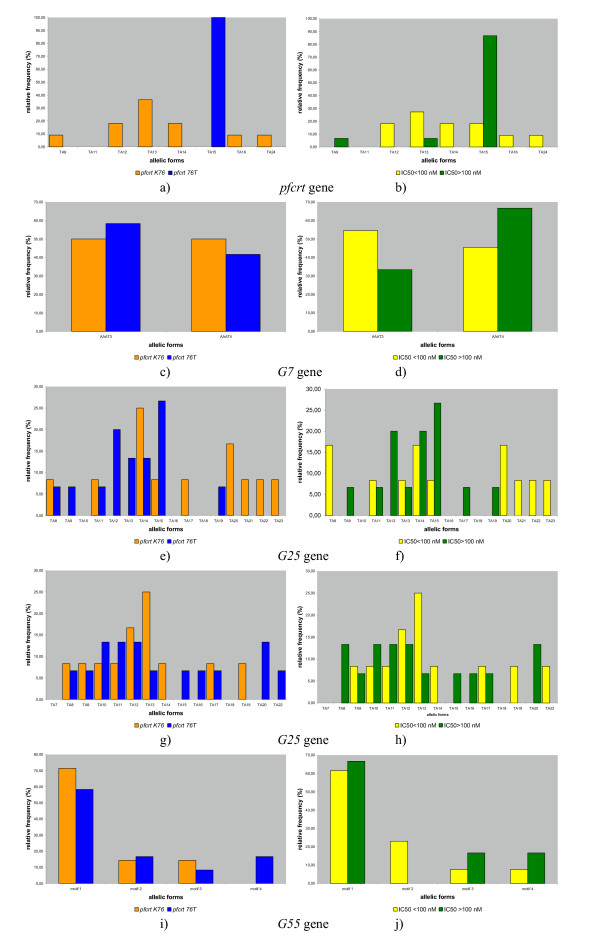
This study tried to find an association between putative transporters gene polymorphisms with in vitro response to CQ and pfcrt genotype in isolates originating from various African countries. To avoid biases of parasites adaptation in culture, fresh isolates obtained from symptomatic, malaria-infected travellers returning from Africa to France were used. Monoclonal isolates included in the study were selected using a msp-2 fragment analysis method. In vitro susceptibility to CQ, single nucleotide polymorphisms and microsatellite polymorphisms in pfcrt, pfmdr1 and six putative transporter genes were established in 27 isolates and three reference strains.
Polymorphism of pfcrt at positions 76 and 220 showed a significant association with in vitro chloroquine resistance (P < .02 and P < .05 respectively). Polymorphism of pfmdr1 at position 86 showed an equally significant association with in vitro chloroquine response (P < .05). No association was found between SNPs or microsatellite polymorphisms of putative transporter genes and in vitro CQR or pfcrt genotype in imported malaria isolates from Africa.
The previously described association between putative transporter gene polymorphisms and in vitro response to chloroquine (CQ) was not confirmed in the present study.
恶性疟原虫耐药性是疟疾流行国家的一个主要健康问题。耐药机制尚未完全阐明。最近,在来自不同地理区域的适应培养的克隆分离株中,已报道假定转运蛋白基因多态性与体外对氯喹(CQ)和奎宁的反应之间存在关联。然而,在另一项针对泰国特定地区分离株的研究中未得到证实。
本研究试图在源自非洲各国的分离株中,寻找假定转运蛋白基因多态性与体外对CQ的反应及pfcrt基因型之间的关联。为避免寄生虫在培养中适应的偏差,使用了从有症状的、从非洲返回法国的疟疾感染旅行者中获得的新鲜分离株。研究中纳入的单克隆分离株采用msp - 2片段分析法进行选择。在27个分离株和3个参考菌株中确定了对CQ的体外敏感性、pfcrt、pfmdr1和6个假定转运蛋白基因中的单核苷酸多态性及微卫星多态性。
pfcrt第76和220位的多态性与体外氯喹耐药性显著相关(分别为P < 0.02和P < 0.05)。pfmdr1第86位的多态性与体外氯喹反应同样显著相关(P < 0.05)。在来自非洲的输入性疟疾分离株中,未发现假定转运蛋白基因的单核苷酸多态性或微卫星多态性与体外氯喹耐药性(CQR)或pfcrt基因型之间存在关联。
本研究未证实先前描述的假定转运蛋白基因多态性与体外对氯喹(CQ)反应之间的关联。