Department of Biology, Washington University, St. Louis, MO 63130.
Proc Natl Acad Sci U S A. 1985 Jul;82(13):4399-403. doi: 10.1073/pnas.82.13.4399.
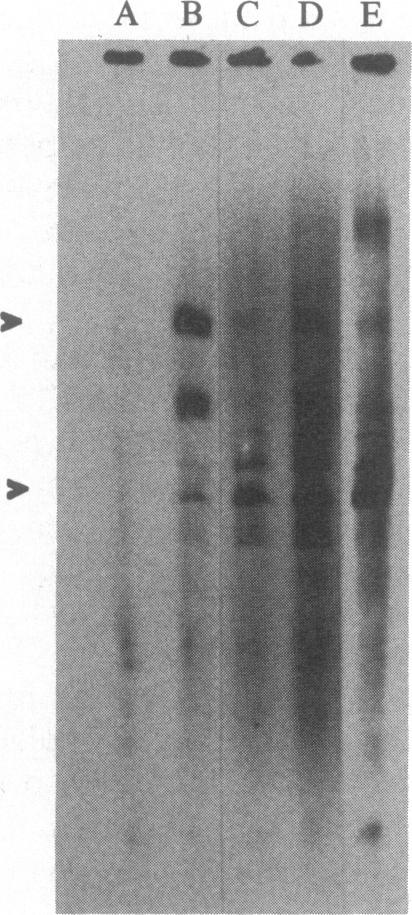
Extensins are hydroxyproline-rich glycoproteins associated with most dicotyledonous plant cell walls. To isolate cDNA clones encoding extensin, we started by isolating poly(A)(+) RNA from carrot root tissue, and then translating the RNA in vitro, in the presence of tritiated leucine or proline. A 33-kDa peptide was identified in the translation products as a putative extensin precursor because: (i) it is rich in proline and poor in leucine, and (ii) the message appears to be more abundant when carrot tissue is wounded. From a cDNA library constructed with poly(A)(+) RNA from wounded carrots, one cDNA clone (pDC5) was identified that specifically hybridized to poly(A)(+) RNA encoding this 33-kDa peptide. We isolated three cDNA clones (pDC11, pDC12, and pDC16) from another cDNA library using pDC5 as a probe. DNA sequence data, RNA hybridization analysis, and hybrid released in vitro translation indicate that the cDNA clone pDC11 encodes extensin and that cDNA clones pDC12 and pDC16 encode the 33-kDa peptide, which as yet has an unknown identity and function. The assumption that the 33-kDa peptide was an extensin precursor was invalid. RNA hybridization and DNA sequence analysis indicate that pDC5 is a hybrid clone corresponding to two RNA species. RNA hybridization analysis showed that RNA encoded by both clone types is accumulated upon wounding.
伸展蛋白是富含羟脯氨酸的糖蛋白,与大多数双子叶植物细胞壁有关。为了分离编码伸展蛋白的 cDNA 克隆,我们首先从胡萝卜根组织中分离 poly(A)(+)RNA,然后在存在氚标记亮氨酸或脯氨酸的情况下体外翻译 RNA。在翻译产物中鉴定出一种 33kDa 的肽作为推定的伸展蛋白前体,因为:(i)它富含脯氨酸而亮氨酸含量低,(ii)当胡萝卜组织受伤时,该消息似乎更为丰富。从受伤胡萝卜的 poly(A)(+)RNA 构建的 cDNA 文库中,鉴定出一个 cDNA 克隆(pDC5),该克隆特异性杂交编码这种 33kDa 肽的 poly(A)(+)RNA。我们使用 pDC5 作为探针从另一个 cDNA 文库中分离出三个 cDNA 克隆(pDC11、pDC12 和 pDC16)。DNA 序列数据、RNA 杂交分析和体外翻译的杂交释放表明,cDNA 克隆 pDC11 编码伸展蛋白,而 cDNA 克隆 pDC12 和 pDC16 编码 33kDa 肽,其身份和功能尚不清楚。33kDa 肽是伸展蛋白前体的假设是无效的。RNA 杂交和 DNA 序列分析表明 pDC5 是对应于两种 RNA 物种的杂交克隆。RNA 杂交分析表明,两种克隆类型编码的 RNA 均在受伤时积累。