Feierabend J, Schaan C, Hertwig B
Botanisches Institut, J. W. Goethe-Universität, P.O. Box 11 19 32, D-6000 Frankfurt am Main, Federal Republic of Germany.
Plant Physiol. 1992 Nov;100(3):1554-61. doi: 10.1104/pp.100.3.1554.
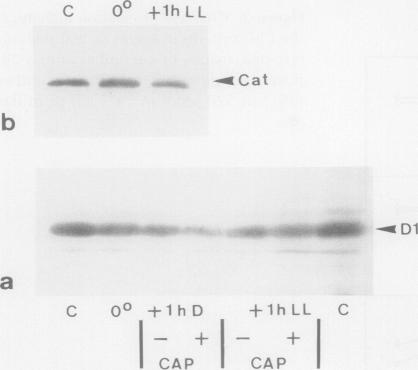
Severe photoinactivation of catalase (EC 1.11.1.6) and a decline of variable fluorescence (F(v)), indicating photoinhibition of photosynthesis, were observed as rapid and specific symptoms in leaves exposed to a high heat-shock temperature of 40 degrees C as well as in leaves exposed to low chilling temperatures in white light of only moderately high photosynthetic photon flux density of 520 muE m(-2) s(-1). Other parameters, such as peroxidase (EC 1.11.1.7), glycolate oxidase (EC 1.1.3.1), glutathione reductase (EC 1.6.4.2), or the chlorophyll content, were hardly affected under these conditions. At a compatible temperature of 22 degrees C, the applied light intensity did not induce severe photoinactivations. In darkness, exposures to high or low temperatures did not affect catalase levels. Also, decline of F(v) in light was not related to temperature sensitivity in darkness. The effective low-temperature ranges inducing photoinactivation of catalase differed significantly for chilling-tolerant and chilling-sensitive plants. In leaves of rye (Secale cereale L.) and pea (Pisum sativum L.), photoinactivation occurred only below 15 degrees C, whereas inactivation occurred at 15 degrees C in cucumber (Cucumis sativus L.) and maize (Zea mays L.). The behavior of F(v) was similar, but the difference between chilling-sensitive and chilling-tolerant plants was less striking. Whereas the catalase polypeptide, although photoinactivated, was not cleaved at 0 to 4 degrees C, the D1 protein of photosystem II was greatly degraded during the low-temperature treatment of rye leaves in light. Rye leaves did not exhibit symptoms of any major general photodamage, even when they were totally depleted of catalase after photoinactivation at 0 to 4 degrees C, and catalase recovered rapidly at normal temperature. In cucumber leaves, the decline of catalase after exposures to bright light at 0 to 4 degrees C was accompanied by bleaching of chlorophyll, and the recovery observed at 25 degrees C was slow and required several days. Similar to the D1 protein of photosystem II, catalase differs greatly from other proteins by its inactivation and high turnover in light. Inasmuch as catalase and D1 protein levels depend on continuous repair synthesis, preferential and rapid declines are generally to be expected in light whenever translation is suppressed by stress actions, such as heat or chilling, and recovery will reflect the repair capacity of the plants.
在暴露于40℃的高热激温度的叶片中,以及在光合光子通量密度仅为中等高度(520 μE m⁻² s⁻¹)的白光下暴露于低温的叶片中,观察到过氧化氢酶(EC 1.11.1.6)的严重光失活和可变荧光(F(v))的下降,这表明光合作用受到光抑制,这些是快速且特定的症状。在这些条件下,其他参数,如过氧化物酶(EC 1.11.1.7)、乙醇酸氧化酶(EC 1.1.3.1)、谷胱甘肽还原酶(EC 1.6.4.2)或叶绿素含量,几乎没有受到影响。在22℃的适宜温度下,所施加的光强度不会诱导严重的光失活。在黑暗中,暴露于高温或低温不会影响过氧化氢酶水平。此外,光照下F(v)的下降与黑暗中的温度敏感性无关。诱导过氧化氢酶光失活的有效低温范围在耐寒和冷敏感植物之间存在显著差异。在黑麦(Secale cereale L.)和豌豆(Pisum sativum L.)的叶片中,光失活仅在15℃以下发生,而在黄瓜(Cucumis sativus L.)和玉米(Zea mays L.)中,失活在15℃时发生。F(v)的表现类似,但冷敏感和耐寒植物之间的差异不太明显。尽管过氧化氢酶多肽在光失活后未被切割,但在光照下对黑麦叶片进行低温处理期间,光系统II的D1蛋白被大量降解。黑麦叶片即使在0至4℃光失活后过氧化氢酶完全耗尽时,也未表现出任何主要的一般光损伤症状,并且过氧化氢酶在常温下迅速恢复。在黄瓜叶片中,在0至4℃暴露于强光后过氧化氢酶的下降伴随着叶绿素的漂白,并且在25℃观察到的恢复缓慢且需要数天。与光系统II的D1蛋白类似,过氧化氢酶因其在光照下的失活和高周转率而与其他蛋白质有很大不同。由于过氧化氢酶和D1蛋白水平取决于持续的修复合成,每当翻译受到热或冷等应激作用抑制时,在光照下通常预期会优先且快速下降,并且恢复将反映植物的修复能力。