Ross C, Cole C V
Department of Botany and Plant Pathology, Colorado State University, Fort Collins, Colorado 80521.
Plant Physiol. 1968 Aug;43(8):1227-31. doi: 10.1104/pp.43.8.1227.
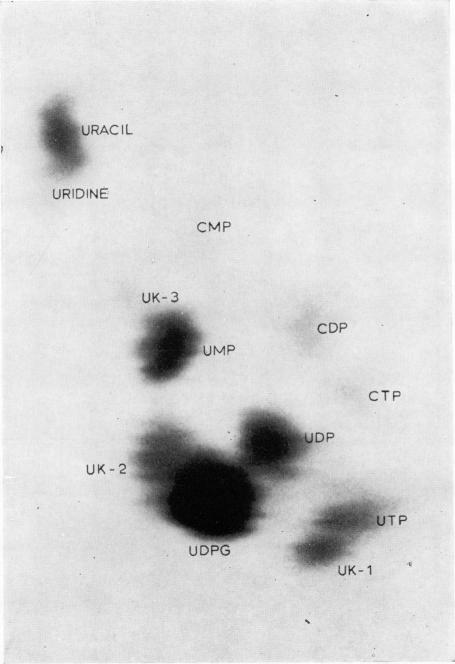
The metabolism of cytidine-2-(14)C and uridine-2-(14)C was studied in discs cut from leaflets of bean plants (Phaseolus vulgaris L.). Cytidine was degraded to carbon dioxide and incorporated into RNA at about the same rates as was uridine. Both nucleosides were converted into the same soluble nucleotides, principally uridine diphosphate glucose, suggesting that cytidine was rapidly deaminated to uridine and then metabolized along the same pathways. However, cytidine was converted to cytidine diphosphate and cytidine triphosphate more effectively than was uridine. Cytidine also was converted into cytidylic acid of RNA much more extensively and into RNA uridylic acid less extensively than was uridine. Azaserine, an antagonist of reactions involving glutamine (including the conversion of uridine triphosphate to cytidine triphosphate), inhibited the conversion of cytidine into RNA uridylic acid with less effect on its incorporation into cytidylic acid. On the other hand, it inhibited the conversion of orotic acid into RNA cytidylic acid much more than into uridylic acid. The results suggest that cytidine is in part metabolized by direct conversion to uridine and in part by conversion to cytidine triphosphate through reactions not involving uridine nucleotides.
在从菜豆(Phaseolus vulgaris L.)叶片切下的叶圆片中研究了胞苷 -2-(14)C和尿苷 -2-(14)C的代谢。胞苷降解为二氧化碳并掺入RNA的速率与尿苷大致相同。两种核苷都转化为相同的可溶性核苷酸,主要是尿苷二磷酸葡萄糖,这表明胞苷迅速脱氨生成尿苷,然后沿相同途径代谢。然而,胞苷比尿苷更有效地转化为胞苷二磷酸和胞苷三磷酸。与尿苷相比,胞苷也更广泛地转化为RNA的胞苷酸,而转化为RNA尿苷酸的程度较低。重氮丝氨酸是涉及谷氨酰胺反应(包括尿苷三磷酸转化为胞苷三磷酸)的拮抗剂,它抑制胞苷转化为RNA尿苷酸,而对其掺入胞苷酸的影响较小。另一方面,它抑制乳清酸转化为RNA胞苷酸的程度远大于转化为尿苷酸的程度。结果表明,胞苷部分通过直接转化为尿苷进行代谢,部分通过不涉及尿苷核苷酸的反应转化为胞苷三磷酸进行代谢。