Plant Physiology and Applied Biochemistry Divisions, Department of Scientific and Industrial Research, Palmerston North, New Zealand.
Plant Physiol. 1971 May;47(5):719-25. doi: 10.1104/pp.47.5.719.
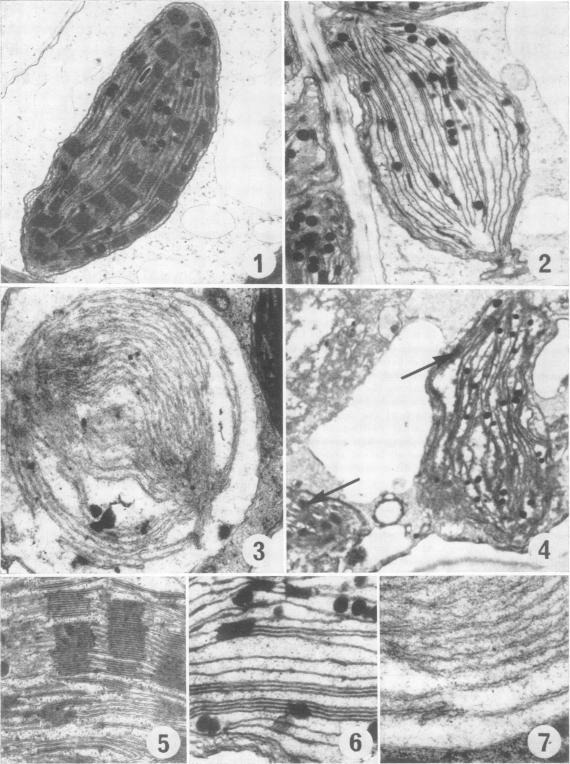
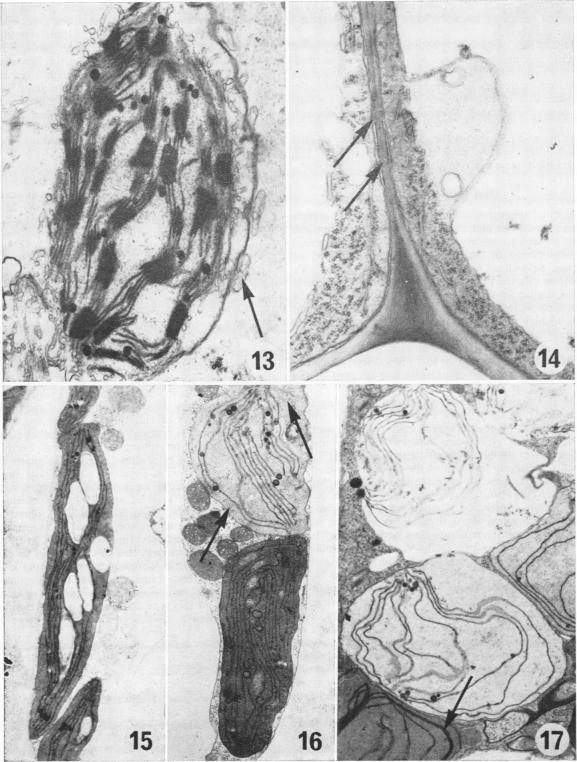
Mesophyll chloroplasts of the C(4)-pathway grasses Sorghum and Paspalum and of the C(3)-pathway legume soybean undergo ultrastructural changes under moderate light intensities (170 w.m(-2), 400-700 nanometers) at a tme when photosynthesis is much reduced by low temperature (10 C). The pattern of ultrastructural change was similar in these species, despite some differences in the initial sites of low temperature action on photosynthesis and differences in their mechanisms of CO(2) fixation. Starch grains in the chloroplasts rapidly reduce in size when chilling stress is applied. At or before the time starch grains completely disappear the membranes of the individual stromal thylakoids close together, reducing the intraspace between them while the chloroplast as a whole begins to swell. Extensive granal stacking appears to hold the thylakoids in position for some time, causing initial swelling to occur in the zone of the peripheral reticulum, when present. At more advanced stages of swelling the thylakoid system unravels while the thylakoid intraspaces dilate markedly. Initial thylakoid intraspace contraction is tentatively ascribed to an increase in the transmembrane hydrogen ion gradient causing movement of cations and undissociated organic acids from the thylakoid intraspace to the stroma. Chloroplast swelling may be caused by a hold-up of some osmotically active photosynthetic product in the chloroplast stroma. After granal unraveling and redilation of the thylakoid intraspaces, chloroplasts appear similar to those isolated in low salt hypotonic media. At the initial stages of stress-induced ultrastructural change, a marked gradient in degree of chloroplast swelling is seen within and between cells, being most pronounced near the surface of the leaf directly exposed to light.
在光合作用因低温(10°C)而大大降低的时候,C(4)途径的高粱和雀稗属植物以及 C(3)途径的豆科植物大豆的叶肉叶绿体在中等光照强度(170 w.m(-2),400-700 纳米)下经历超微结构变化。尽管这些物种在低温对光合作用作用的初始部位和 CO(2)固定的机制上存在一些差异,但超微结构变化的模式是相似的。当受到冷胁迫时,叶绿体中的淀粉粒迅速缩小。在淀粉粒完全消失之前或之后,基质类囊体的膜彼此靠近,减小它们之间的间隔,而整个叶绿体开始膨胀。大量的基粒堆叠似乎使类囊体保持在一定的位置,导致在有外周网的情况下,初始膨胀发生在周边网区。在膨胀的更高级阶段,类囊体系统解体,而类囊体间隔明显扩张。类囊体间隔最初的收缩被暂时归因于跨膜氢离子梯度的增加,导致阳离子和未离解的有机酸从类囊体间隔移动到基质。叶绿体的膨胀可能是由于某些具有渗透活性的光合作用产物在叶绿体基质中滞留造成的。在基粒解体和类囊体间隔重新扩张之后,叶绿体与在低盐低渗介质中分离的叶绿体相似。在应激诱导的超微结构变化的初始阶段,细胞内和细胞之间的叶绿体膨胀程度存在明显的梯度,在直接暴露于光的叶片表面附近最为明显。