Department of Horticulture, Purdue University, West Lafayette, Indiana 47907.
Plant Physiol. 1983 Apr;71(4):861-8. doi: 10.1104/pp.71.4.861.
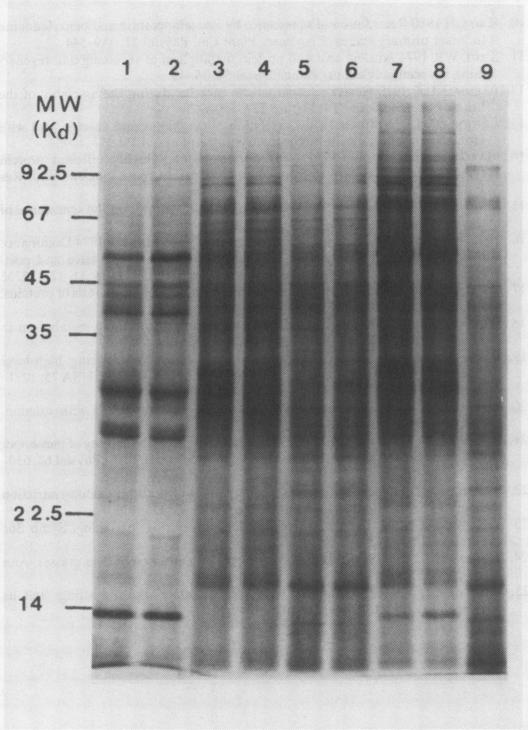
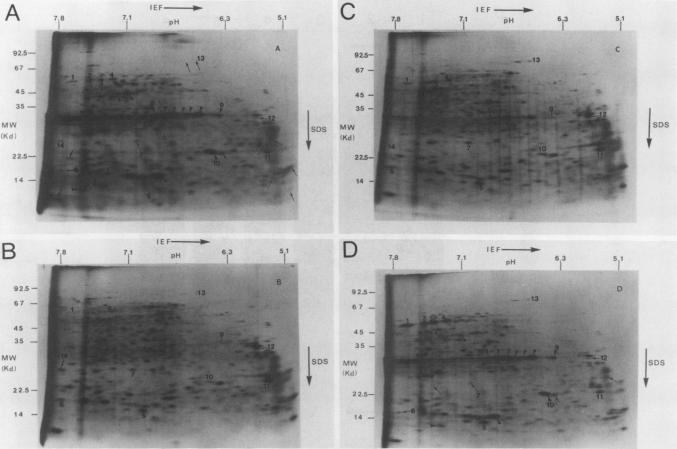
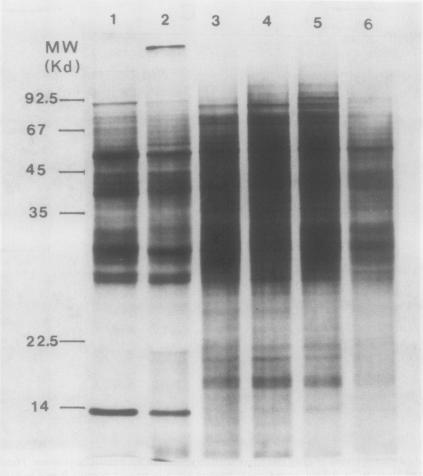
Cotyledons of light-grown soybean (Glycine max L. var Wayne) seedlings were used as a model system to study the possibility that aging requires qualitative changes in protein synthesis. Cotyledons reached a final stage of senescence and then abscised about 22 days after imbibition. Cotyledon senescence was reversed at 20 days after germination by epicotyl removal. Thereafter, the cotyledons regained much of the chlorophyll, RNA, protein, and polyribosomes lost during aging.Total poly(A)mRNA was extracted from 4-, 12-, 20-day-old, and rejuvenated cotyledons and translated in a wheat germ system. Comparison of translation products on two-dimensional O'Farrell gels showed that many translation products increased in quantity during aging, while roughly half as many decreased. Rejuvenation returned the translation products to approximately 4-day-old levels in roughly half of those products which were diminished with age. Conversely, almost one-third of the products which had increased with age decreased with rejuvenation. None of the translation products were totally lost nor were newly synthesized products detected during aging. Therefore, aging in this system probably does not involve complete gene repression or depression. The observation that epicotyl removal causes a reversal in the levels of various proteins synthesized in vitro was corroborated by similar observations following in vivo labeling of cotyledon sections and analysis by SDS-polyacrylamide gel electrophoresis and fluorography. Densitometric scans of fluorograms revealed a gradual shift in profiles of both in vitro and in vivo translation products during aging. Rejuvenated cotyledon proteins had a profile resembling that of 4-day-old cotyledons. The overall level of [(35)S]methionine incorporation into protein in vivo declined gradually during aging but was restored to 4-day-old levels within 2 days after epicotyl removal.
光培养的大豆(Glycine max L. var Wayne)幼苗子叶被用作研究衰老是否需要蛋白质合成质量变化的模型系统。子叶在吸胀后约 22 天达到衰老的最终阶段,然后脱落。在发芽后 20 天,通过去除上胚轴使子叶衰老逆转。此后,子叶恢复了在衰老过程中丢失的大部分叶绿素、RNA、蛋白质和多核糖体。从 4 天、12 天、20 天和再生的子叶中提取总 poly(A)mRNA,并在小麦胚乳系统中进行翻译。在二维 O'Farrell 凝胶上比较翻译产物表明,许多翻译产物在衰老过程中数量增加,而大约一半的翻译产物减少。再生使大约一半随年龄减少的翻译产物恢复到大约 4 天龄的水平。相反,大约三分之一随年龄增加的产物随再生而减少。在衰老过程中,没有检测到翻译产物完全丢失或新合成产物。因此,在这个系统中衰老可能不涉及完全的基因抑制或衰减。观察到去除上胚轴会导致体外合成的各种蛋白质水平逆转,这一观察结果得到了通过体内标记子叶切片和 SDS-聚丙烯酰胺凝胶电泳和放射自显影分析进行的类似观察结果的证实。放射自显影片的密度扫描揭示了在衰老过程中,体外和体内翻译产物的图谱逐渐发生变化。再生的子叶蛋白的图谱类似于 4 天龄子叶的图谱。体内 [(35)S] 甲硫氨酸掺入蛋白质的总水平在衰老过程中逐渐下降,但在去除上胚轴后 2 天内恢复到 4 天龄水平。