Holowach L P, Madison J T, Thompson J F
United States Plant, Soil and Nutrition Laboratory, Agricultural Research Service, United States Department of Agriculture, Ithaca, New York 14853.
Plant Physiol. 1986 Feb;80(2):561-7. doi: 10.1104/pp.80.2.561.
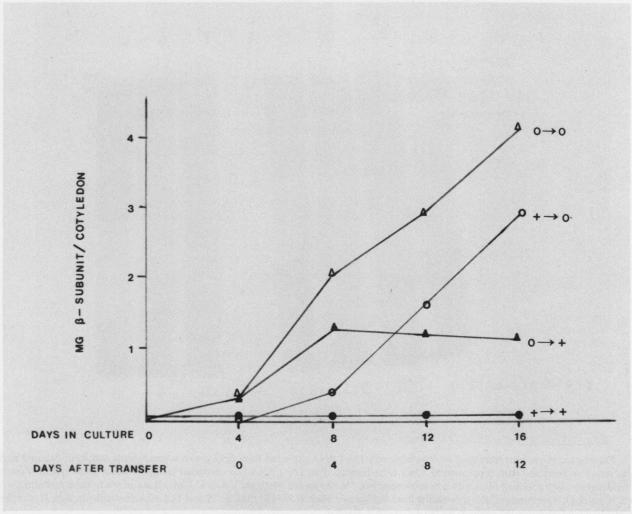
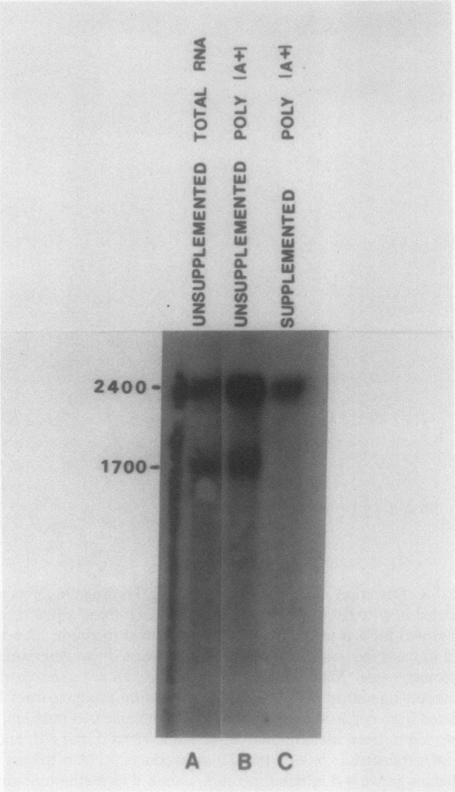
In previous studies (GL Creason et al. 1983 Biochem Biophys Res Commun 117: 658-662; LP Holowach et al. 1984 Plant Physiol 74: 576-583), we have shown that when soybean (Glycine max L. Merrill cv Provar) cotyledons are cultured in medium supplemented with l-methionine, the beta-subunit of 7S protein and beta-mRNA are absent. We have carried out further studies on the mechanism of the methionine action. In one experiment, cotyledons were cultured for 16 days with or without methionine. After 4 days, some cotyledons were transferred from methionine-supplemented to basal (no methionine) medium and vice versa. In basal medium, beta-subunit was detected at 4 days whereas in methionine-supplemented medium, no beta-subunit was present. When cotyledons were transferred from basal to methionine-supplemented medium, the beta-subunit increased within a 4 day period and then remained constant (on a per cotyledon basis). This result indicated that methionine was not acting by accelerating the degradation of the beta-subunit. Four days after transfer from supplemented to basal medium cotyledons contained beta-subunit, thus demonstrating that the inhibition was reversible. During this time, the uncombined methionine declined from 7 to 1.5 mumoles methionine per gram fresh weight. When beta-mRNA was measured by in vitro translation, functional beta-mRNA was absent in tissue that was not accumulating beta-subunit. The messenger RNA for the beta-subunit had a half-life of about 1 day in the presence of methionine. Hybridization of cotyledon mRNA with cDNA complementary to beta-mRNA revealed that the 1700 nucleotide beta-mRNA was not present in supplemented cotyledons. Thus, expression of the beta-subunit gene is controlled at the level of transcription, RNA processing, or RNA turnover, rather than at the level of translation.
在之前的研究中(GL·克里森等人,1983年,《生物化学与生物物理研究通讯》117: 658 - 662;LP·霍洛瓦奇等人,1984年,《植物生理学》74: 576 - 583),我们已经表明,当大豆(Glycine max L. Merrill品种Provar)子叶在添加了L - 甲硫氨酸的培养基中培养时,7S蛋白的β亚基和β - mRNA缺失。我们对甲硫氨酸作用的机制进行了进一步研究。在一项实验中,子叶在有或没有甲硫氨酸的情况下培养16天。4天后,一些子叶从添加甲硫氨酸的培养基转移到基础(无甲硫氨酸)培养基,反之亦然。在基础培养基中,4天时检测到β亚基,而在添加甲硫氨酸的培养基中,不存在β亚基。当子叶从基础培养基转移到添加甲硫氨酸的培养基时,β亚基在4天内增加,然后保持恒定(以每个子叶为基础)。该结果表明甲硫氨酸不是通过加速β亚基的降解起作用。从添加甲硫氨酸的培养基转移到基础培养基4天后,子叶含有β亚基,从而证明这种抑制是可逆的。在此期间,未结合的甲硫氨酸从每克鲜重7微摩尔下降到1.5微摩尔。当通过体外翻译测量β - mRNA时,在不积累β亚基的组织中不存在功能性β - mRNA。在有甲硫氨酸存在的情况下,β亚基的信使RNA半衰期约为1天。子叶mRNA与与β - mRNA互补的cDNA杂交表明,1700个核苷酸的β - mRNA在添加甲硫氨酸的子叶中不存在。因此,β亚基基因的表达是在转录、RNA加工或RNA周转水平上受到控制,而不是在翻译水平上。