Ku M S, Monson R K, Littlejohn R O, Nakamoto H, Fisher D B, Edwards G E
Botany Department, Washington State University, Pullman, Washington 99164.
Plant Physiol. 1983 Apr;71(4):944-8. doi: 10.1104/pp.71.4.944.
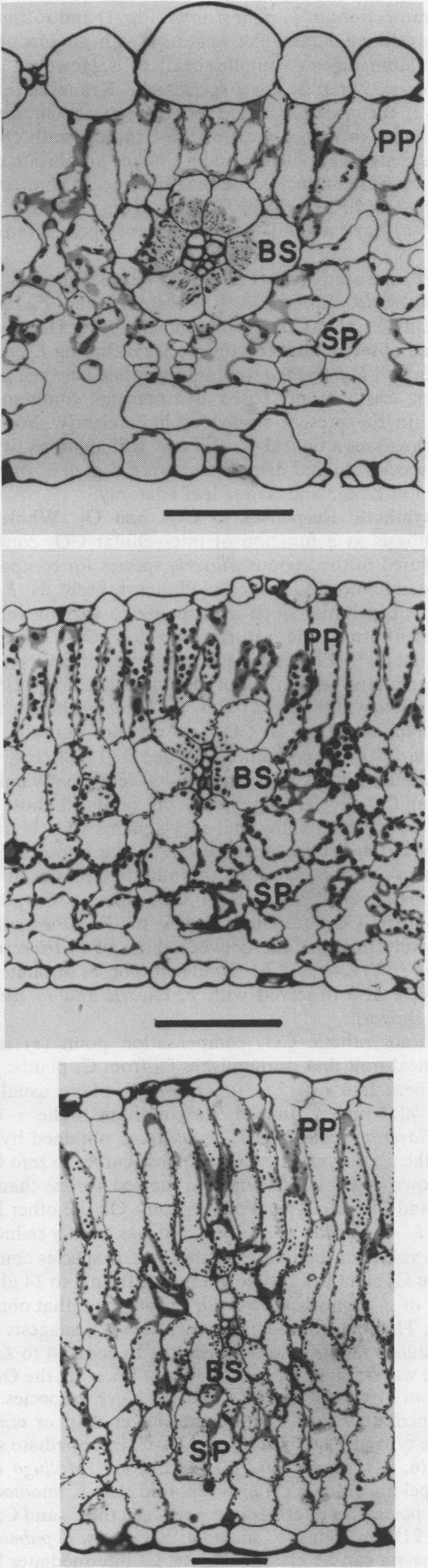
Four species of the genus Flaveria, namely F. anomala, F. linearis, F. pubescens, and F. ramosissima, were identified as intermediate C(3)-C(4) plants based on leaf anatomy, photosynthetic CO(2) compensation point, O(2) inhibition of photosynthesis, and activities of C(4) enzymes. F. anomala and F. ramosissima exhibit a distinct Kranz-like leaf anatomy, similar to that of the C(4) species F. trinervia, while the other C(3)-C(4) intermediate Flaveria species possess a less differentiated Kranz-like leaf anatomy. Photosynthetic CO(2) compensation points of these intermediates at 30 degrees C were very low relative to those of C(3) plants, ranging from 7 to 14 microliters per liter. In contrast to C(3) plants, net photosynthesis by the intermediates was not sensitive to O(2) concentrations below 5% and decreased relatively slowly with increasing O(2) concentration. Under similar conditions, the percentage inhibition of photosynthesis by 21% O(2) varied from 20% to 25% in the intermediates compared with 28% in Lycopersicon esculentum, a typical C(3) species. The inhibition of carboxylation efficiency by 21% O(2) varied from 17% for F. ramosissima to 46% for F. anomala and were intermediate between the C(4) (2% for F. trinervia) and C(3) (53% for L. esculentum) values. The intermediate Flaveria species, especially F. ramosissima, have substantial activities of the C(4) enzymes, phosphoenolpyruvate carboxylase, pyruvate, orthophosphate dikinase, NADP-malic enzyme, and NADP-malate dehydrogenase, indicating potential for C(4) photosynthesis. It appears that these Flaveria species may be true biochemical C(3)-C(4) intermediates.
黄顶菊属的四个物种,即异形黄顶菊、线叶黄顶菊、柔毛黄顶菊和多枝黄顶菊,根据叶片解剖结构、光合二氧化碳补偿点、氧气对光合作用的抑制作用以及C4酶的活性,被鉴定为中间型C(3)-C(4)植物。异形黄顶菊和多枝黄顶菊呈现出明显的类花环叶解剖结构,类似于C(4)物种三脉黄顶菊的结构,而其他中间型黄顶菊属物种的类花环叶解剖结构分化程度较低。这些中间型植物在30℃时的光合二氧化碳补偿点相对于C(3)植物非常低,范围为每升7至14微升。与C(3)植物不同,中间型植物的净光合作用对低于5%的氧气浓度不敏感,并且随着氧气浓度的增加下降相对缓慢。在相似条件下,21%氧气对中间型植物光合作用的抑制百分比在20%至25%之间,相比之下,典型的C(3)物种番茄为28%。21%氧气对羧化效率的抑制作用在多枝黄顶菊中为17%,在异形黄顶菊中为46%,介于C(4)(三脉黄顶菊为2%)和C(3)(番茄为53%)的值之间。中间型黄顶菊属物种,尤其是多枝黄顶菊,具有较高活性的C(4)酶,如磷酸烯醇式丙酮酸羧化酶、丙酮酸磷酸双激酶、NADP-苹果酸酶和NADP-苹果酸脱氢酶,表明其具有C(4)光合作用的潜力。看来这些黄顶菊属物种可能是真正的生化C(3)-C(4)中间型植物。