Cheng S H, Moore B D, Edwards G E, Ku M S
Program in Plant Physiology, Washington State University, Pullman, Washington 99164-4230.
Plant Physiol. 1988 Aug;87(4):867-73. doi: 10.1104/pp.87.4.867.
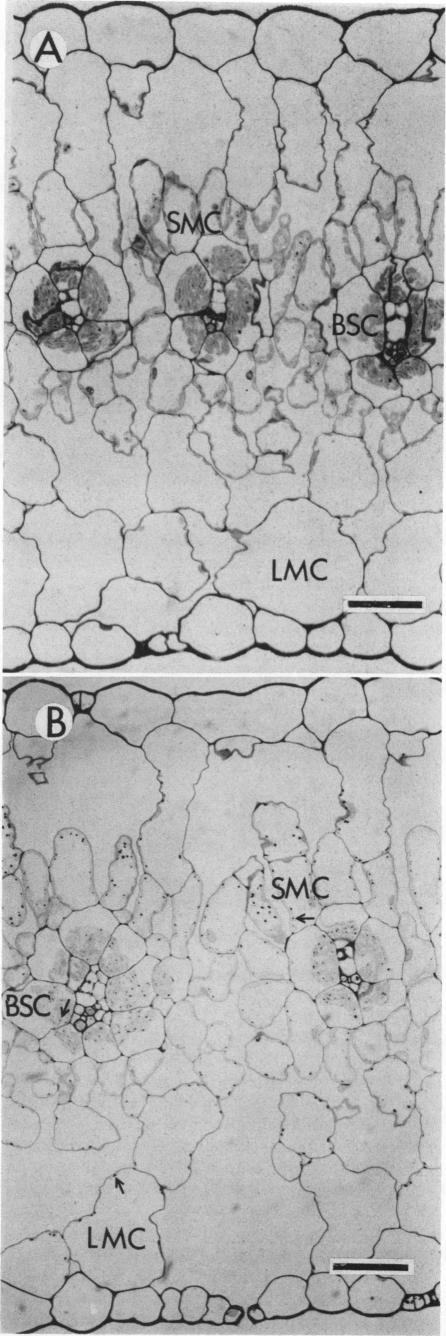
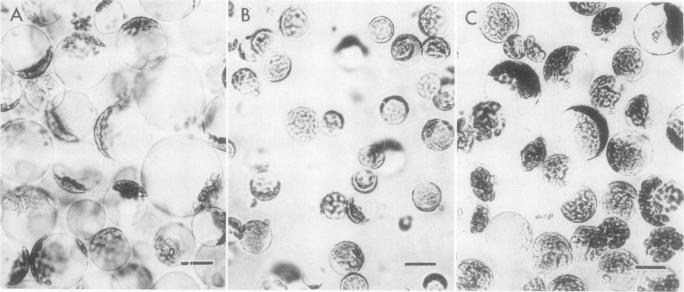
Light microscopic examination of leaf cross-sections showed that Flaveria brownii A. M. Powell exhibits Kranz anatomy, in which distinct, chloroplast-containing bundle sheath cells are surrounded by two types of mesophyll cells. Smaller mesophyll cells containing many chloroplasts are arranged around the bundle sheath cells. Larger, spongy mesophyll cells, having fewer chloroplasts, are located between the smaller mesophyll cells and the epidermis. F. brownii has very low CO(2) compensation points at different O(2) levels, which is typical of C(4) plants, yet it does show about 4% inhibition of net photosynthesis by 21% O(2) at 30 degrees C. Protoplasts of the three photosynthetic leaf cell types were isolated according to relative differences in their buoyant densities. On a chlorophyll basis, the activities of phosphoenolpyruvate carboxylase and pyruvate, Pi dikinase (carboxylation phase of C(4) pathway) were highest in the larger mesophyll protoplasts, intermediate in the smaller mesophyll protoplasts, and lowest, but still present, in the bundle sheath protoplasts. In contrast, activities of ribulose 1,5-bisphosphate carboxylase, other C(3) cycle enzymes, and NADP-malic enzyme showed a reverse gradation, although there were significant activities of these enzymes in mesophyll cells. As indicated by sodium dodecyl sulfate-polyacrylamide gel electrophoresis, the banding pattern of certain polypeptides of the total soluble proteins from the three cell types also supported the distribution pattern obtained by activity assays of these enzymes. Analysis of initial (14)C products in whole leaves and extrapolation of pulse-labeling curves to zero time indicated that about 80% of the CO(2) is fixed into C(4) acids (malate and aspartate), whereas about 20% of the CO(2) directly enters the C(3) cycle. This is consistent with the high activity of enzymes for CO(2) fixation by the C(4) pathway and the substantial activity of enzymes of the C(3) cycle in the mesophyll cells. Therefore, F. brownii appears to have some capacity for C(3) photosynthesis in the mesophyll cells and should be considered a C(4)-like species.
叶片横切面的光学显微镜检查显示,布朗黄顶菊(Flaveria brownii A. M. Powell)具有花环型解剖结构,其中含有叶绿体的明显维管束鞘细胞被两种类型的叶肉细胞包围。含有许多叶绿体的较小叶肉细胞围绕着维管束鞘细胞排列。较大的海绵状叶肉细胞含有的叶绿体较少,位于较小叶肉细胞和表皮之间。布朗黄顶菊在不同氧气水平下具有非常低的二氧化碳补偿点,这是C4植物的典型特征,但在30℃时,21%的氧气确实会对其净光合作用产生约4%的抑制作用。根据三种光合叶细胞类型的浮力密度相对差异分离出了原生质体。以叶绿素为基础,磷酸烯醇式丙酮酸羧化酶和丙酮酸磷酸双激酶(C4途径的羧化阶段)的活性在较大叶肉原生质体中最高,在较小叶肉原生质体中居中,在维管束鞘原生质体中最低,但仍有活性。相比之下,核酮糖-1,5-二磷酸羧化酶、其他C3循环酶和NADP-苹果酸酶的活性呈现相反的梯度,尽管这些酶在叶肉细胞中有显著活性。如十二烷基硫酸钠-聚丙烯酰胺凝胶电泳所示,三种细胞类型总可溶性蛋白质中某些多肽的条带模式也支持了通过这些酶的活性测定获得的分布模式。对全叶初始(14)C产物的分析以及将脉冲标记曲线外推至零时间表明,约80%的二氧化碳固定为C4酸(苹果酸和天冬氨酸),而约20%的二氧化碳直接进入C3循环。这与C4途径中二氧化碳固定酶的高活性以及叶肉细胞中C3循环酶的大量活性一致。因此,布朗黄顶菊似乎在叶肉细胞中具有一定的C3光合作用能力,应被视为一种类似C4的物种。