Fuerst E P, Nakatani H Y, Dodge A D, Penner D, Arntzen C J
MSU-DOE Plant Research Laboratory, Michigan State University, East Lansing, Michigan 48824.
Plant Physiol. 1985 Apr;77(4):984-9. doi: 10.1104/pp.77.4.984.
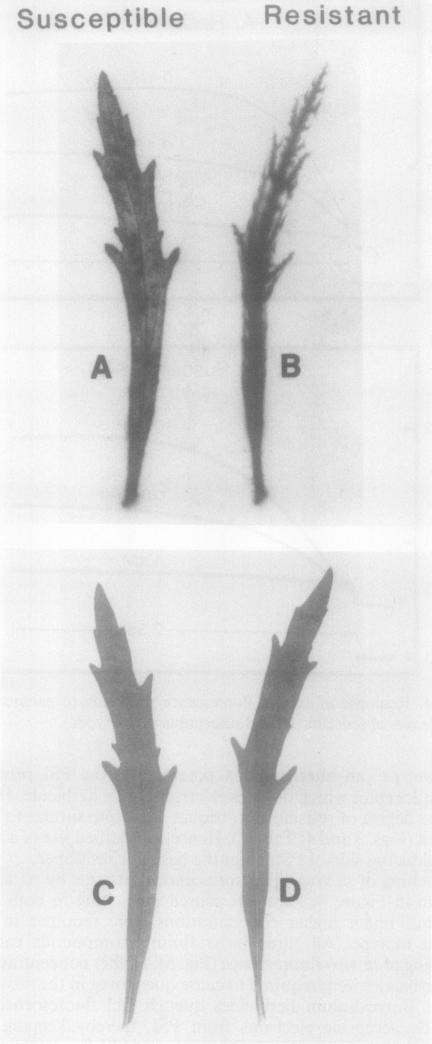
A biotype of Conyza bonariensis (L.) Cronq. (identical to Conyza linefolia in other publications) originating in Egypt is resistant to the herbicide 1,1'-dimethyl-4,4'-bipyridinium ion (paraquat). Penetration of the cuticle by [(14)C]paraquat was greater in the resistant biotype than the susceptible (wild) biotype; therefore, resistance was not due to differences in uptake. The resistant and susceptible biotypes were indistinguishable by measuring in vitro photosystem I partial reactions using paraquat, 6,7-dihydrodipyrido [1,2-alpha:2',1'-c] pyrazinediium ion (diquat), or 7,8-dihydro-6H-dipyrido [1,2-alpha:2',1'-c] [1,4] diazepinediium ion (triquat) as electron acceptors. Therefore, alteration at the electron acceptor level of photosystem I is not the basis for resistance. Chlorophyll fluorescence measured in vivo was quenched in the susceptible biotype by leaf treatment with the bipyridinium herbicides. Resistance to quenching of in vivo chlorophyll fluorescence was observed in the resistant biotype, indicating that the herbicide was excluded from the chloroplasts. Movement of [(14)C] paraquat was restricted in the resistant biotype when excised leaves were supplied [(14)C]paraquat through the petiole. We propose that the mechanism of resistance to paraquat is exclusion of paraquat from its site of action in the chloroplast by a rapid sequestration mechanism. No differential binding of paraquat to cell walls isolated from susceptible and resistant biotypes could be detected. The exact site and mechanism of paraquat binding to sequester the herbicide remains to be determined.
源自埃及的一种小蓬草(等同于其他文献中的线叶小蓬草)生物型对除草剂1,1'-二甲基-4,4'-联吡啶离子(百草枯)具有抗性。[(14)C]百草枯对抗性生物型角质层的穿透性高于敏感(野生)生物型;因此,抗性并非由于吸收差异所致。通过使用百草枯、6,7-二氢二吡啶并[1,2-α:2',1'-c]吡嗪二鎓离子(敌草快)或7,8-二氢-6H-二吡啶并[1,2-α:2',1'-c][1,4]二氮杂卓二鎓离子(特草快)作为电子受体来测量体外光系统I的部分反应,抗性和敏感生物型并无区别。因此,光系统I电子受体水平的改变并非抗性的基础。通过用联吡啶类除草剂处理叶片,敏感生物型体内测量的叶绿素荧光被淬灭。在抗性生物型中观察到对体内叶绿素荧光淬灭的抗性,表明除草剂被排除在叶绿体之外。当通过叶柄向离体叶片供应[(14)C]百草枯时,[(14)C]百草枯在抗性生物型中的移动受到限制。我们提出,对百草枯的抗性机制是通过快速隔离机制将百草枯排除在其在叶绿体中的作用位点之外。未检测到百草枯与从敏感和抗性生物型中分离出的细胞壁有差异结合。百草枯结合以隔离除草剂的确切位点和机制仍有待确定。