Brunharo Caio A C G, Hanson Bradley D
Department of Plant Sciences, University of California, Davis, DavisCA, United States.
Front Plant Sci. 2017 Aug 25;8:1485. doi: 10.3389/fpls.2017.01485. eCollection 2017.
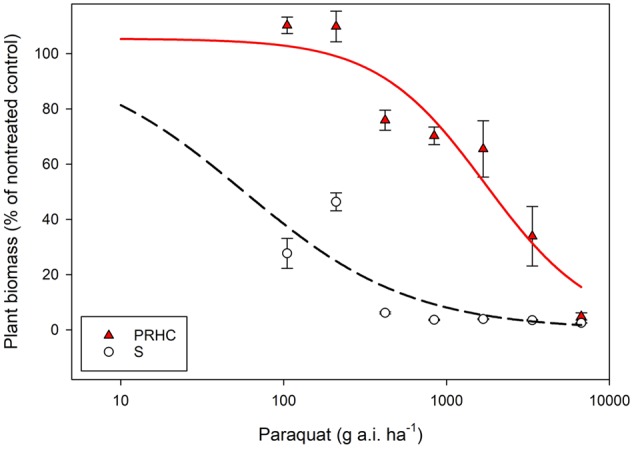
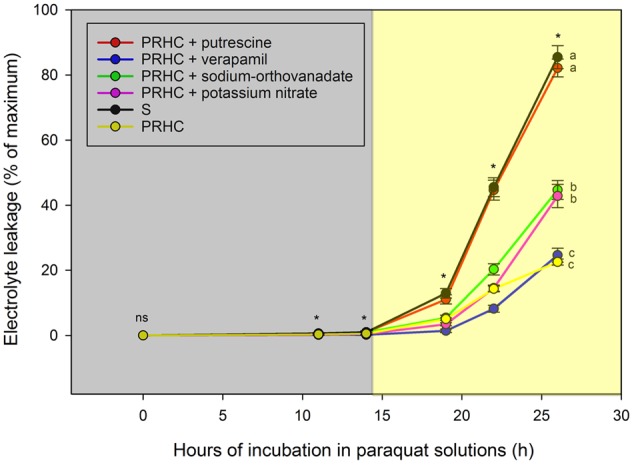
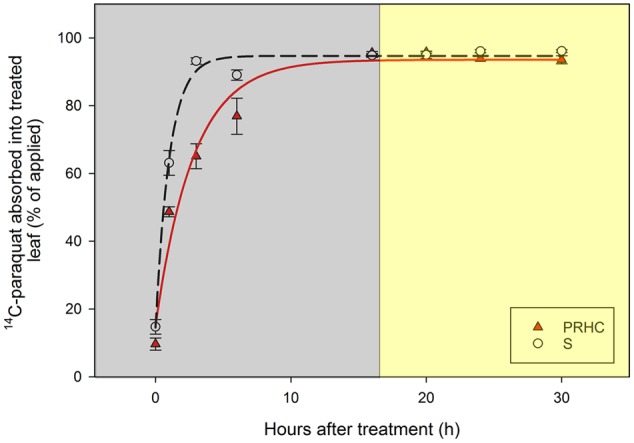
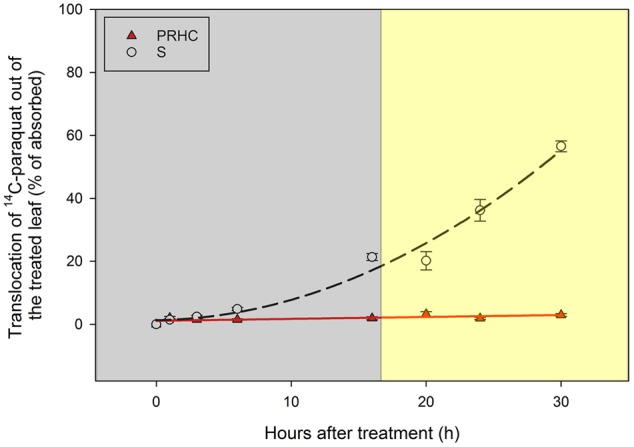
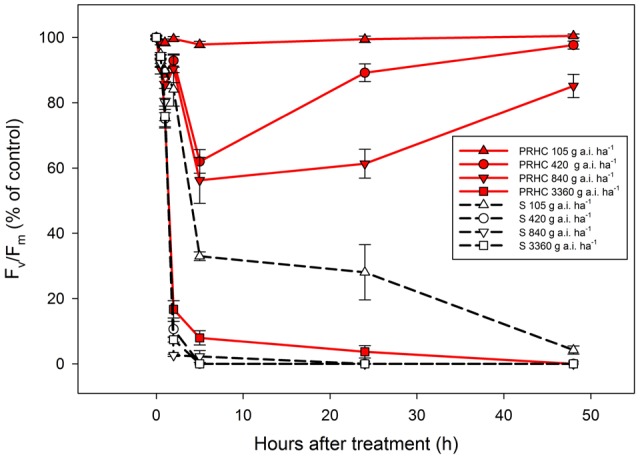
L. spp. (Lam.) Husnot (LOLMU) is a winter annual weed, common to row crops, orchards and roadsides. Glyphosate-resistant populations of LOLMU are widespread in California. In many situations, growers have switched to paraquat or other postemergence herbicides to manage glyphosate-resistant LOLMU populations. Recently, poor control of LOLMU with paraquat was reported in a prune orchard in California where paraquat has been used several times. We hypothesize that the low efficacy observed is due to the selection of a paraquat-resistant biotype of LOLMU. Greenhouse dose-response experiments conducted with a susceptible (S) and the putative paraquat-resistant biotype (PRHC) confirmed paraquat resistance in PRHC. Herbicide absorption studies indicated that paraquat is absorbed faster in S than PRHC, although the maximum absorption estimates were similar for the two biotypes. Conversely, translocation of C-paraquat under light-manipulated conditions was restricted to the treated leaf of PRHC, whereas herbicide translocation out of the treated leaf was nearly 20 times greater in S. To determine whether paraquat was active within the plant cells, the photosynthetic performance was assessed after paraquat application using the parameter maximum quantum yield of photosystem II (F/F). Paraquat reaches the chloroplasts of PRHC, since there was a transitory inhibition of photosynthetic activity in PRHC leaves. However, PRHC F/F recovered to initial levels by 48 h after paraquat treatment. No paraquat metabolites were found, indicating that resistance is not due to paraquat degradation. LOLMU leaf segments were exposed to paraquat following pretreatments with inhibitors of plasma membrane- and tonoplast-localized transporter systems to selectively block paraquat intracellular movement. Subsequent evaluation of membrane integrity indicated that pre-exposure to putrescine resulted in the resistant biotype responding to paraquat similarly to S. These results strongly indicate that vacuolar sequestration is involved in the resistance to paraquat in this population of LOLMU.
意大利黑麦草(L. spp. (Lam.) Husnot,简称LOLMU)是一种冬季一年生杂草,常见于大田作物、果园和路边。抗草甘膦的意大利黑麦草种群在加利福尼亚州广泛分布。在许多情况下,种植者已转而使用百草枯或其他苗后除草剂来管理抗草甘膦的意大利黑麦草种群。最近,在加利福尼亚州的一个李子园中,多次使用百草枯后,出现了对意大利黑麦草防除效果不佳的情况。我们推测观察到的低防效是由于选择出了一种抗百草枯的意大利黑麦草生物型。用一个敏感型(S)和假定的抗百草枯生物型(PRHC)进行的温室剂量反应试验证实了PRHC对百草枯具有抗性。除草剂吸收研究表明,虽然两种生物型的最大吸收估计值相似,但S型对百草枯的吸收比PRHC型更快。相反,在光照控制条件下,C - 百草枯在PRHC中的转运仅限于处理过的叶片,而在S型中,除草剂从处理过的叶片中的转运几乎是PRHC型的20倍。为了确定百草枯在植物细胞内是否具有活性,在施用百草枯后,使用光系统II的最大量子产率(F/F)参数评估光合性能。百草枯到达了PRHC的叶绿体,因为PRHC叶片中的光合活性出现了短暂抑制。然而,在百草枯处理后48小时,PRHC的F/F恢复到了初始水平。未发现百草枯代谢产物,表明抗性不是由于百草枯降解。在用质膜和液泡膜定位的转运系统抑制剂预处理后,将意大利黑麦草叶片切段暴露于百草枯中,以选择性阻断百草枯的细胞内移动。随后对膜完整性的评估表明,预先暴露于腐胺会使抗性生物型对百草枯的反应与S型相似。这些结果有力地表明,液泡隔离参与了该意大利黑麦草种群对百草枯的抗性。