Meza-Basso L, Alberdi M, Raynal M, Ferrero-Cadinanos M L, Delseny M
Laboratoire de Physiologie Végétale, U.A. 565 du Centre National de la Recherche Scientifique, Université de Perpignan, Avenue de Villeneuve, 66025 Perpignan-Cédex, France.
Plant Physiol. 1986 Nov;82(3):733-8. doi: 10.1104/pp.82.3.733.
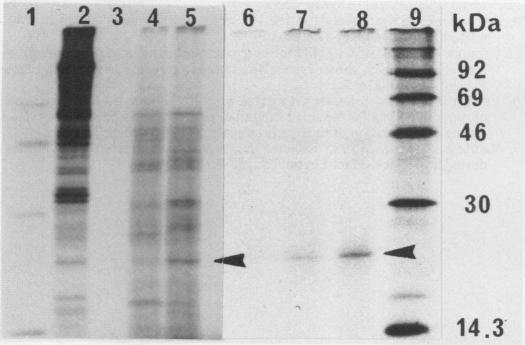
Changes induced by cold treatment in young rapeseed (Brassica napus) seedlings were investigated at the molecular level. Following germination at 18 degrees C for 48 hours, one half of the seedlings was transferred to 0 degrees C for another 48 hour period, the other half being kept at 18 degrees C as a control. Newly synthesized proteins were labeled for the last 6 hours of incubation with [(35)S]methionine. The different polypeptides were separated by two-dimensional electrophoresis in polyacrylamide gels. Newly synthesized proteins were revealed by fluorography. Protein synthesis clearly continues at 0 degrees C and some polypeptides preferentially accumulate at this temperature. On the other hand, synthesis of several others is repressed while many are insensitive to cold treatment. Similar changes are also observed when mRNA is prepared from cold treated seedlings, translated in vitro in a reticulocyte cell free system and compared with the products of mRNA extracted from control samples. Among the genes which are repressed we identified the small subunit of ribulose 1,6-bisphosphate carboxylase. These changes are also detectable after shorter treatments.
在分子水平上研究了低温处理对油菜(甘蓝型油菜)幼苗的影响。种子在18℃下萌发48小时后,将一半幼苗转移至0℃再处理48小时,另一半则保持在18℃作为对照。在孵育的最后6小时用[³⁵S]甲硫氨酸标记新合成的蛋白质。通过聚丙烯酰胺凝胶二维电泳分离不同的多肽。通过荧光自显影法显示新合成的蛋白质。蛋白质合成在0℃时明显继续,并且一些多肽在该温度下优先积累。另一方面,其他几种蛋白质的合成受到抑制,而许多蛋白质对低温处理不敏感。当从经低温处理的幼苗中制备mRNA,在网织红细胞无细胞系统中进行体外翻译,并与从对照样品中提取的mRNA产物进行比较时,也观察到类似的变化。在被抑制的基因中,我们鉴定出了核酮糖1,6-二磷酸羧化酶的小亚基。较短处理后也可检测到这些变化。