Department of Plant Biology, Carnegie Institution of Washington, Stanford, California 94305-1297.
Plant Physiol. 1990 Feb;92(2):434-9. doi: 10.1104/pp.92.2.434.
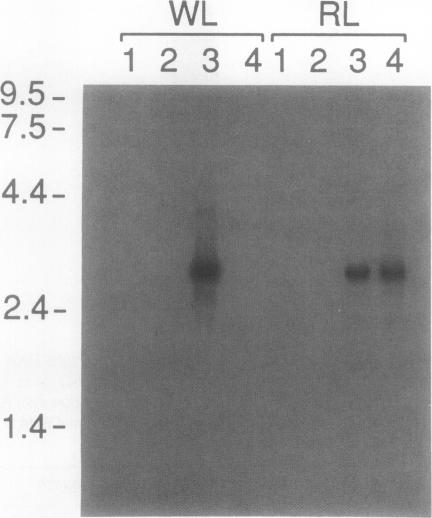
Induction of nitrate reductase activity and mRNA by nitrate and light is prevented if chloroplasts are destroyed by photooxidation in norflurazon-treated squash (Cucurbita maxima L.) cotyledons. The enzyme activity and mRNA can be induced if norflurazon-treated squash seedlings are kept in low-intensity red light, which minimizes photodamage to the plastids. It is concluded that induction of nitrate reductase activity and nitrate reductase mRNA requires intact plastids. If squash seedlings grown in low-intensity red light are transferred to photooxidative white light, nitrate reductase activity accumulates during the first 12 hours after the shift and declines thereafter. Thus photodamage to the plastids and the disappearance of nitrate reductase activity and mRNA are events separable in time, and disappearance of the enzyme activity is a consequence of the damage to the plastids.
如果用硝呋酮处理南瓜(Cucurbita maxima L.)子叶来破坏叶绿体,那么硝酸盐还原酶的活性和 mRNA 会被硝酸盐和光诱导。如果将硝呋酮处理的南瓜幼苗保存在低强度的红光下,最小化对质体的光损伤,那么可以诱导酶活性和 mRNA。因此,诱导硝酸盐还原酶活性和硝酸盐还原酶 mRNA 需要完整的质体。如果在低强度红光下生长的南瓜幼苗被转移到光氧化的白光下,那么硝酸盐还原酶活性在转移后的前 12 小时内积累,之后下降。因此,质体的光损伤以及硝酸盐还原酶活性和 mRNA 的消失是可以在时间上分开的事件,而酶活性的消失是质体损伤的结果。