Biochemistry Department, Michigan State University, East Lansing, Michigan 48824.
Plant Physiol. 1992 Mar;98(3):919-26. doi: 10.1104/pp.98.3.919.
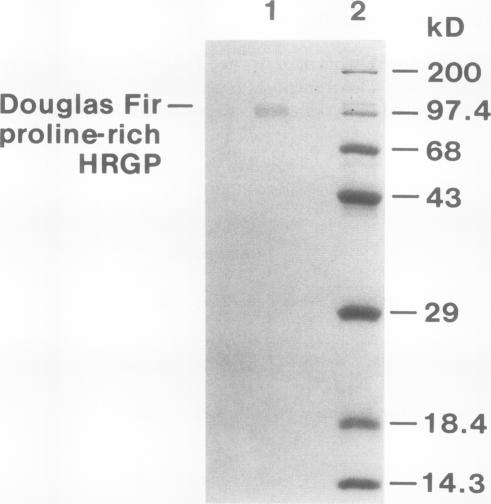
Intact cell elution of suspension cultures derived from Douglas fir, Pseudotsuga menziesii (Mirbel) Franco, yielded two extensin monomers, the first hydroxyproline-rich glycoproteins (HRGPs) to be isolated from a gymnosperm. These HRGPs resolved on Superose-6 gel filtration. The smaller monomer was compositionally similar to angiosperm extensins like tomato P1. The larger monomer had a simple composition reminiscent of repetitive proline-rich proteins (RPRPs) from soybean cell walls and contained proline, hydroxyproline, and sugar; hence designated a proline-hydroxyproline-rich glycoprotein (PHRGP). The simple composition of the PHRGP implied a periodic structure which was confirmed by the simple chymotryptic map and 45-residue partial sequence of the major proline-hydroxyproline-rich glycoprotein chymotryptide 5: Lys-Pro-Hyp-Val-Hyp-Val-Ile-Pro-Pro-Hyp-Val-Val-Lys-Pro-Hyp-Hyp-Val- Tyr-Lys-Pro-Hyp-Val-Hyp-Val-Ile-Pro-Pro-Hyp-Val-Val-Lys-Pro-Hyp-Hyp- Val-Tyr-Lys-Ile-Pro-Pro(Hyp)-Val-Ile-Lys-Pro. Proline-hydroxyproline-rich glycoprotein chymotryptide 5 contained an 18-residue tandem repeat devoid of tetra(hydroxy)-proline or serine; it also contained two instances of the five-residue motif Hyp-Hyp-Val-Tyr-Lys and five of the general Pro-Pro-X-X-Lys motif, thereby establishing its homology with typical angiosperm RPRPs and extensins from tomato, petunia, carrot, tobacco, sugar beet, and Phaseolus. Unlike the nonglycosylated soybean RPRP, the highly purified Douglas fir PHRGP was lightly glycosylated, confirmed by a quantitative hydroxyproline glycoside profile, indicating that extensins can range from highly glycosylated hydroxyproline to little or no glycosylated hydroxyproline. Comparison of extensin sequence data strongly indicates that a major determinant of hydroxyproline glycosylation specificity is hydroxyproline contiguity: extensins with tetrahydroxyproline blocks are very highly arabinosylated (>90% hydroxyproline glycosylated), tri- and dihydroxyproline are less so, and single hydroxyproline residues perhaps not at all. Despite high yields of extensins eluted from intact cells, the Douglas fir cell wall itself was hydroxyproline poor yet remarkably rich in protein (>20%), again emphasizing the existence of other structural cell wall proteins that are neither HRGPs nor glycine-rich proteins.
从道格拉斯冷杉(Pseudotsuga menziesii(Mirbel)Franco)悬浮培养物中完整细胞洗脱得到两种伸展蛋白单体,这是首次从裸子植物中分离得到的第一类富含羟脯氨酸的糖蛋白(HRGPs)。这些 HRGPs 在 Superose-6 凝胶过滤中得到解析。较小的单体在组成上与茄属植物如番茄 P1 的伸展蛋白相似。较大的单体组成简单,类似于大豆细胞壁中的富含脯氨酸的重复蛋白(RPRPs),并含有脯氨酸、羟脯氨酸和糖;因此被指定为脯氨酸-羟脯氨酸丰富的糖蛋白(PHRGP)。PHRGP 的简单组成暗示了一种周期性结构,这通过主要脯氨酸-羟脯氨酸丰富糖蛋白糜蛋白酶肽 5 的简单糜蛋白酶图谱和 45 个残基的部分序列得到证实:Lys-Pro-Hyp-Val-Hyp-Val-Ile-Pro-Pro-Hyp-Val-Val-Lys-Pro-Hyp-Hyp-Val-Tyr-Lys-Pro-Hyp-Val-Hyp-Val-Ile-Pro-Pro-Hyp-Val-Val-Lys-Pro-Hyp-Hyp-Val-Tyr-Lys-Ile-Pro-Pro(Hyp)-Val-Ile-Lys-Pro。脯氨酸-羟脯氨酸丰富的糖蛋白糜蛋白酶肽 5 包含一个 18 个残基的串联重复序列,没有四(羟)脯氨酸或丝氨酸;它还包含两个五残基基序 Hyp-Hyp-Val-Tyr-Lys 和五个一般的 Pro-Pro-X-X-Lys 基序,从而确立了它与典型的被子植物 RPRPs 和来自番茄、矮牵牛、胡萝卜、烟草、甜菜和菜豆的伸展蛋白的同源性。与非糖基化的大豆 RPRP 不同,高度纯化的道格拉斯冷杉 PHRGP 轻度糖基化,通过定量羟脯氨酸糖苷谱得到证实,表明伸展蛋白可以从高度糖基化的羟脯氨酸到几乎没有糖基化的羟脯氨酸变化。伸展蛋白序列数据的比较强烈表明,羟脯氨酸糖基化特异性的主要决定因素是羟脯氨酸的连续性:含有四羟基脯氨酸块的伸展蛋白高度阿拉伯糖基化(>90%的羟脯氨酸糖基化),三羟基和二羟基脯氨酸的程度较低,而单个羟脯氨酸残基可能根本没有。尽管从完整细胞中洗脱得到的伸展蛋白产量很高,但道格拉斯冷杉细胞壁本身羟脯氨酸含量低,但富含蛋白质(>20%),这再次强调了存在其他结构细胞壁蛋白,它们既不是 HRGPs 也不是甘氨酸丰富的蛋白。