Arntzen J W
National Museum of Natural History-Naturalis, PO Box 9517, 2300 RA Leiden, The Netherlands.
Front Zool. 2006 May 4;3:8. doi: 10.1186/1742-9994-3-8.
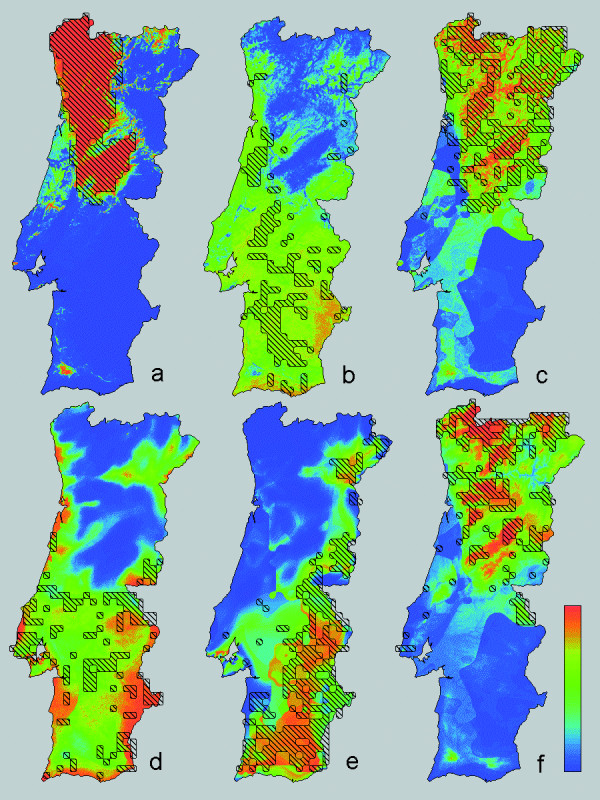
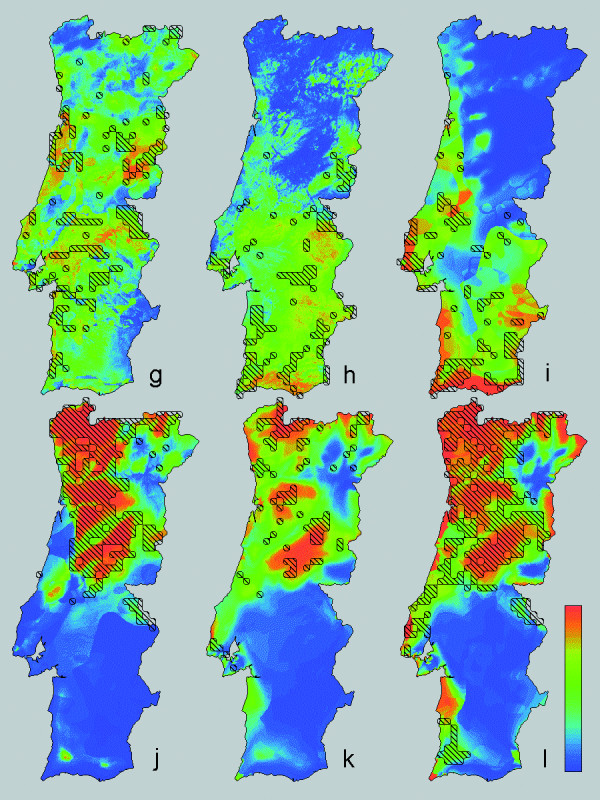
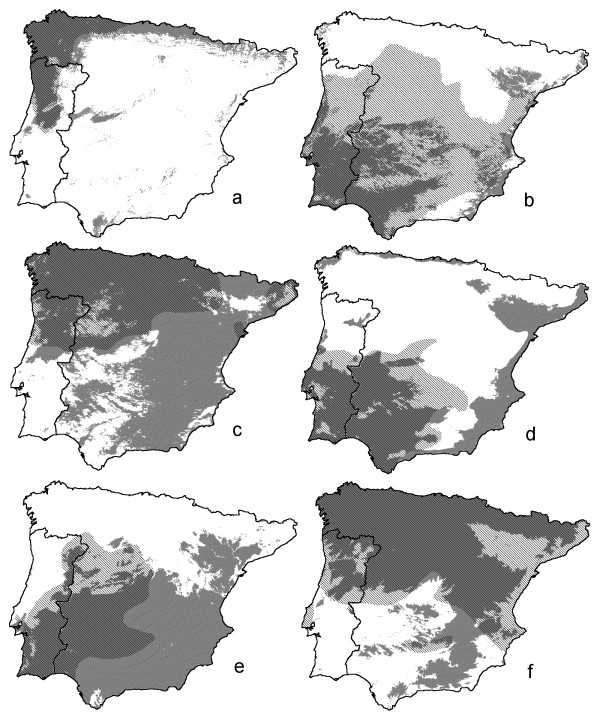
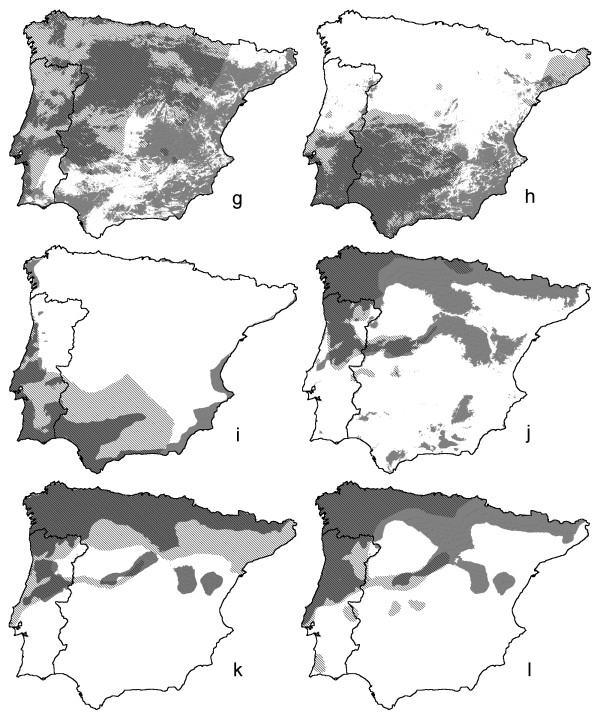
Aim of the study was to identify the conditions under which spatial-environmental models can be used for the improved understanding of species distributions, under the explicit criterion of model predictive performance. I constructed distribution models for 17 amphibian and 21 reptile species in Portugal from atlas data and 13 selected ecological variables with stepwise logistic regression and a geographic information system. Models constructed for Portugal were extrapolated over Spain and tested against range maps and atlas data.
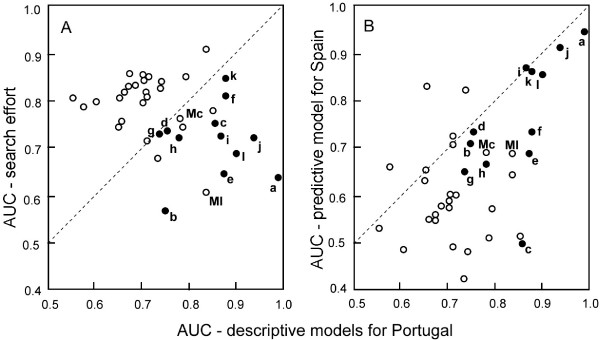
Descriptive model precision ranged from 'fair' to 'very good' for 12 species showing a range border inside Portugal ('edge species', kappa (k) 0.35-0.89, average 0.57) and was at best 'moderate' for 26 species with a countrywide Portuguese distribution ('non-edge species', k = 0.03-0.54, average 0.29). The accuracy of the prediction for Spain was significantly related to the precision of the descriptive model for the group of edge species and not for the countrywide species. In the latter group data were consistently better captured with the single variable search-effort than by the panel of environmental data.
Atlas data in presence-absence format are often inadequate to model the distribution of species if the considered area does not include part of the range border. Conversely, distribution models for edge-species, especially those displaying high precision, may help in the correct identification of parameters underlying the species range and assist with the informed choice of conservation measures.
本研究的目的是在模型预测性能这一明确标准下,确定空间环境模型可用于更好地理解物种分布的条件。我利用地图集数据和13个选定的生态变量,通过逐步逻辑回归和地理信息系统,构建了葡萄牙17种两栖动物和21种爬行动物的分布模型。为葡萄牙构建的模型被外推到西班牙,并根据分布图和地图集数据进行检验。
对于12种在葡萄牙境内有分布边界的物种(“边缘物种”,卡帕值(κ)为0.35 - 0.89,平均为0.57),描述性模型精度从“一般”到“非常好”不等;而对于26种在葡萄牙全国范围内分布的物种(“非边缘物种”,κ = 0.03 - 0.54,平均为0.29),描述性模型精度至多为“中等”。对西班牙的预测准确性与边缘物种组描述性模型的精度显著相关,而与全国分布物种组的精度无关。在后一组中,单变量搜索努力比环境数据组能更一致地捕捉数据。
如果所考虑的区域不包括部分分布边界,以存在 - 缺失格式呈现的地图集数据通常不足以对物种分布进行建模。相反,边缘物种的分布模型,尤其是那些显示高精度的模型,可能有助于正确识别物种分布范围背后的参数,并有助于明智地选择保护措施。