Diaz Heijtz Rochellys, Castellanos F Xavier
Department of Psychiatry, New York University School of Medicine, New York VA Medical Center, 423 East 23rd Street, New York, NY 10010, USA.
Behav Brain Funct. 2006 May 26;2:18. doi: 10.1186/1744-9081-2-18.
Molecular genetic studies suggest the dopamine D1 receptor (D1R) may be implicated in attention-deficit/hyperactivity disorder (ADHD). As little is known about the potential motor role of D1R in ADHD, animal models may provide important insights into this issue.
We investigated the effects of a full and selective D1R agonist, SKF-81297 (0.3, 3 and 10 mg/kg), on motor behaviour and expression of the plasticity-associated gene, c-fos, in habituated young adult male Spontaneously Hypertensive Rats (SHR), the most commonly used animal model of ADHD, and Wistar-Kyoto (WKY; the strain from which SHR were derived).
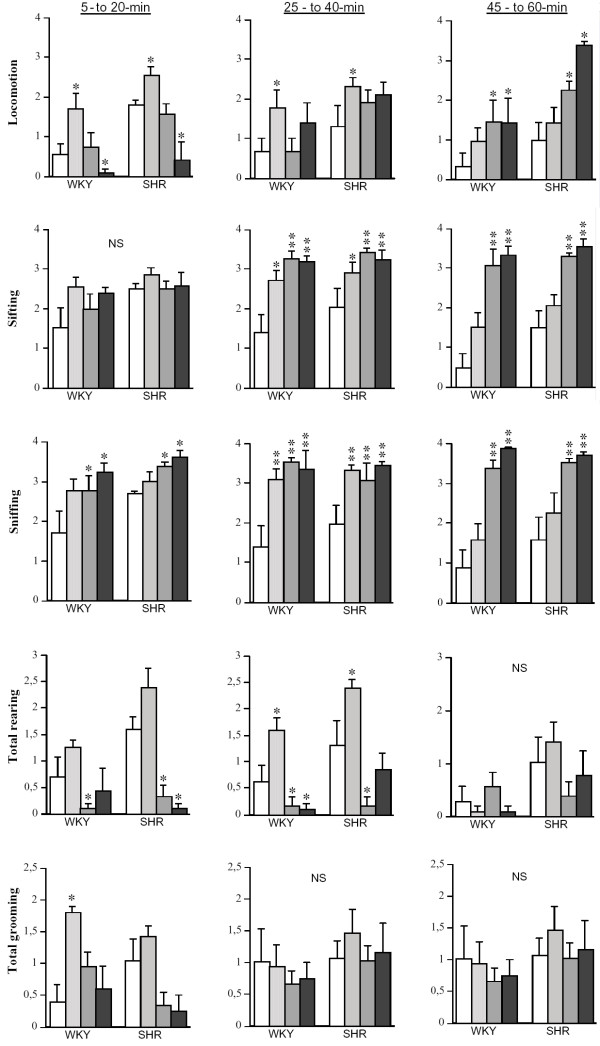
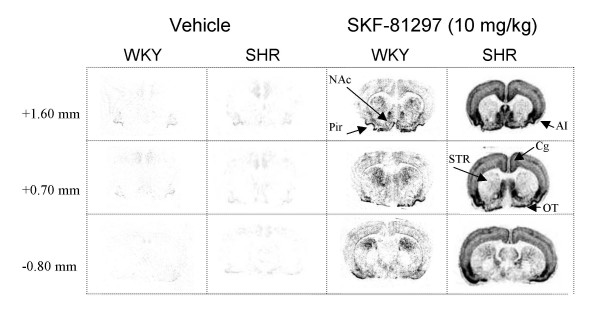
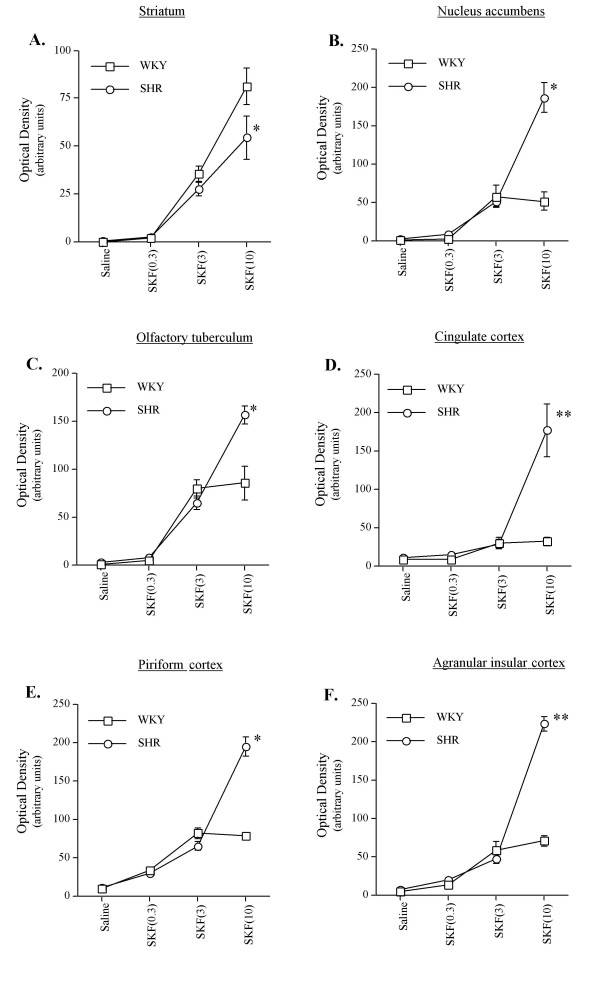
SHR rats were more behaviourally active than WKY rats after injection with vehicle. The 0.3 mg/kg dose of SKF-81297 increased motor behaviour (locomotion, sifting, rearing, and sniffing) in both SHR and WKY rats. Total grooming was also stimulated, but only in WKY rats. The same dose increased c-fos mRNA expression in the piriform cortex of both strains. The 3 mg/kg dose increased sifting and sniffing in both strains. Locomotion was also stimulated towards the end of the testing period. The intermediate dose decreased total rearing in both strains, and produced a significant increase in c-fos mRNA in the striatum, nucleus accumbens, olfactory tuberculum, and in the cingulate, agranular insular and piriform cortices. The 10 mg/kg dose of SKF-81297 produced a biphasic effect on locomotion, which was characterized by an initial decrease followed by later stimulation. The latter stimulatory effect was more pronounced in SHR than in WKY rats when compared to their respective vehicle-injected groups. The 10 mg/kg dose also stimulated sifting and sniffing in both strains. Both the 3 and 10 mg/kg doses had no effect on total grooming. The 10 mg/kg dose induced significantly higher levels of c-fos mRNA expression in the nucleus accumbens and adjacent cortical regions (but not striatum) of SHR when compared to WKY rats.
The present results suggest a potential alteration in D1R neurotransmission within the frontal-striatal circuitry of SHR involved in motor control. These findings extend our understanding of the molecular alterations in SHR, a heuristically useful model of ADHD.
分子遗传学研究表明,多巴胺D1受体(D1R)可能与注意力缺陷多动障碍(ADHD)有关。由于对D1R在ADHD中的潜在运动作用知之甚少,动物模型可能为这个问题提供重要的见解。
我们研究了一种完全和选择性D1R激动剂SKF-81297(0.3、3和10mg/kg)对习惯化的成年雄性自发性高血压大鼠(SHR,最常用的ADHD动物模型)和Wistar-Kyoto大鼠(WKY,SHR的起源品系)的运动行为和可塑性相关基因c-fos表达的影响。
注射赋形剂后,SHR大鼠比WKY大鼠行为更活跃。0.3mg/kg剂量的SKF-81297增加了SHR和WKY大鼠的运动行为(运动、筛动、竖毛和嗅探)。总的梳理行为也受到刺激,但仅在WKY大鼠中。相同剂量增加了两个品系梨状皮质中的c-fos mRNA表达。3mg/kg剂量增加了两个品系的筛动和嗅探。在测试期结束时运动也受到刺激。中间剂量减少了两个品系的总竖毛行为,并使纹状体、伏隔核、嗅结节以及扣带回、无颗粒岛叶和梨状皮质中的c-fos mRNA显著增加。10mg/kg剂量的SKF-81297对运动产生双相作用,其特征是最初下降随后是后期刺激。与各自注射赋形剂的组相比,后一种刺激作用在SHR中比在WKY大鼠中更明显。10mg/kg剂量也刺激了两个品系的筛动和嗅探。3和10mg/kg剂量对总的梳理行为均无影响。与WKY大鼠相比,10mg/kg剂量在SHR的伏隔核和相邻皮质区域(但不是纹状体)诱导了显著更高水平的c-fos mRNA表达。
目前的结果表明,参与运动控制的SHR额叶-纹状体回路中D1R神经传递可能发生改变。这些发现扩展了我们对SHR(一种对ADHD启发式有用的模型)分子改变的理解。