
三轮(1R/2R/3R)基因组复制与脊椎动物糖酵解途径的进化。
Three rounds (1R/2R/3R) of genome duplications and the evolution of the glycolytic pathway in vertebrates.
作者信息
Steinke Dirk, Hoegg Simone, Brinkmann Henner, Meyer Axel
机构信息
Lehrstuhl für Evolutionsbiologie und Zoologie, Department of Biology, University of Konstanz, 78457 Konstanz, Germany.
出版信息
BMC Biol. 2006 Jun 6;4:16. doi: 10.1186/1741-7007-4-16.
BACKGROUND
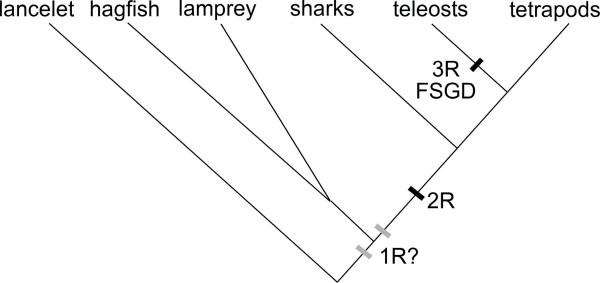
Evolution of the deuterostome lineage was accompanied by an increase in systematic complexity especially with regard to highly specialized tissues and organs. Based on the observation of an increased number of paralogous genes in vertebrates compared with invertebrates, two entire genome duplications (2R) were proposed during the early evolution of vertebrates. Most glycolytic enzymes occur as several copies in vertebrate genomes, which are specifically expressed in certain tissues. Therefore, the glycolytic pathway is particularly suitable for testing theories of the involvement of gene/genome duplications in enzyme evolution.
RESULTS
We assembled datasets from genomic databases of at least nine vertebrate species and at least three outgroups (one deuterostome and two protostomes), and used maximum likelihood and Bayesian methods to construct phylogenies of the 10 enzymes of the glycolytic pathway. Through this approach, we intended to gain insights into the vertebrate specific evolution of enzymes of the glycolytic pathway. Many of the obtained gene trees generally reflect the history of two rounds of duplication during vertebrate evolution, and were in agreement with the hypothesis of an additional duplication event within the lineage of teleost fish. The retention of paralogs differed greatly between genes, and no direct link to the multimeric structure of the active enzyme was found.
CONCLUSION
The glycolytic pathway has subsequently evolved by gene duplication and divergence of each constituent enzyme with taxon-specific individual gene losses or lineage-specific duplications. The tissue-specific expression might have led to an increased retention for some genes since paralogs can subdivide the ancestral expression domain or find new functions, which are not necessarily related to the original function.
背景
后口动物谱系的进化伴随着系统复杂性的增加,特别是在高度特化的组织和器官方面。基于观察到脊椎动物中旁系同源基因的数量比无脊椎动物中多,有人提出在脊椎动物早期进化过程中发生了两次全基因组复制(2R)。大多数糖酵解酶在脊椎动物基因组中以多个拷贝的形式存在,并在特定组织中特异性表达。因此,糖酵解途径特别适合于检验基因/基因组复制参与酶进化的理论。
结果
我们从至少九个脊椎动物物种和至少三个外群(一个后口动物和两个原口动物)的基因组数据库中组装数据集,并使用最大似然法和贝叶斯方法构建糖酵解途径10种酶的系统发育树。通过这种方法,我们旨在深入了解糖酵解途径中酶的脊椎动物特异性进化。许多获得的基因树总体上反映了脊椎动物进化过程中两轮复制的历史,并且与硬骨鱼谱系中发生额外复制事件的假设一致。旁系同源基因的保留在基因之间差异很大,并且未发现与活性酶的多聚体结构有直接联系。
结论
糖酵解途径随后通过基因复制和各组成酶的分化而进化,伴有特定分类群的个别基因丢失或特定谱系的复制。组织特异性表达可能导致一些基因的保留增加,因为旁系同源基因可以细分祖先的表达域或找到新功能,这些功能不一定与原始功能相关。



 Zotero 插件