Lodoen Melissa B, Lanier Lewis L
Department of Microbiology and Immunology and the Cancer Research Institute, University of California, San Francisco, 94143-0414, USA.
Curr Opin Immunol. 2006 Aug;18(4):391-8. doi: 10.1016/j.coi.2006.05.002. Epub 2006 Jun 12.
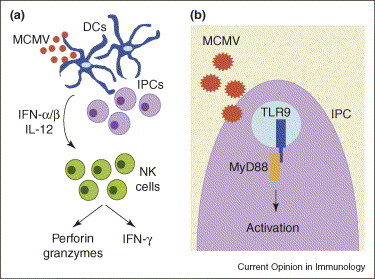
Natural killer (NK) cells serve as a crucial first line of defense against tumors and a diverse range of pathogens. Recognition of infection by NK cells is accomplished by the activation of receptors on the NK cell surface, which initiate NK cell effector functions. Many of the receptors and ligands involved in NK cell antimicrobial activity have been identified, and we are beginning to appreciate how they function during infection. In addition, NK cells are activated by cytokines (e.g. interleukin 12 and type I interferons), which are products of activated macrophages and dendritic cells. In response to these activating stimuli, NK cells secrete cytokines and chemokines and lyse target cells. Recent studies have focused on the mechanisms by which NK cells recognize and respond to viruses, parasites and bacteria, and on the unique role of NK cells in innate immunity to infection.
自然杀伤(NK)细胞是抵御肿瘤和多种病原体的关键第一道防线。NK细胞通过激活其表面受体来识别感染,这些受体启动NK细胞的效应功能。许多参与NK细胞抗菌活性的受体和配体已被鉴定出来,我们也开始了解它们在感染过程中的作用机制。此外,NK细胞可被细胞因子(如白细胞介素12和I型干扰素)激活,这些细胞因子是活化巨噬细胞和树突状细胞的产物。响应这些激活刺激,NK细胞分泌细胞因子和趋化因子并裂解靶细胞。最近的研究集中在NK细胞识别和应对病毒、寄生虫及细菌的机制,以及NK细胞在感染固有免疫中的独特作用。