Grimm Sandra L, Bu Wen, Longley Mary Ann, Roop Dennis R, Li Yi, Rosen Jeffrey M
Department of Molecular and Cellular Biology, Baylor College of Medicine, One Baylor Plaza, Houston, TX 77030, USA.
Breast Cancer Res. 2006;8(3):R29. doi: 10.1186/bcr1504. Epub 2006 Jun 21.
Keratin 6 (K6) has previously been identified as a marker of early mammary gland development and has also been proposed to be a marker of mammary gland progenitor cells. However, the function of K6 in the mammary gland was not known, so we examined the expression pattern of the protein during both embryonic and postnatal mammary development, as well as the mammary gland phenotype of mice that were null for both K6a and K6b isoforms.
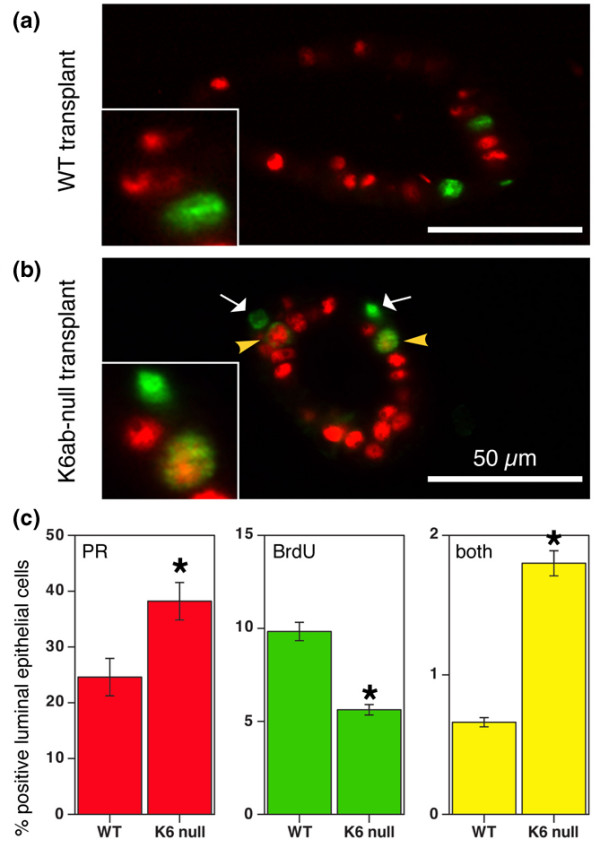
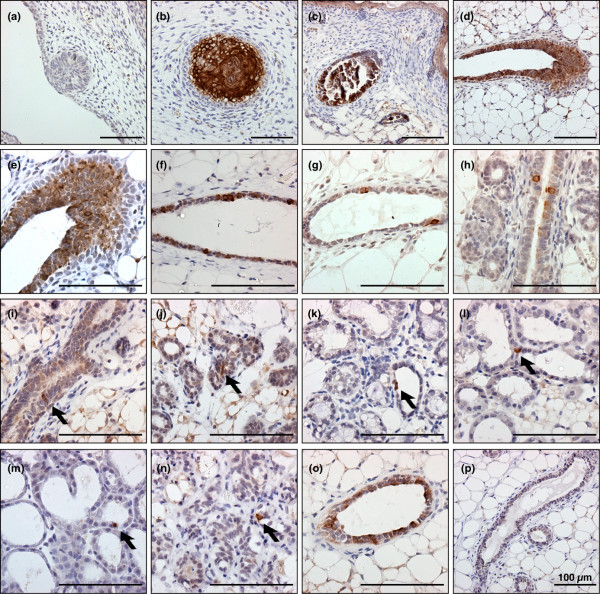
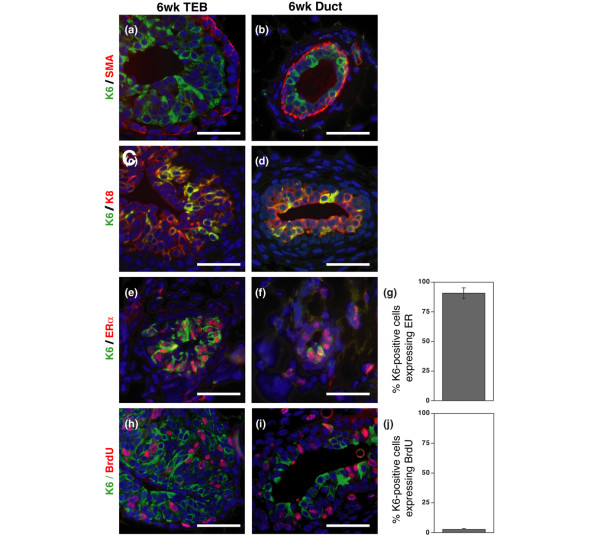
Immunostaining was performed to determine the expression pattern of K6a throughout mammary gland development, from the embryonic mammary bud to lactation. Double immunofluorescence was used to co-localize K6 with known markers of mammary gland development. Wild-type and K6ab-null mammary tissues were transplanted into the cleared fat pads of nude mice and the outgrowths were analyzed for morphology by whole-mount staining and for markers of mammary epithelium by immunostaining. Finally, progesterone receptor (PR) and bromodeoxyuridine co-localization was quantified by double immunofluorescence in wild-type and K6ab-null mammary outgrowths.
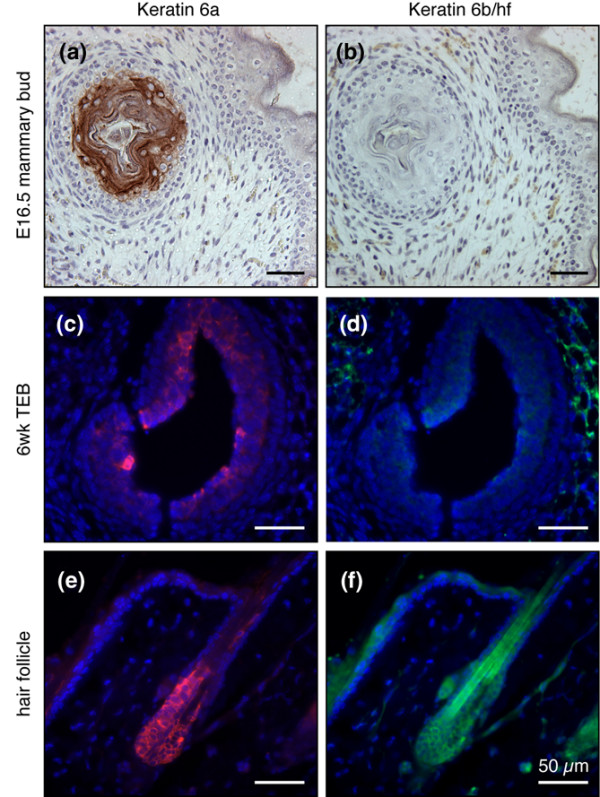
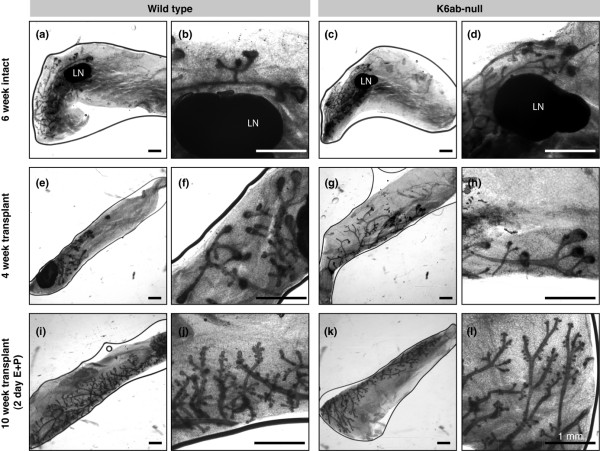
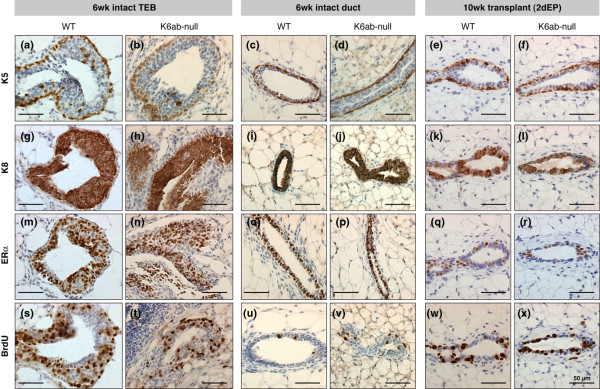
Here we report that K6 is expressed earlier than described previously, by embryonic day 16.5. K6a is the predominant isoform expressed in the mammary gland, localized in the body cells and luminal epithelial cells but not in the cap cells or myoepithelial cells. Co-localization studies showed that most K6a-positive cells express steroid receptors but do not proliferate. When both the K6a and K6b genes are deleted, mammary gland development appears normal, with similar expression of most molecular markers examined in both the pubertal gland and the mature gland. Loss of K6a and K6b, however, leads to an increase in the number of steroid-receptor-positive cells, and increased co-localization of steroid receptor expression and proliferation was observed.
Although K6a was not essential for mammary gland development, loss of both K6a and K6b resulted in an increase in PR-positive mammary epithelial cells and decreased proliferation after exposure to steroid hormones. There was also increased co-localization of PR and bromodeoxyuridine, suggesting alterations in patterning events important for normal lobuloalveolar development.
角蛋白6(K6)先前已被确定为早期乳腺发育的标志物,也有人提出它是乳腺祖细胞的标志物。然而,K6在乳腺中的功能尚不清楚,因此我们研究了该蛋白在胚胎期和出生后乳腺发育过程中的表达模式,以及K6a和K6b亚型均缺失的小鼠的乳腺表型。
进行免疫染色以确定K6a在从胚胎期乳腺芽到哺乳期整个乳腺发育过程中的表达模式。采用双重免疫荧光法使K6与已知的乳腺发育标志物共定位。将野生型和K6ab基因缺失的乳腺组织移植到裸鼠清除后的脂肪垫中,通过整体染色分析其生长形态,并通过免疫染色分析乳腺上皮标志物。最后,通过双重免疫荧光法定量野生型和K6ab基因缺失的乳腺生长物中孕激素受体(PR)和溴脱氧尿苷的共定位情况。
我们在此报告,K6的表达比先前描述的时间更早,在胚胎第16.5天就已表达。K6a是在乳腺中表达的主要亚型,定位于体细胞和腔上皮细胞,但不在帽细胞或肌上皮细胞中。共定位研究表明,大多数K6a阳性细胞表达类固醇受体但不增殖。当K6a和K6b基因均缺失时,乳腺发育看起来正常,在青春期乳腺和成熟乳腺中检测的大多数分子标志物表达相似。然而,K6a和K6b的缺失导致类固醇受体阳性细胞数量增加,并且观察到类固醇受体表达与增殖的共定位增加。
尽管K6a对乳腺发育并非必不可少,但K6a和K6b均缺失导致PR阳性乳腺上皮细胞数量增加,并且在暴露于类固醇激素后增殖减少。PR和溴脱氧尿苷的共定位也增加,表明对正常小叶腺泡发育重要的模式形成事件发生了改变。