Wang Yun, Botolin Daniela, Xu Jinghua, Christian Barbara, Mitchell Ernestine, Jayaprakasam Bolleddula, Nair Muraleedharan G, Peters Jeffrey M, Busik Julia V, Olson L Karl, Jump Donald B
Department of Physiology, Michigan State University, East Lansing, MI 48824, USA.
J Lipid Res. 2006 Sep;47(9):2028-41. doi: 10.1194/jlr.M600177-JLR200. Epub 2006 Jun 21.
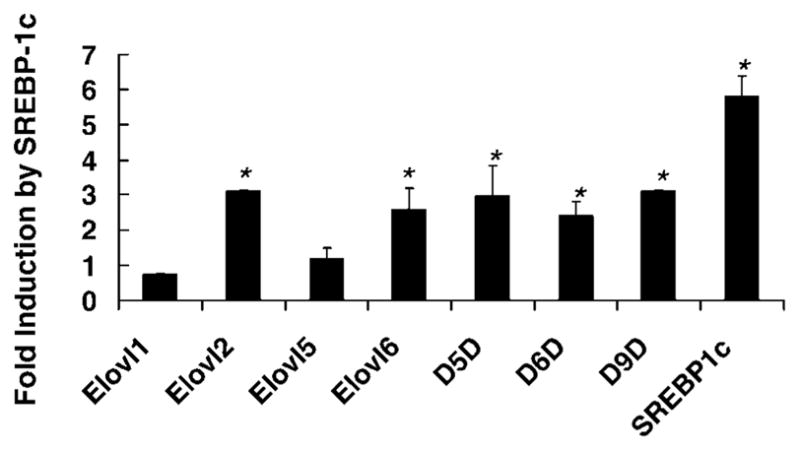
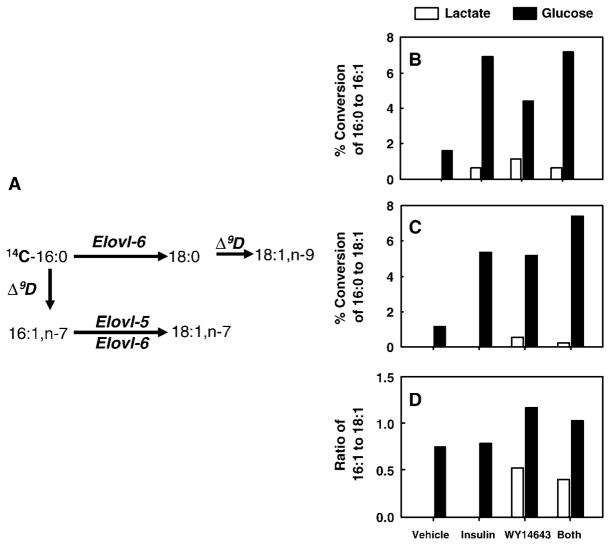
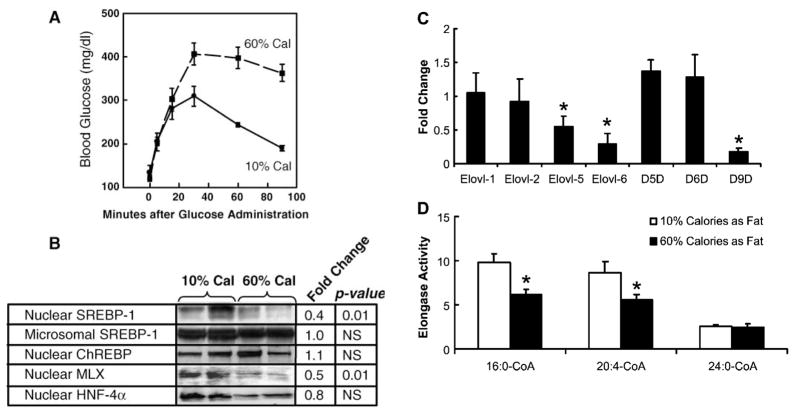
Fatty acid elongases and desaturases play an important role in hepatic and whole body lipid composition. We examined the role that key transcription factors played in the control of hepatic elongase and desaturase expression. Studies with peroxisome proliferator-activated receptor alpha (PPARalpha)-deficient mice establish that PPARalpha was required for WY14643-mediated induction of fatty acid elongase-5 (Elovl-5), Elovl-6, and all three desaturases [Delta(5) desaturase (Delta(5)D), Delta(6)D, and Delta(9)D]. Increased nuclear sterol-regulatory element binding protein-1 (SREBP-1) correlated with enhanced expression of Elovl-6, Delta(5)D, Delta(6)D, and Delta(9)D. Only Delta(9)D was also regulated independently by liver X receptor (LXR) agonist. Glucose induction of l-type pyruvate kinase, Delta(9)D, and Elovl-6 expression required the carbohydrate-regulatory element binding protein/MAX-like factor X (ChREBP/MLX) heterodimer. Suppression of Elovl-6 and Delta(9)D expression in livers of streptozotocin-induced diabetic rats and high fat-fed glucose-intolerant mice correlated with low levels of nuclear SREBP-1. In leptin-deficient obese mice (Lep(ob/ob)), increased SREBP-1 and MLX nuclear content correlated with the induction of Elovl-5, Elovl-6, and Delta(9)D expression and the massive accumulation of monounsaturated fatty acids (18:1,n-7 and 18:1,n-9) in neutral lipids. Diabetes- and obesity-induced changes in hepatic lipid composition correlated with changes in elongase and desaturase expression. In conclusion, these studies establish a role for PPARalpha, LXR, SREBP-1, ChREBP, and MLX in the control of hepatic fatty acid elongase and desaturase expression and lipid composition.
脂肪酸延长酶和去饱和酶在肝脏及全身脂质组成中发挥着重要作用。我们研究了关键转录因子在调控肝脏延长酶和去饱和酶表达中所起的作用。对过氧化物酶体增殖物激活受体α(PPARα)缺陷小鼠的研究表明,PPARα是WY14643介导的脂肪酸延长酶5(Elovl - 5)、Elovl - 6以及所有三种去饱和酶[Δ(5)去饱和酶(Δ(5)D)、Δ(6)D和Δ(9)D]诱导所必需的。核固醇调节元件结合蛋白1(SREBP - 1)增加与Elovl - 6、Δ(5)D、Δ(6)D和Δ(9)D表达增强相关。只有Δ(9)D也受肝脏X受体(LXR)激动剂独立调控。葡萄糖诱导l型丙酮酸激酶、Δ(9)D和Elovl - 6表达需要碳水化合物调节元件结合蛋白/MAX样因子X(ChREBP/MLX)异二聚体。链脲佐菌素诱导的糖尿病大鼠和高脂喂养的葡萄糖不耐受小鼠肝脏中Elovl - 6和Δ(9)D表达的抑制与核SREBP - 1水平降低相关。在瘦素缺乏的肥胖小鼠(Lep(ob/ob))中,SREBP - 1和MLX核含量增加与Elovl - 5、Elovl - 6和Δ(9)D表达的诱导以及中性脂质中单不饱和脂肪酸(18:1,n - 7和18:1,n - 9)的大量积累相关。糖尿病和肥胖诱导的肝脏脂质组成变化与延长酶和去饱和酶表达的变化相关。总之,这些研究确立了PPARα、LXR、SREBP - 1、ChREBP和MLX在调控肝脏脂肪酸延长酶和去饱和酶表达及脂质组成中的作用。