Shchyolkina Anna K, Kaluzhny Dmitry N, Arndt-Jovin Donna J, Jovin Thomas M, Zhurkin Victor B
Engelhardt Institute of Molecular Biology, Russian Academy of Sciences, 119991 Moscow, Russia.
Nucleic Acids Res. 2006 Jun 23;34(11):3239-45. doi: 10.1093/nar/gkl431. Print 2006.
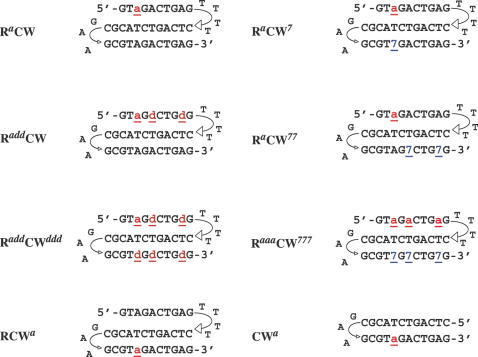
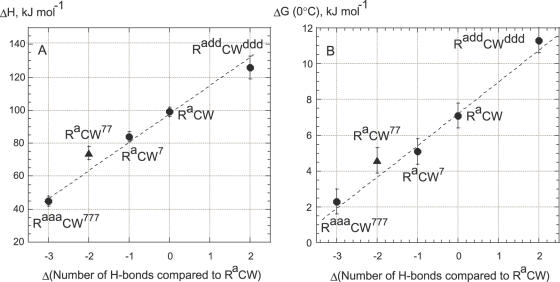
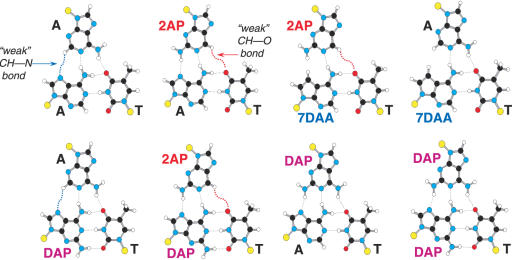
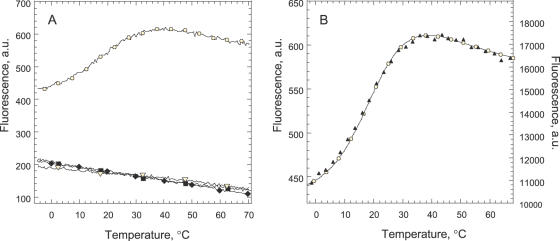
Several cellular processes involve alignment of three nucleic acids strands, in which the third strand (DNA or RNA) is identical and in a parallel orientation to one of the DNA duplex strands. Earlier, using 2-aminopurine as a fluorescent reporter base, we demonstrated that a self-folding oligonucleotide forms a recombination-like structure consistent with the R-triplex. Here, we extended this approach, placing the reporter 2-aminopurine either in the 5'- or 3'-strand. We obtained direct evidence that the 3'-strand forms a stable duplex with the complementary central strand, while the 5'-strand participates in non-Watson-Crick interactions. Substituting 2,6-diaminopurine or 7-deazaadenine for adenine, we tested and confirmed the proposed hydrogen bonding scheme of the A*(T.A) R-type triplet. The adenine substitutions expected to provide additional H-bonds led to triplex structures with increased stability, whereas the substitutions consistent with a decrease in the number of H-bonds destabilized the triplex. The triplex formation enthalpies and free energies exhibited linear dependences on the number of H-bonds predicted from the A*(T.A) triplet scheme. The enthalpy of the 10 nt long intramolecular triplex of -100 kJ x mol(-1) demonstrates that the R-triplex is relatively unstable and thus an ideal candidate for a transient intermediate in homologous recombination, t-loop formation at the mammalian telomere ends, and short RNA invasion into a duplex. On the other hand, the impact of a single H-bond, 18 kJ x mol(-1), is high compared with the overall triplex formation enthalpy. The observed energy advantage of a 'correct' base in the third strand opposite the Watson-Crick base pair may be a powerful mechanism for securing selectivity of recognition between the single strand and the duplex.
几个细胞过程涉及三条核酸链的排列,其中第三条链(DNA或RNA)与DNA双链中的一条链相同且方向平行。此前,我们使用2-氨基嘌呤作为荧光报告碱基,证明了一种自折叠寡核苷酸形成了与R-三链体一致的重组样结构。在此,我们扩展了这种方法,将报告分子2-氨基嘌呤置于5'-链或3'-链中。我们获得了直接证据,即3'-链与互补的中心链形成稳定的双链,而5'-链参与非沃森-克里克相互作用。用2,6-二氨基嘌呤或7-脱氮腺嘌呤取代腺嘌呤,我们测试并证实了A*(T.A) R型三联体的氢键方案。预期能提供额外氢键的腺嘌呤取代导致三链体结构稳定性增加,而与氢键数量减少一致的取代则使三链体不稳定。三链体形成的焓和自由能与根据A*(T.A)三联体方案预测的氢键数量呈线性关系。-100 kJ x mol(-1)的10 nt长分子内三链体的焓表明,R-三链体相对不稳定,因此是同源重组中瞬时中间体、哺乳动物端粒末端t-环形成以及短RNA侵入双链的理想候选者。另一方面,单个氢键的影响为18 kJ x mol(-1),与三链体形成的总焓相比很高。在与沃森-克里克碱基对相对的第三条链中观察到的“正确”碱基的能量优势可能是确保单链与双链之间识别选择性的有力机制。