Carvalho Pinto-Silva, Catian R, Moukha Serge, Matias William G, Creppy Edmond E
Department of Environmental Engineering, Toxicological Laboratory of the Federal University of Santa Catarina, Brazil Campus Universitário, Trindade 88040-900, Brazil.
Int J Environ Res Public Health. 2006 Mar;3(1):4-10. doi: 10.3390/ijerph2006030001.
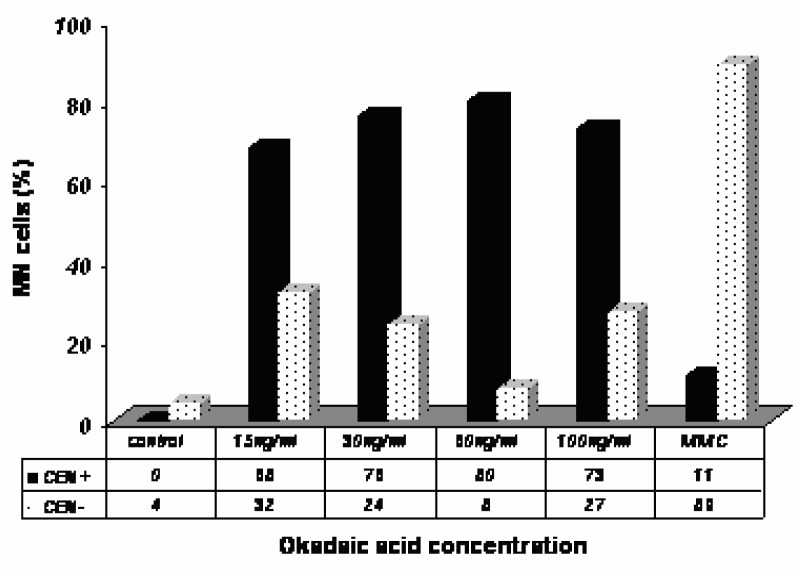
Okadaic Acid (OA) the major diarrheic shellfish poisoning (DSP) toxin is known as a tumor promoter and seems likely implicated in the genesis of digestive cancer. Little is known regarding genotoxicity and carcinogenicity of Domoic Acid (DA), the major Amnesic Shellfish Poisoning (ASP) toxin. Both OA and DA occur in seafood and are of human health concerns. Micronuclei (MN) arise from abnormalities in nuclear division during mitosis due to a failure of the mitotic spindle or by complex chromosomal configurations that pose problems during anaphase. In order to evaluate the ability of okadaic acid (OA) and domoic acid (DA) to induce DNA damage we performed the micronucleus assay using the Caco-2 cell line. To discriminate between a clastogenic or aneugenic effect of OA and DA, the micronucleus assay was conducted by cytokinesis-block micronucleus assay using cytochalasin B with Giemsa staining and/or acridine orange staining, in parallel to fluorescence in situ hybridization (FISH) using a concentrated human pan-centromeric chromosome paint probe. Our results showed that OA and DA significantly increased the frequency of MN in Caco-2 cells. The MN caused by OA are found in mononucleated cells and binucleated cells, whereas those caused by DA are mainly in binucleated cells. The results of FISH analysis showed that OA induced centromere-positive micronuclei and DA increased the percentage of MN without a centromeric signal. In conclusion, both OA and DA bear mutagenic potential as revealed in Caco-2 cells by induction of MN formation. Moreover, OA induced whole chromosome loss suggesting a specific aneugenic potential, whereas DA seems simply clastogenic. At present, one cannot rule out possible DNA damage of intestinal cells if concentrations studied are reached in vivo, since this may happen with concentrations of toxins just below regulatory limits in case of frequent consumption of contaminated shell fishes.
冈田酸(OA)是主要的腹泻性贝类毒素(DSP),是一种肿瘤促进剂,似乎与消化系统癌症的发生有关。关于主要的失忆性贝类毒素(ASP)——软骨藻酸(DA)的遗传毒性和致癌性,人们了解甚少。OA和DA都存在于海鲜中,对人类健康构成威胁。微核(MN)是由于有丝分裂纺锤体功能障碍或后期出现复杂染色体构型导致核分裂异常而产生的。为了评估冈田酸(OA)和软骨藻酸(DA)诱导DNA损伤的能力,我们使用Caco-2细胞系进行了微核试验。为了区分OA和DA的致断裂或非整倍体效应,通过使用细胞松弛素B进行胞质分裂阻断微核试验,并结合吉姆萨染色和/或吖啶橙染色来进行微核试验,同时使用浓缩的人类全着丝粒染色体涂染探针进行荧光原位杂交(FISH)。我们的结果表明,OA和DA显著增加了Caco-2细胞中MN的频率。由OA引起的MN存在于单核细胞和双核细胞中,而由DA引起的MN主要存在于双核细胞中。FISH分析结果表明,OA诱导着丝粒阳性微核,而DA增加了无着丝粒信号的MN的百分比。总之,如在Caco-2细胞中通过诱导MN形成所揭示的那样,OA和DA都具有诱变潜力。此外,OA诱导整条染色体丢失,表明具有特定的非整倍体潜力,而DA似乎只是具有致断裂性。目前,如果体内达到所研究的浓度,就不能排除肠道细胞可能受到的DNA损伤,因为在频繁食用受污染贝类的情况下,毒素浓度可能刚好低于监管限值时就会发生这种情况。