Fosgate G T
Department of Veterinary Integrative Biosciences, College of Veterinary Medicine and Biomedical Sciences, Texas A&M University, College Station, TX 77843-4458, USA.
Emerg Themes Epidemiol. 2006 Jul 17;3:7. doi: 10.1186/1742-7622-3-7.
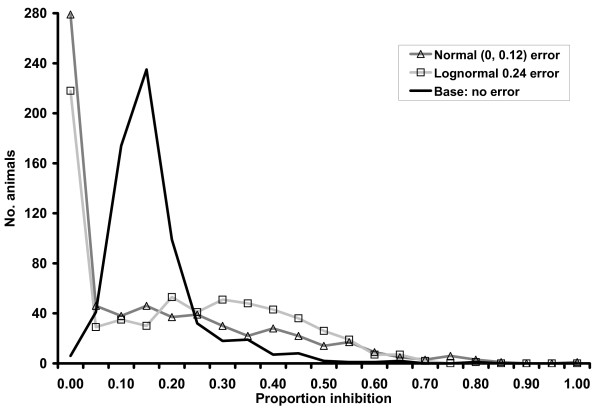
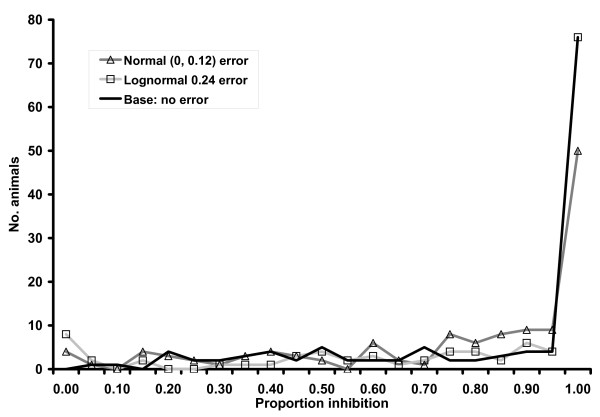
Diagnostic test evaluations are susceptible to random and systematic error. Simulated non-differential random error for six different error distributions was evaluated for its effect on measures of diagnostic accuracy for a brucellosis competitive ELISA. Test results were divided into four categories: < 0.25, 0.25-0.349, 0.35-0.499, and > or = 0.50 proportions inhibition for calculation of likelihood ratios and diagnostic odds ratios. Larger variance components of the error structure resulted in larger accuracy attenuations as measured by the area under the receiver-operating characteristic curve and systematic components appeared to cause little bias. Added error caused point estimates of likelihood ratios to be biased towards the null value (1.0) for all categories except 0.25-0.349. Results for the 0.35-0.499 category also extended beyond the null value for some error structures. Diagnostic odds ratios were consistently biased towards the null when the < 0.25 category was considered the reference level. Non-differential measurement error can lead to biased results in the quantitative evaluation of ELISA and the direction is not always towards the null value.
诊断试验评估容易受到随机误差和系统误差的影响。针对六种不同误差分布的模拟非差异性随机误差,评估了其对布鲁氏菌病竞争ELISA诊断准确性指标的影响。试验结果分为四类:抑制率比例<0.25、0.25 - 0.349、0.35 - 0.499以及≥0.50,用于计算似然比和诊断比值比。误差结构中较大的方差成分导致通过接受者操作特征曲线下面积衡量的准确性衰减更大,而系统成分似乎几乎不产生偏差。除0.25 - 0.349类别外,额外误差导致所有类别的似然比点估计偏向无效值(1.0)。对于某些误差结构,0.35 - 0.499类别的结果也超出了无效值。当将<0.25类别视为参考水平时,诊断比值比始终偏向无效值。非差异性测量误差可导致ELISA定量评估结果出现偏差,且偏差方向并不总是朝向无效值。