Lollini Pier-Luigi, Motta Santo, Pappalardo Francesco
Sezione di Cancerologia, Dipartimento di Patologia Sperimentale, University of Bologna, Italy.
BMC Bioinformatics. 2006 Jul 20;7:352. doi: 10.1186/1471-2105-7-352.
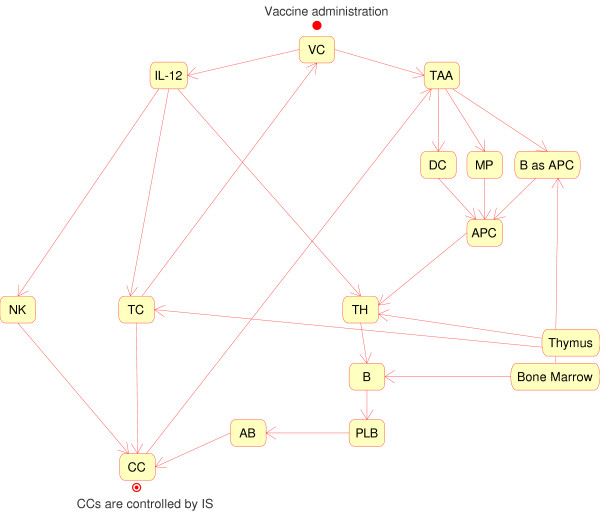
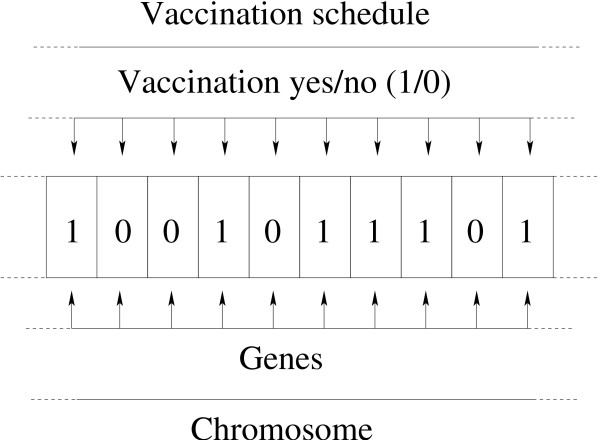
Immunological prevention of cancer has been obtained in HER-2/neu transgenic mice using a vaccine that combines 3 different immune stimuli (Triplex vaccine) that is repeatedly administered for the entire lifespan of the host (Chronic protocol). Biological experiments leave open the question of whether the Chronic protocol is indeed the minimal vaccination schedule affording 100% protection, or whether shorter protocols could be applied that would result in the same efficacy. A biological solution would require an enormous number of experiments, each lasting at least one year. Therefore we approached this problem by developing a simulator (SimTriplex) which describes the immune response activated by Triplex vaccine. This simulator, tested against in vivo experiments on HER-2/neu mice, reproduces all the vaccination protocols used in the in vivo experiments. The simulator should describe any vaccination protocol within the tested range. A possible solution to the former open question using a minimal search strategy based on a genetic algorithm is presented. This is the first step toward a more general approach of biological or clinical constraints for the search of an effective vaccination schedule.
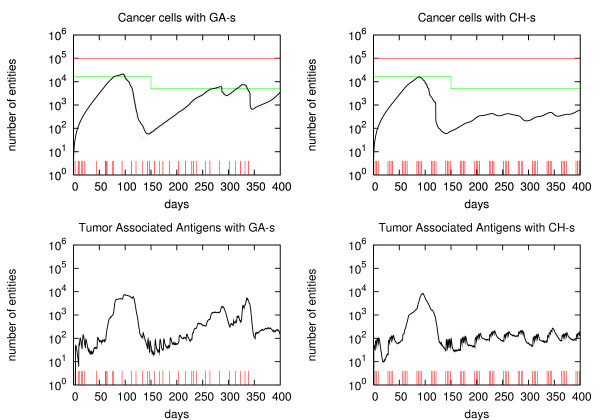
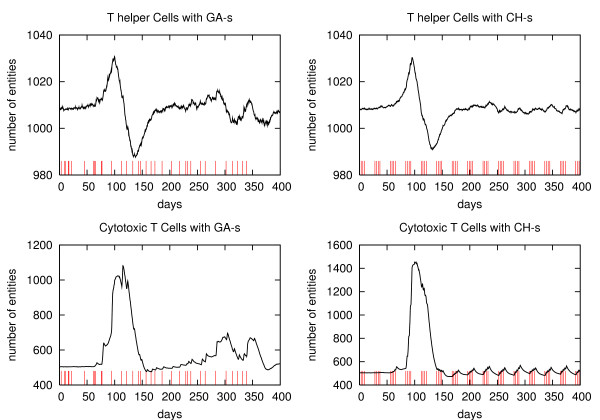
The results suggest that the Chronic protocol included a good number of redundant vaccine administrations, and that maximal protection could still be obtained with a number of vaccinations approximately 40% less than with the Chronic protocol.
This approach may have important connotations with regard to translation of cancer immunopreventive approaches to human situations, in which it is desirable to minimize the number of vaccinations. We are currently setting up experiments in mice to test whether the actual effectiveness of the vaccination protocol agrees with the genetic algorithm.
在HER-2/neu转基因小鼠中,通过使用一种结合了3种不同免疫刺激的疫苗(三联疫苗)实现了癌症的免疫预防,该疫苗在宿主的整个生命周期内反复给药(慢性方案)。生物学实验留下了一个问题:慢性方案是否确实是提供100%保护的最小疫苗接种时间表,或者是否可以应用更短的方案并产生相同的效果。生物学解决方案需要进行大量实验,每个实验至少持续一年。因此,我们通过开发一个模拟器(SimTriplex)来解决这个问题,该模拟器描述了三联疫苗激活的免疫反应。这个模拟器经过针对HER-2/neu小鼠的体内实验测试,重现了体内实验中使用的所有疫苗接种方案。该模拟器应描述测试范围内的任何疫苗接种方案。本文提出了一种基于遗传算法的最小搜索策略来解决之前未解决问题的可能方案。这是朝着更通用的生物学或临床约束方法迈出的第一步,用于寻找有效的疫苗接种时间表。
结果表明,慢性方案包含大量冗余的疫苗接种,并且接种次数比慢性方案减少约40%时仍可获得最大保护。
这种方法对于将癌症免疫预防方法转化为人类应用可能具有重要意义,在人类应用中希望尽量减少疫苗接种次数。我们目前正在小鼠中开展实验,以测试疫苗接种方案的实际效果是否与遗传算法一致。