Smeulders Esther S T F, van Haastregt Jolanda C M, van Hoef Elisabeth F M, van Eijk Jacques Th M, Kempen Gertrudis I J M
Maastricht University, Faculty of Health Sciences, Department of Health Care Studies, P.O. Box 616, 6200 MD Maastricht, The Netherlands.
BMC Health Serv Res. 2006 Jul 20;6:91. doi: 10.1186/1472-6963-6-91.
Congestive heart failure (CHF) has a substantial impact on care utilisation and quality of life. It is crucial for patients to cope with CHF adequately, if they are to live an acceptable life. Self-management may play an important role in this regard. Previous studies have shown the effectiveness of the 'Chronic Disease Self-Management Program' (CDSMP), a group-based cognitive behavioural programme for patients with various chronic conditions. However, the programme's effectiveness has not yet been studied specifically among CHF patients. This paper presents the design of a randomised controlled trial to evaluate the effects of the CDSMP on psychosocial attributes, health behaviour, quality of life, and health care utilisation of CHF patients.
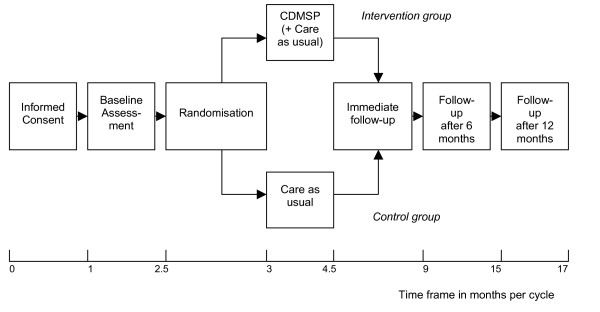
METHODS/DESIGN: The programme is being evaluated in a two-group randomised controlled trial. Patients were eligible if they had been diagnosed with CHF and experienced slight to marked limitation of physical activity. They were selected from the Heart Failure and/or Cardiology Outpatient Clinics of six hospitals. Eligible patients underwent a baseline assessment and were subsequently allocated to the intervention or control group. Patients allocated to the intervention group were invited to attend the self-management programme consisting of six weekly sessions, led by a CHF nurse specialist and a CHF patient. Those allocated to the control group received care as usual. Follow-up measurements are being carried out immediately after the intervention period, and six and twelve months after the start of the intervention. An effect evaluation and a process evaluation are being conducted. The primary outcomes of the effect evaluation are self-efficacy expectancies, perceived control, and cognitive symptom management. The secondary outcome measures are smoking and drinking behaviour, Body Mass Index (BMI), physical activity level, self-care behaviour, health-related quality of life, perceived autonomy, symptoms of anxiety and depression, and health care utilisation. The programme's feasibility is assessed by measuring compliance with the protocol, patients' attendance and adherence, and the opinions about the programme.
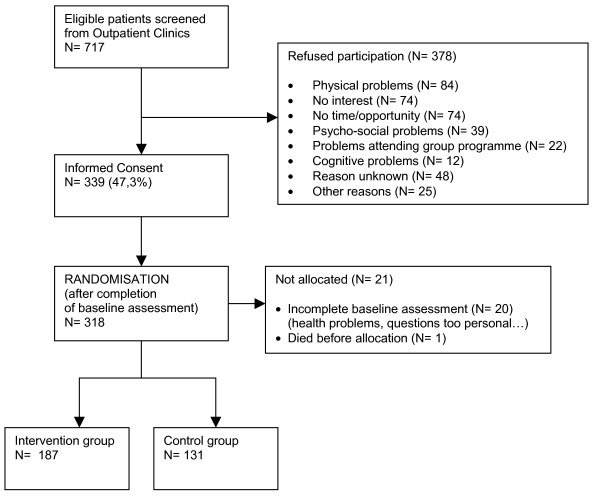
A total number of 318 patients were included in the trial. At present, follow-up data are being collected. The results of the trial become clear after completion of the data collection in January 2007.
Trialregister (http://www.trialregister.nl/trialreg/admin/rctview.asp?TC=467) ISRCTN88363287.
充血性心力衰竭(CHF)对医疗服务利用和生活质量有重大影响。若患者想要过上可接受的生活,充分应对CHF至关重要。自我管理在这方面可能发挥重要作用。先前的研究已表明“慢性病自我管理项目”(CDSMP)的有效性,这是一个针对各种慢性病患者的基于小组的认知行为项目。然而,该项目在CHF患者中的有效性尚未得到专门研究。本文介绍了一项随机对照试验的设计,以评估CDSMP对CHF患者心理社会属性、健康行为、生活质量和医疗服务利用的影响。
方法/设计:该项目正在一项两组随机对照试验中进行评估。如果患者被诊断为CHF且身体活动有轻度至明显受限,则符合入选条件。他们从六家医院的心力衰竭和/或心脏病门诊诊所中选取。符合条件的患者接受基线评估,随后被分配到干预组或对照组。分配到干预组的患者被邀请参加由一名CHF护士专家和一名CHF患者主持的为期六周的自我管理项目。分配到对照组的患者接受常规护理。在干预期结束后、干预开始后六个月和十二个月进行随访测量。正在进行效果评估和过程评估。效果评估的主要结果是自我效能期望、感知控制和认知症状管理。次要结果测量包括吸烟和饮酒行为、体重指数(BMI)、身体活动水平、自我护理行为、健康相关生活质量、感知自主性、焦虑和抑郁症状以及医疗服务利用。通过测量对方案的依从性、患者的出勤和坚持情况以及对该项目的意见来评估该项目的可行性。
共有318名患者纳入试验。目前,正在收集随访数据。2007年1月完成数据收集后,试验结果将清晰明了。
Trialregister(http://www.trialregister.nl/trialreg/admin/rctview.asp?TC=467)ISRCTN88363287。