
辛酸对脂肪细胞脂肪生成的调节作用:活性氧的参与
Modulation of adipocyte lipogenesis by octanoate: involvement of reactive oxygen species.
作者信息
Guo Wen, Xie Weisheng, Han Jianrong
机构信息
Obesity Research Unit, Department of Medicine, Boston University School of Medicine, Boston, MA 02118, USA.
出版信息
Nutr Metab (Lond). 2006 Jul 27;3:30. doi: 10.1186/1743-7075-3-30.
BACKGROUND
Octanoate is a medium-chain fatty acid (MCFA) that is rich in milk and tropical dietary lipids. It also accounts for 70% of the fatty acids in commercial medium chain triglycerides (MCT). Use of MCT for weight control tracks back to early 1950s and is highlighted by recent clinical trials. The molecular mechanisms of the weight reduction effect remain not completely understood. The findings of significant amounts of MCFA in adipose tissue in MCT-fed animals and humans suggest a direct influence of MCFA on fat cell functions.
METHODS
3T3-L1 adipocytes were treated with octanoate in a high glucose culture medium supplemented with 10% fetal bovine serum and 170 nM insulin. The effects on lipogenesis, fatty acid oxidation, cellular concentration of reactive oxygen species (ROS), and the expression and activity of peroxisome proliferator receptor gamma (PPARgamma) and its associated lipogenic genes were assessed. In selected experiments, long-chain fatty acid oleate, PPARgamma agonist troglitazone, and antioxidant N-acetylcysteine were used in parallel. Effects of insulin, L-carnitine, and etomoxir on beta-oxidation were also measured.
RESULTS
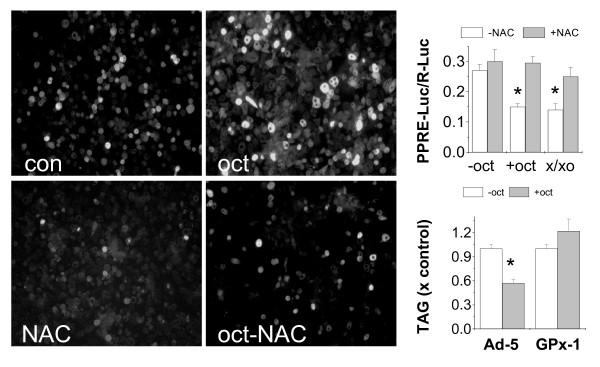
Beta-oxidation of octanoate was primarily independent of CPT-I. Treatment with octanoate was linked to an increase in ROS in adipocytes, a decrease in triglyceride synthesis, and reduction of lipogenic gene expression. Co-treatment with troglitazone, N-acetylcysteine, or over-expression of glutathione peroxidase largely reversed the effects of octanoate.
CONCLUSION
These findings suggest that octanoate-mediated inactivation of PPARgamma might contribute to the down regulation of lipogenic genes in adipocytes, and ROS appears to be involved as a mediator in this process.
背景
辛酸是一种中链脂肪酸(MCFA),富含于牛奶和热带饮食脂质中。它还占商业中链甘油三酯(MCT)中脂肪酸的70%。MCT用于体重控制可追溯到20世纪50年代初,最近的临床试验突出了这一点。体重减轻作用的分子机制仍未完全了解。在喂食MCT的动物和人类脂肪组织中发现大量MCFA,这表明MCFA对脂肪细胞功能有直接影响。
方法
在补充有10%胎牛血清和170 nM胰岛素的高糖培养基中用辛酸处理3T3-L1脂肪细胞。评估对脂肪生成、脂肪酸氧化、活性氧(ROS)细胞浓度以及过氧化物酶体增殖物激活受体γ(PPARγ)及其相关脂肪生成基因的表达和活性的影响。在选定的实验中,平行使用长链脂肪酸油酸、PPARγ激动剂曲格列酮和抗氧化剂N-乙酰半胱氨酸。还测量了胰岛素、L-肉碱和依托莫昔对β氧化的影响。
结果
辛酸的β氧化主要独立于肉碱棕榈酰转移酶-I(CPT-I)。用辛酸处理与脂肪细胞中ROS增加、甘油三酯合成减少以及脂肪生成基因表达降低有关。与曲格列酮、N-乙酰半胱氨酸共同处理或谷胱甘肽过氧化物酶过表达在很大程度上逆转了辛酸的作用。
结论
这些发现表明,辛酸介导的PPARγ失活可能导致脂肪细胞中脂肪生成基因的下调,并且ROS似乎在此过程中作为介质参与其中。


 Zotero 插件