Porta Francesca, Takala Jukka, Weikert Christian, Bracht Hendrik, Kolarova Anna, Lauterburg Bernhard H, Borotto Erika, Jakob Stephan M
Department of Intensive Care Medicine, University Hospital Bern, CH-3010 Bern, Switzerland.
Crit Care. 2006;10(4):R118. doi: 10.1186/cc5013.
Sepsis may impair mitochondrial utilization of oxygen. Since hepatic dysfunction is a hallmark of sepsis, we hypothesized that the liver is more susceptible to mitochondrial dysfunction than the peripheral tissues, such as the skeletal muscle. We studied the effect of prolonged endotoxin infusion on liver, muscle and kidney mitochondrial respiration and on hepatosplanchnic oxygen transport and microcirculation in pigs.
20 anesthetized pigs were randomized to receive endotoxin or saline infusion for 24 hours. Muscle, liver and kidney mitochondrial respiration was assessed. Cardiac output (thermodilution), carotid, superior mesenteric and kidney arterial, portal venous (ultrasound Doppler) and microcirculatory blood flow (laser Doppler) were measured, and systemic and regional oxygen transport and lactate exchange were calculated.
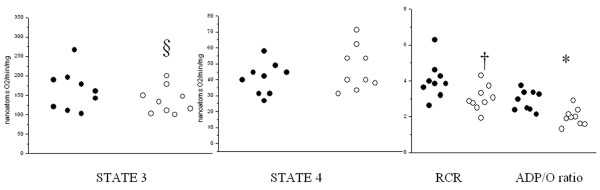
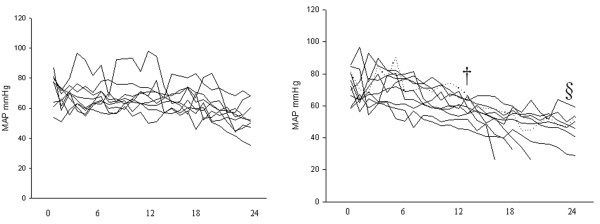
Endotoxin infusion induced hyperdynamic shock and impaired the glutamate- and succinate-dependent mitochondrial respiratory control ratio (RCR) in the liver (glutamate: endotoxemia: median [range] 2.8 [2.3-3.8] vs. controls: 5.3 [3.8-7.0]; p<0.001; succinate: endotoxemia: 2.9 [1.9-4.3] vs. controls: 3.9 [2.6-6.3] p=0.003). While the ADP:O ratio was reduced with both substrates, maximal ATP production was impaired only in the succinate-dependent respiration. Hepatic oxygen consumption and extraction, and liver surface laser Doppler blood flow remained unchanged. Glutamate-dependent respiration in the muscle and kidney was unaffected.
Endotoxemia reduces the efficiency of hepatic but neither skeletal muscle nor kidney mitochondrial respiration, independent of regional and microcirculatory blood flow changes.
脓毒症可能损害线粒体对氧的利用。由于肝功能障碍是脓毒症的一个标志,我们推测肝脏比骨骼肌等外周组织更容易受到线粒体功能障碍的影响。我们研究了长时间输注内毒素对猪肝脏、肌肉和肾脏线粒体呼吸以及肝内脏氧输送和微循环的影响。
将20只麻醉猪随机分为两组,分别接受24小时的内毒素输注或生理盐水输注。评估肌肉、肝脏和肾脏的线粒体呼吸。测量心输出量(热稀释法)、颈动脉、肠系膜上动脉和肾动脉、门静脉(超声多普勒)以及微循环血流量(激光多普勒),并计算全身和局部的氧输送以及乳酸交换。
输注内毒素导致高动力性休克,并损害肝脏中依赖谷氨酸和琥珀酸的线粒体呼吸控制率(RCR)(谷氨酸:内毒素血症:中位数[范围]2.8[2.3 - 3.8],对照组:5.3[3.8 - 7.0];p < 0.001;琥珀酸:内毒素血症:2.9[1.9 - 4.3],对照组:3.9[2.6 - 6.3],p = 0.003)。虽然两种底物的ADP:O比值均降低,但仅依赖琥珀酸的呼吸中的最大ATP生成受到损害。肝脏氧消耗和摄取以及肝脏表面激光多普勒血流保持不变。肌肉和肾脏中依赖谷氨酸的呼吸未受影响。
内毒素血症降低了肝脏线粒体呼吸效率,但不影响骨骼肌和肾脏的线粒体呼吸,且与局部和微循环血流量变化无关。