Minagawa Asako, Takaku Hiroaki, Ishii Ryohei, Takagi Masamichi, Yokoyama Shigeyuki, Nashimoto Masayuki
Department of Applied Life Sciences, Niigata University of Pharmacy and Applied Life Sciences, Niigata 956-8603, Japan.
Nucleic Acids Res. 2006 Aug 11;34(13):3811-8. doi: 10.1093/nar/gkl517. Print 2006.
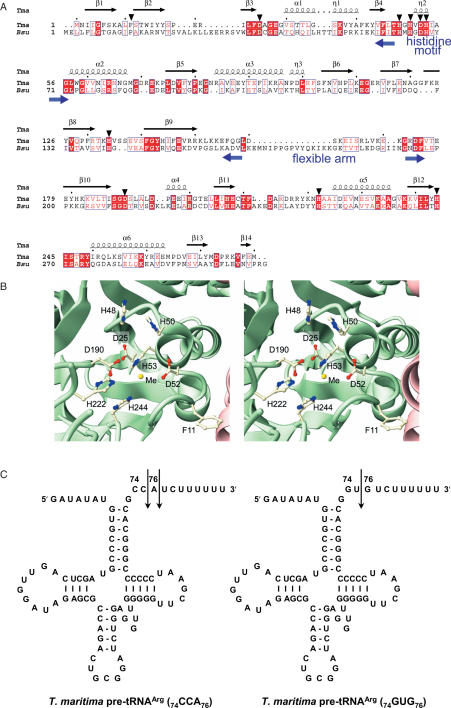
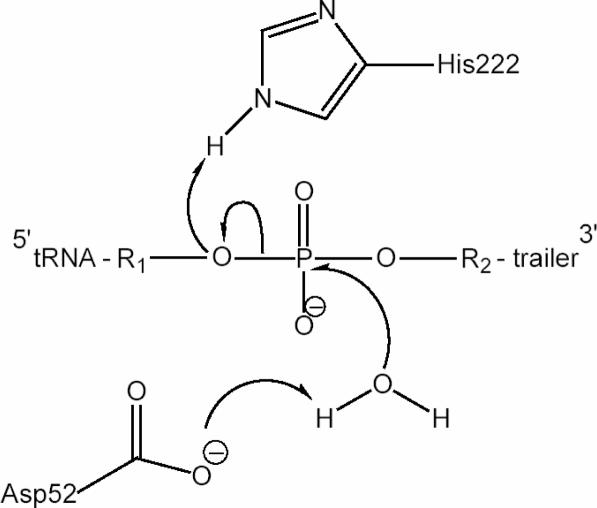
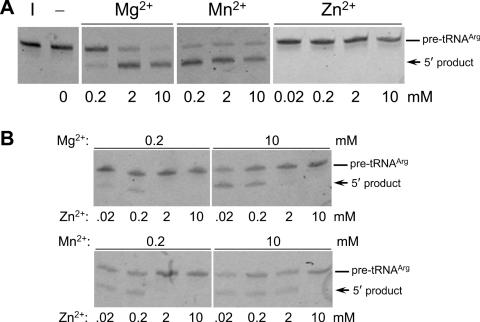
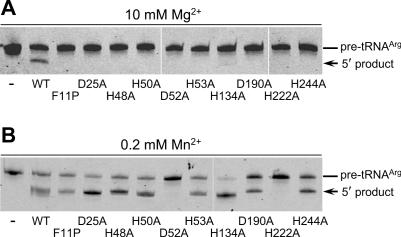
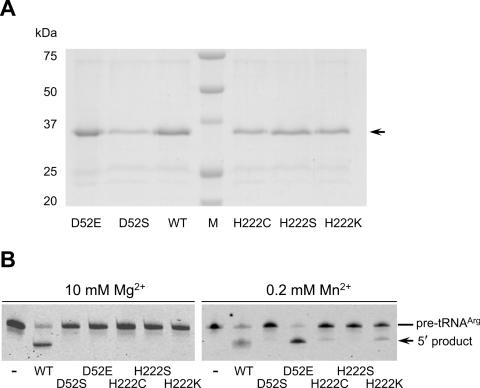
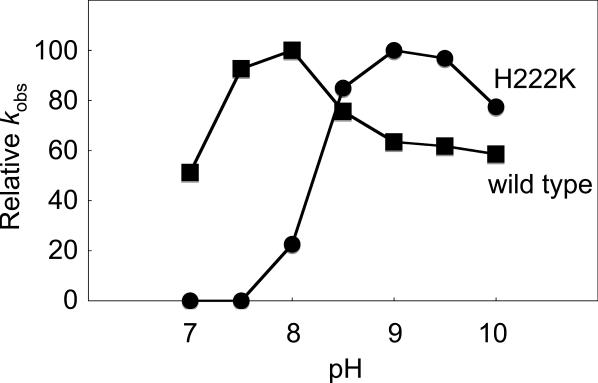
Thermotoga maritima tRNase Z cleaves pre-tRNAs containing the 74CCA76 sequence precisely after the A76 residue to create the mature 3' termini. Its crystal structure has revealed a four-layer alphabeta/betaalpha sandwich fold that is typically found in the metallo-beta-lactamase superfamily. The well-conserved six histidine and two aspartate residues together with metal ions are assumed to form the tRNase Z catalytic center. Here, we examined tRNase Z variants containing single amino acid substitutions in the catalytic center for pre-tRNA cleavage. Cleavage by each variant in the presence of Mg2+ was hardly detected, although it is bound to pre-tRNA. Surprisingly, however, Mn2+ ions restored the lost Mg2+-dependent activity with two exceptions of the Asp52Ala and His222Ala substitutions, which abolished the activity almost completely. These results provide a piece of evidence that Asp-52 and His-222 directly contribute the proton transfer for the catalysis.
嗜热栖热菌(Thermotoga maritima)的tRNase Z能在A76残基之后精确切割含有74CCA76序列的前体tRNA,从而产生成熟的3'末端。其晶体结构显示出一种四层αβ/βα三明治折叠结构,这种结构通常存在于金属β-内酰胺酶超家族中。六个保守的组氨酸和两个天冬氨酸残基与金属离子共同被认为形成了tRNase Z的催化中心。在此,我们研究了在催化中心含有单个氨基酸取代的tRNase Z变体对前体tRNA的切割作用。尽管每个变体都能与前体tRNA结合,但在Mg2+存在的情况下几乎检测不到其切割作用。然而,令人惊讶的是,除了Asp52Ala和His222Ala取代这两个几乎完全消除活性的例外情况外,Mn2+离子恢复了丧失的Mg2+依赖性活性。这些结果提供了一条证据,表明Asp-52和His-222直接参与了催化过程中的质子转移。