Laboratory of Yeast Genetics and Molecular Biology, School of Life Sciences, Nanjing Normal University, 1 Wenyuan Road, Nanjing 210046, China.
BMC Evol Biol. 2011 Jul 23;11:219. doi: 10.1186/1471-2148-11-219.
tRNase Z removes the 3'-trailer sequences from precursor tRNAs, which is an essential step preceding the addition of the CCA sequence. tRNase Z exists in the short (tRNase ZS) and long (tRNase ZL) forms. Based on the sequence characteristics, they can be divided into two major types: bacterial-type tRNase ZS and eukaryotic-type tRNase ZL, and one minor type, Thermotoga maritima (TM)-type tRNase ZS. The number of tRNase Zs is highly variable, with the largest number being identified experimentally in the flowering plant Arabidopsis thaliana. It is unknown whether multiple tRNase Zs found in A. thaliana is common to the plant kingdom. Also unknown is the extent of sequence and structural conservation among tRNase Zs from the plant kingdom.
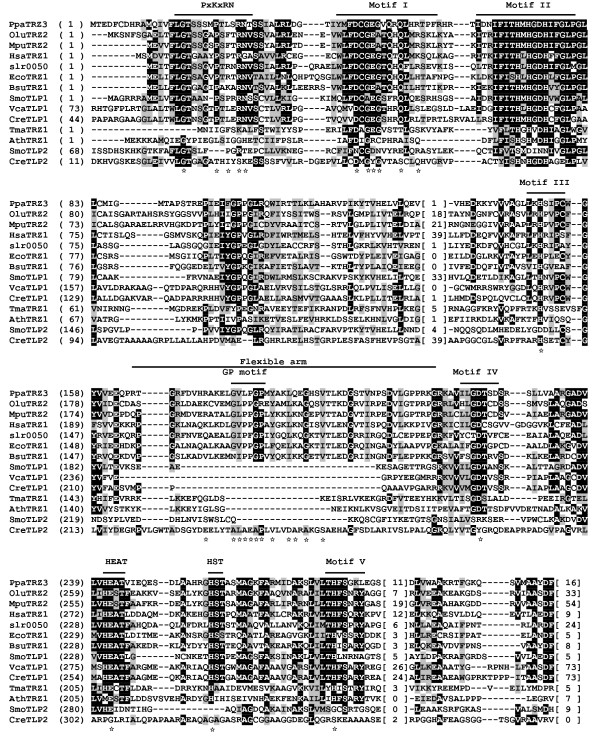
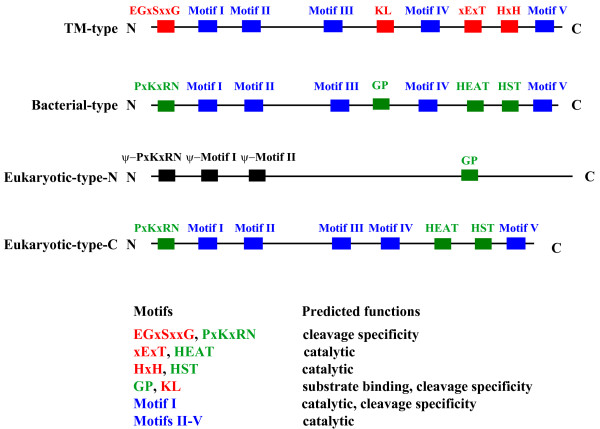
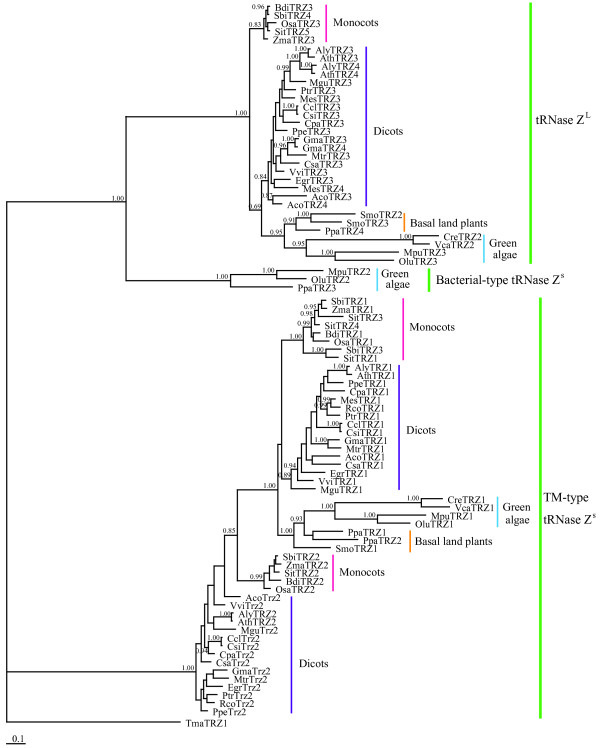
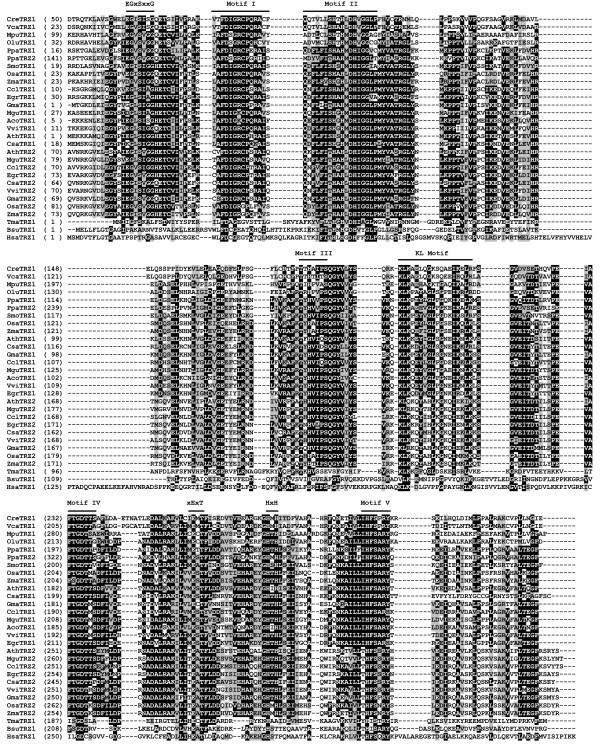
We report the identification and analysis of candidate tRNase Zs in 27 fully sequenced genomes of green plants, the great majority of which are flowering plants. It appears that green plants contain multiple distinct tRNase Zs predicted to reside in different subcellular compartments. Furthermore, while the bacterial-type tRNase ZSs are present only in basal land plants and green algae, the TM-type tRNase ZSs are widespread in green plants. The protein sequences of the TM-type tRNase ZSs identified in green plants are similar to those of the bacterial-type tRNase ZSs but have distinct features, including the TM-type flexible arm, the variant catalytic HEAT and HST motifs, and a lack of the PxKxRN motif involved in CCA anti-determination (inhibition of tRNase Z activity by CCA), which prevents tRNase Z cleavage of mature tRNAs. Examination of flowering plant chloroplast tRNA genes reveals that many of these genes encode partial CCA sequences. Based on our results and previous studies, we predict that the plant TM-type tRNase ZSs may not recognize the CCA sequence as an anti-determinant.
Our findings substantially expand the current repertoire of the TM-type tRNase ZSs and hint at the possibility that these proteins may have been selected for their ability to process chloroplast pre-tRNAs with whole or partial CCA sequences. Our results also support the coevolution of tRNase Zs and tRNA 3'-trailer sequences in plants.
tRNase Z 从前体 tRNA 上切除 3' 尾部序列,这是添加 CCA 序列之前的一个必要步骤。tRNase Z 存在短(tRNase ZS)和长(tRNase ZL)两种形式。根据序列特征,它们可分为两种主要类型:细菌型 tRNase ZS 和真核型 tRNase ZL,以及一种较少的 Thermotoga maritima (TM)-型 tRNase ZS。tRNase Z 的数量变化很大,在开花植物拟南芥中实验鉴定的数量最多。目前尚不清楚拟南芥中发现的多种 tRNase Z 是否在植物界中普遍存在。也不知道植物界中 tRNase Z 之间的序列和结构保守程度。
我们报告了在 27 个已完全测序的绿色植物基因组中候选 tRNase Z 的鉴定和分析,其中绝大多数是开花植物。似乎绿色植物含有多种不同的 tRNase Z,预测它们位于不同的亚细胞隔室中。此外,虽然细菌型 tRNase ZSs 仅存在于基生陆地植物和绿藻中,但 TM 型 tRNase ZSs 在绿色植物中广泛存在。在绿色植物中鉴定出的 TM 型 tRNase ZSs 的蛋白质序列与细菌型 tRNase ZSs 相似,但具有不同的特征,包括 TM 型柔性臂、变体催化 HEAT 和 HST 基序,以及缺乏参与 CCA 反决定(CCA 抑制 tRNase Z 活性)的 PxKxRN 基序,这可防止 tRNase Z 切割成熟的 tRNA。对开花植物叶绿体 tRNA 基因的检查表明,其中许多基因编码部分 CCA 序列。根据我们的结果和以前的研究,我们预测植物 TM 型 tRNase ZSs 可能不会将 CCA 序列识别为反决定因素。
我们的发现大大扩展了当前 TM 型 tRNase ZSs 的 repertoire,并暗示这些蛋白质可能是因为它们能够处理具有完整或部分 CCA 序列的叶绿体前 tRNA 而被选择的。我们的结果还支持 tRNase Zs 和 tRNA 3' 尾部序列在植物中的共同进化。