Chanut-Delalande Hélène, Fernandes Isabelle, Roch Fernando, Payre François, Plaza Serge
Centre de Biologie du Développement, CNRS UMR 5547, Université Paul Sabatier, Toulouse, France.
PLoS Biol. 2006 Sep;4(9):e290. doi: 10.1371/journal.pbio.0040290.
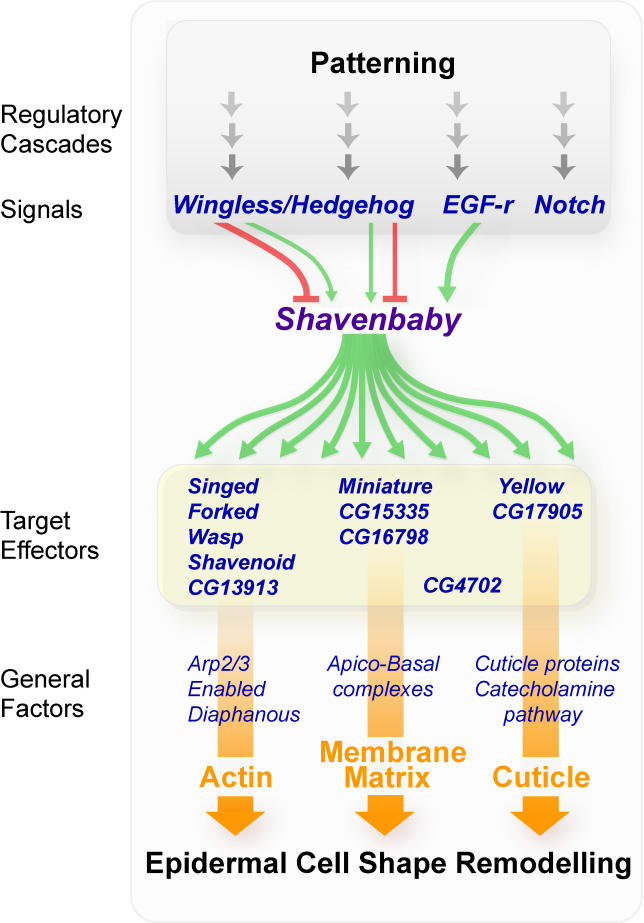
It is well established that developmental programs act during embryogenesis to determine animal morphogenesis. How these developmental cues produce specific cell shape during morphogenesis, however, has remained elusive. We addressed this question by studying the morphological differentiation of the Drosophila epidermis, governed by a well-known circuit of regulators leading to a stereotyped pattern of smooth cells and cells forming actin-rich extensions (trichomes). It was shown that the transcription factor Shavenbaby plays a pivotal role in the formation of trichomes and underlies all examined cases of the evolutionary diversification of their pattern. To gain insight into the mechanisms of morphological differentiation, we sought to identify shavenbaby's downstream targets. We show here that Shavenbaby controls epidermal cell shape, through the transcriptional activation of different classes of cellular effectors, directly contributing to the organization of actin filaments, regulation of the extracellular matrix, and modification of the cuticle. Individual inactivation of shavenbaby's targets produces distinct trichome defects and only their simultaneous inactivation prevent trichome formation. Our data show that shavenbaby governs an evolutionarily conserved developmental module consisting of a set of genes collectively responsible for trichome formation, shedding new light on molecular mechanisms acting during morphogenesis and the way they can influence evolution of animal forms.
发育程序在胚胎发生过程中发挥作用以决定动物形态发生,这一点已得到充分证实。然而,这些发育线索在形态发生过程中如何产生特定的细胞形状,仍然难以捉摸。我们通过研究果蝇表皮的形态分化来解决这个问题,果蝇表皮的形态分化受一个著名的调控回路控制,该回路导致形成光滑细胞和形成富含肌动蛋白的延伸结构(毛状体)的细胞的定型模式。研究表明,转录因子无毛宝宝在毛状体的形成中起关键作用,并且是其模式进化多样化的所有已研究案例的基础。为了深入了解形态分化的机制,我们试图鉴定无毛宝宝的下游靶点。我们在此表明,无毛宝宝通过转录激活不同类别的细胞效应器来控制表皮细胞形状,这些效应器直接有助于肌动蛋白丝的组织、细胞外基质的调节以及角质层的修饰。单独使无毛宝宝的靶点失活会产生不同的毛状体缺陷,只有它们同时失活才能阻止毛状体形成。我们的数据表明,无毛宝宝控制着一个进化上保守的发育模块,该模块由一组共同负责毛状体形成的基因组成,为形态发生过程中起作用的分子机制及其影响动物形态进化的方式提供了新的线索。