Heyer Wolf-Dietrich, Li Xuan, Rolfsmeier Michael, Zhang Xiao-Ping
Sections of Microbiology, University of California Davis, CA 95616-8665, USA.
Nucleic Acids Res. 2006;34(15):4115-25. doi: 10.1093/nar/gkl481. Epub 2006 Aug 25.
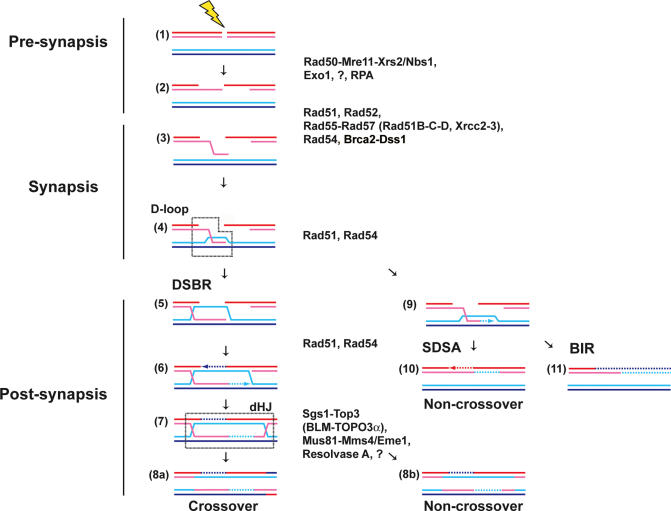
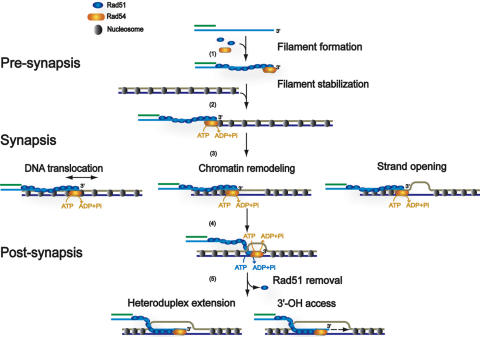
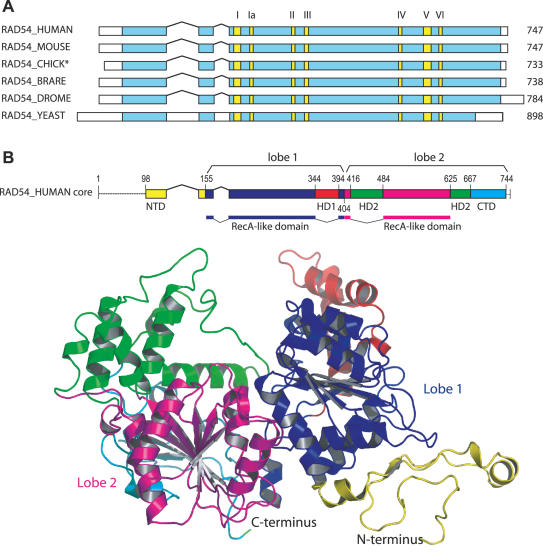
Homologous recombination (HR) is a ubiquitous cellular pathway that mediates transfer of genetic information between homologous or near homologous (homeologous) DNA sequences. During meiosis it ensures proper chromosome segregation in the first division. Moreover, HR is critical for the tolerance and repair of DNA damage, as well as in the recovery of stalled and broken replication forks. Together these functions preserve genomic stability and assure high fidelity transmission of the genetic material in the mitotic and meiotic cell divisions. This review will focus on the Rad54 protein, a member of the Snf2-family of SF2 helicases, which translocates on dsDNA but does not display strand displacement activity typical for a helicase. A wealth of genetic, cytological, biochemical and structural data suggests that Rad54 is a core factor of HR, possibly acting at multiple stages during HR in concert with the central homologous pairing protein Rad51.
同源重组(HR)是一种普遍存在的细胞途径,它介导同源或近乎同源(同祖异源)DNA序列之间的遗传信息转移。在减数分裂过程中,它确保第一次分裂时染色体的正确分离。此外,同源重组对于DNA损伤的耐受性和修复以及停滞和断裂复制叉的恢复至关重要。这些功能共同维持了基因组的稳定性,并确保了遗传物质在有丝分裂和减数分裂细胞分裂中的高保真传递。本综述将聚焦于Rad54蛋白,它是SF2解旋酶Snf2家族的成员,能在双链DNA上移位,但不具有解旋酶典型的链置换活性。大量的遗传、细胞学、生化和结构数据表明,Rad54是同源重组的核心因子,可能在同源重组的多个阶段与核心同源配对蛋白Rad51协同作用。