Chérif-Zahar B, Bloy C, Le Van Kim C, Blanchard D, Bailly P, Hermand P, Salmon C, Cartron J P, Colin Y
Institut National de la Santé et de la Recherche Médicale Unité U76, Institut National de Transfusion Sanguine, Paris, France.
Proc Natl Acad Sci U S A. 1990 Aug;87(16):6243-7. doi: 10.1073/pnas.87.16.6243.
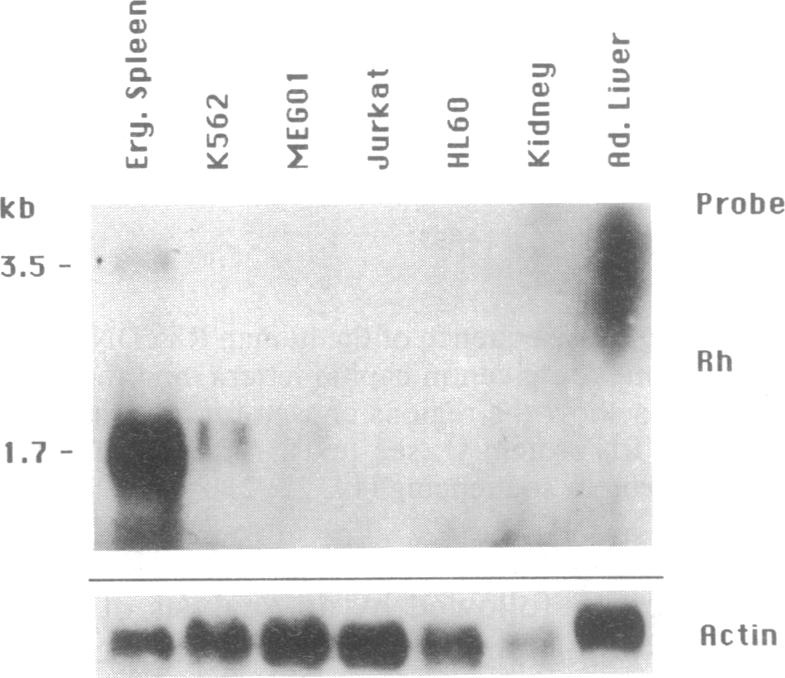
cDNA clones encoding a human blood group Rh polypeptide were isolated from a human bone marrow cDNA library by using a polymerase chain reaction-amplified DNA fragment encoding the known common N-terminal region of the Rh proteins. The entire primary structure of the Rh polypeptide has been deduced from the nucleotide sequence of a 1384-base-pair-long cDNA clone. Translation of the open reading frame indicates that the Rh protein is composed of 417 amino acids, including the initiator methionine, which is removed in the mature protein, lacks a cleavable N-terminal sequence, and has no consensus site for potential N-glycosylation. The predicted molecular mass of the protein is 45,500, while that estimated for the Rh protein analyzed in NaDodSO4/polyacrylamide gels is in the range of 30,000-32,000. These findings suggest either that the hydrophobic Rh protein behaves abnormally on NaDodSO4 gels or that the Rh mRNA may encode a precursor protein, which is further matured by a proteolytic cleavage of the C-terminal region of the polypeptide. Hydropathy analysis and secondary structure predictions suggest the presence of 13 membrane-spanning domains, indicating that the Rh polypeptide is highly hydrophobic and deeply buried within the phospholipid bilayer. In RNA blot-hybridization (Northern) analysis, the Rh cDNA probe detects a major 1.7-kilobase and a minor 3.5-kilobase mRNA species in adult erythroblasts, fetal liver, and erythroid (K562, HEL) and megakaryocytic (MEG01) leukemic cell lines, but not in adult liver and kidney tissues or lymphoid (Jurkat) and promyelocytic (HL60) cell lines. These results suggest that the expression of the Rh gene(s) might be restricted to tissues or cell lines expressing erythroid characters.
通过使用聚合酶链反应扩增的、编码Rh蛋白已知常见N端区域的DNA片段,从人骨髓cDNA文库中分离出编码人血型Rh多肽的cDNA克隆。Rh多肽的完整一级结构已从一个1384碱基对长的cDNA克隆的核苷酸序列推导得出。开放阅读框的翻译表明,Rh蛋白由417个氨基酸组成,包括起始甲硫氨酸,该甲硫氨酸在成熟蛋白中被去除,缺乏可裂解的N端序列,且没有潜在N糖基化的共有位点。该蛋白的预测分子量为45,500,而在十二烷基硫酸钠/聚丙烯酰胺凝胶中分析的Rh蛋白的估计分子量在30,000 - 32,000范围内。这些发现表明,要么是疏水性的Rh蛋白在十二烷基硫酸钠凝胶上行为异常,要么是Rh mRNA可能编码一种前体蛋白,该前体蛋白通过多肽C端区域的蛋白水解切割进一步成熟。亲水性分析和二级结构预测表明存在13个跨膜结构域,这表明Rh多肽高度疏水且深埋在磷脂双分子层中。在RNA印迹杂交(Northern)分析中,Rh cDNA探针在成人成红细胞、胎儿肝脏以及红系(K562、HEL)和巨核细胞系(MEG01)白血病细胞系中检测到一个主要的1.7千碱基和一个次要的3.5千碱基的mRNA种类,但在成人肝脏和肾脏组织或淋巴系(Jurkat)和早幼粒细胞系(HL60)细胞系中未检测到。这些结果表明,Rh基因的表达可能仅限于表达红系特征的组织或细胞系。