Spinsanti Giacomo, Panti Cristina, Lazzeri Elisa, Marsili Letizia, Casini Silvia, Frati Francesco, Fossi Cristina Maria
Evolutionary Biology Department, University of Siena, Siena, Italy.
BMC Mol Biol. 2006 Sep 19;7:32. doi: 10.1186/1471-2199-7-32.
Odontocete cetaceans occupy the top position of the marine food-web and are particularly sensitive to the bioaccumulation of lipophilic contaminants. The effects of environmental pollution on these species are highly debated and various ecotoxicological studies have addressed the impact of xenobiotic compounds on marine mammals, raising conservational concerns. Despite its sensitivity, quantitative real-time PCR (qRT-PCR) has never been used to quantify gene induction caused by exposure of cetaceans to contaminants. A limitation for the application of qRT-PCR is the need for appropriate reference genes which allow the correct quantification of gene expression. A systematic evaluation of potential reference genes in cetacean skin biopsies is presented, in order to validate future qRT-PCR studies aiming at using the expression of selected genes as non-lethal biomarkers.
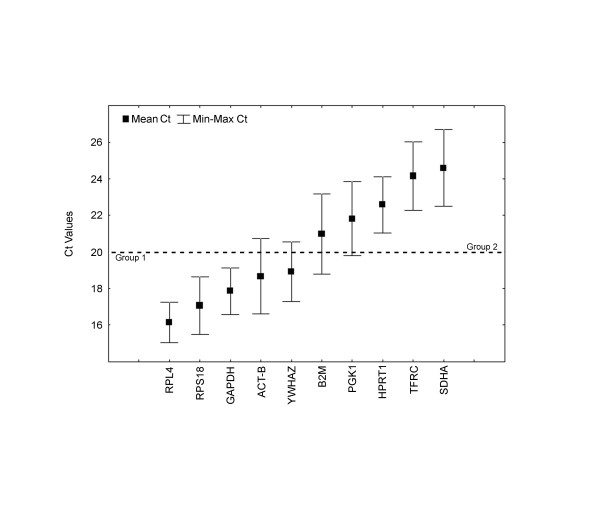
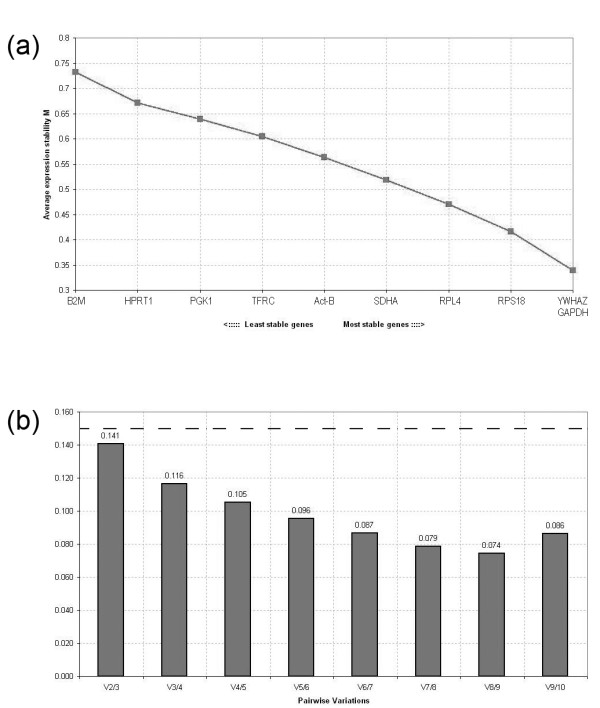
Ten commonly used housekeeping genes (HKGs) were partially sequenced in the striped dolphin (Stenella coeruleoalba) and, for each gene, PCR primer pairs were specifically designed and tested in qRT-PCR assays. The expression of these potential control genes was examined in 30 striped dolphin skin biopsy samples, obtained from specimens sampled in the north-western Mediterranean Sea. The stability of selected control genes was determined using three different specific VBA applets (geNorm, NormFinder and BestKeeper) which produce highly comparable results. Glyceraldehyde-3P-dehydrogenase (GAPDH) and tyrosine 3-monooxygenase (YWHAZ) always rank as the two most stably expressed HKGs according to the analysis with geNorm and Normfinder, and are defined as optimal control genes by BestKepeer. Ribosomal protein L4 (RPL4) and S18 (RPS18) also exhibit a remarkable stability of their expression levels. On the other hand, transferrin receptor (TFRC), phosphoglycerate kinase 1 (PGK1), hypoxanthine ribosyltransferase (HPRT1) and beta-2-microglobin (B2M) show variable expression among the studied samples and appear as less suitable reference genes for data normalization.
In this work, we have provided essential background information for the selection of control genes in qRT-PCR studies of cetacean skin biopsies, as a molecular technique to investigate ecotoxicological hazard in marine mammals. Of 10 HKGs tested, those encoding for YWHAZ and GAPDH appear as the most reliable control genes for the normalization of qRT-PCR data in the analysis of striped dolphin skin biopsies. Potentially useful reference genes are also those encoding for ribosomal proteins L4 and S18.
齿鲸类鲸目动物处于海洋食物网的顶端,对亲脂性污染物的生物累积尤为敏感。环境污染对这些物种的影响备受争议,各种生态毒理学研究探讨了外源化合物对海洋哺乳动物的影响,引发了保护方面的担忧。尽管具有敏感性,但定量实时聚合酶链反应(qRT-PCR)从未被用于量化鲸类动物接触污染物所导致的基因诱导。qRT-PCR应用的一个限制是需要合适的内参基因,以实现基因表达的正确定量。本文对鲸类皮肤活检样本中的潜在内参基因进行了系统评估,以验证未来旨在将选定基因的表达用作非致死生物标志物的qRT-PCR研究。
在条纹原海豚(Stenella coeruleoalba)中对10个常用管家基因(HKGs)进行了部分测序,并针对每个基因专门设计了PCR引物对,并在qRT-PCR分析中进行了测试。在从地中海西北部采集的30份条纹原海豚皮肤活检样本中检测了这些潜在对照基因的表达。使用三种不同的特定VBA小程序(geNorm、NormFinder和BestKeeper)确定选定对照基因的稳定性,这些小程序产生的结果具有高度可比性。根据geNorm和Normfinder的分析,甘油醛-3-磷酸脱氢酶(GAPDH)和酪氨酸3-单加氧酶(YWHAZ)始终是两个表达最稳定的HKGs,并被BestKepeer定义为最佳对照基因。核糖体蛋白L4(RPL4)和S18(RPS18)的表达水平也表现出显著的稳定性。另一方面,转铁蛋白受体(TFRC)、磷酸甘油酸激酶1(PGK1)、次黄嘌呤核糖基转移酶(HPRT1)和β-2-微球蛋白(B2M)在所研究的样本中表现出可变表达,似乎不太适合作为数据标准化的内参基因。
在这项工作中,我们为鲸类皮肤活检的qRT-PCR研究中选择对照基因提供了重要的背景信息,qRT-PCR是一种用于研究海洋哺乳动物生态毒理学危害的分子技术。在所测试的10个HKGs中,编码YWHAZ和GAPDH的基因似乎是条纹原海豚皮肤活检分析中qRT-PCR数据标准化最可靠的对照基因。编码核糖体蛋白L4和S18的基因也是潜在有用的内参基因。