Rijkers G T, Griffioen A W, Zegers B J, Cambier J C
Department of Immunology, University Hospital for Children and Youth Het Wilhelmina Kinderziekenhuis, Utrecht, The Netherlands.
Proc Natl Acad Sci U S A. 1990 Nov;87(22):8766-70. doi: 10.1073/pnas.87.22.8766.
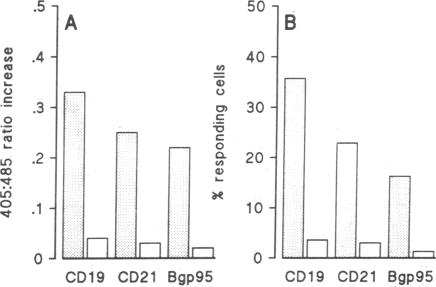
We have examined the ability of membrane immunoglobulin-binding ligands to desensitize several human B-cell surface molecules that normally transduce signals leading to Ca2+ mobilization. Ligation of membrane IgM or IgD leads to heterologous desensitization of the reciprocal receptor in Epstein-Barr virus-transformed B-cell lines and peripheral blood B cells, as evidenced by a failure of cells to mobilize in response to receptor ligation. Under these conditions CD19, CD21, and B-cell gp95 ligation also did not lead to normal Ca2+ mobilization, indicating that these transducers are also desensitized. The desensitization does not reflect receptor modulation from the cell surface or reduced accessibility to ligand and is long lived, lasting greater than 16 hr. Finally, data that indicate that desensitized cells remain responsive to the G protein activating agent AIF4-, as measured by Ca2+ mobilization, suggest that desensitization reflects uncoupling of these receptors from G proteins that are intermediaries in their transduction of signals. We hypothesize that the molecular target of desensitization may be a recently described membrane immunoglobulin-associated and inducibly tyrosine-phosphorylated protein complex that may function as a master transducer in B cells, analogous to CD3 in T cells.
我们研究了膜免疫球蛋白结合配体使几种通常能转导导致钙离子动员信号的人B细胞表面分子脱敏的能力。膜IgM或IgD的连接导致爱泼斯坦-巴尔病毒转化的B细胞系和外周血B细胞中相互受体的异源脱敏,这可通过细胞在受体连接时未能动员钙离子来证明。在这些条件下,CD19、CD21和B细胞gp95的连接也不会导致正常的钙离子动员,表明这些转导分子也被脱敏。这种脱敏并不反映受体从细胞表面的调节或配体可及性的降低,并且持续时间长,超过16小时。最后,通过钙离子动员测量的数据表明,脱敏细胞对G蛋白激活剂AIF4-仍有反应,这表明脱敏反映了这些受体与作为信号转导中介的G蛋白的解偶联。我们假设脱敏的分子靶点可能是最近描述的膜免疫球蛋白相关且可诱导酪氨酸磷酸化的蛋白复合物,它可能在B细胞中起主转导分子的作用,类似于T细胞中的CD3。