Charles-Edwards Elizabeth M, deSouza Nandita M
Cancer Research UK Clinical Magnetic Resonance Research Group, Institute of Cancer Research and Royal Marsden NHS Foundation Trust, Sutton, Surrey, UK.
Cancer Imaging. 2006 Sep 13;6(1):135-43. doi: 10.1102/1470-7330.2006.0021.
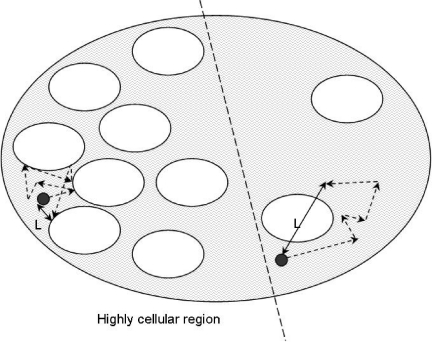
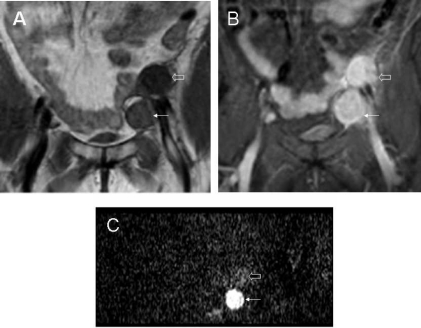
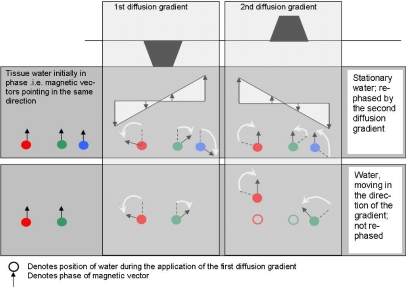
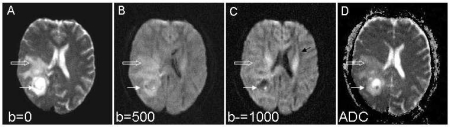
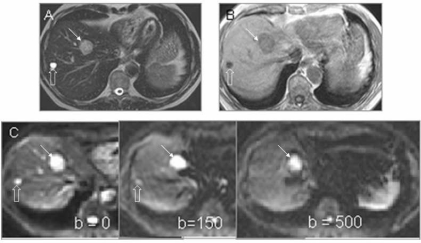
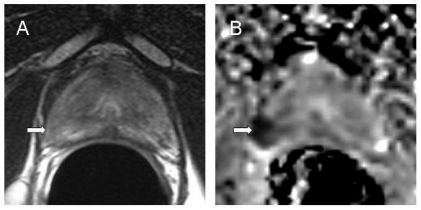
Diffusion-weighted magnetic resonance imaging (DW-MRI) provides image contrast through measurement of the diffusion properties of water within tissues. Application of diffusion sensitising gradients to the MR pulse sequence allows water molecular displacement over distances of 1-20 microm to be recognised. Diffusion can be predominantly unidirectional (anisotropic) or not (isotropic). Combining images obtained with different amounts of diffusion weighting provides an apparent diffusion coefficient (ADC) map. In cancer imaging DW-MRI has been used to distinguish brain tumours from peritumoural oedema. It is also increasingly exploited to differentiate benign and malignant lesions in liver, breast and prostate where increased cellularity of malignant lesions restricts water motion in a reduced extracellular space. It is proving valuable in monitoring treatment where changes due to cell swelling and apoptosis are measurable as changes in ADC at an earlier stage than subsequent conventional radiological response indicators.
扩散加权磁共振成像(DW-MRI)通过测量组织内水的扩散特性来提供图像对比度。在MR脉冲序列中应用扩散敏感梯度可识别水分子在1-20微米距离上的位移。扩散可以主要是单向的(各向异性)或不是(各向同性)。将用不同扩散加权量获得的图像相结合可提供表观扩散系数(ADC)图。在癌症成像中,DW-MRI已被用于区分脑肿瘤与瘤周水肿。它也越来越多地被用于区分肝脏、乳腺和前列腺中的良性和恶性病变,其中恶性病变细胞增多限制了细胞外空间减少时的水运动。事实证明,它在监测治疗方面很有价值,因为与随后的传统放射学反应指标相比,细胞肿胀和凋亡引起的变化在更早阶段就可作为ADC的变化进行测量。