Urakov Valery N, Valouev Igor A, Kochneva-Pervukhova Natalia V, Packeiser Anna N, Vishnevsky Alexander Yu, Glebov Oleg O, Smirnov Vladimir N, Ter-Avanesyan Michael D
Institute of Experimental Cardiology, Cardiology Research Center, Moscow, 121552, Russia.
BMC Mol Biol. 2006 Oct 11;7:34. doi: 10.1186/1471-2199-7-34.
Termination of translation in eukaryotes requires two release factors, eRF1, which recognizes all three nonsense codons and facilitates release of the nascent polypeptide chain, and eRF3 stimulating translation termination in a GTP-depended manner. eRF3 from different organisms possess a highly conservative C region (eRF3C), which is responsible for the function in translation termination, and almost always contain the N-terminal extension, which is inessential and vary both in structure and length. In the yeast Saccharomyces cerevisiae the N-terminal region of eRF3 is responsible for conversion of this protein into the aggregated and functionally inactive prion form.
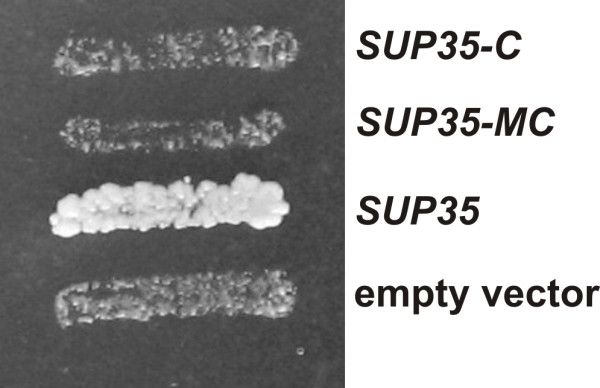
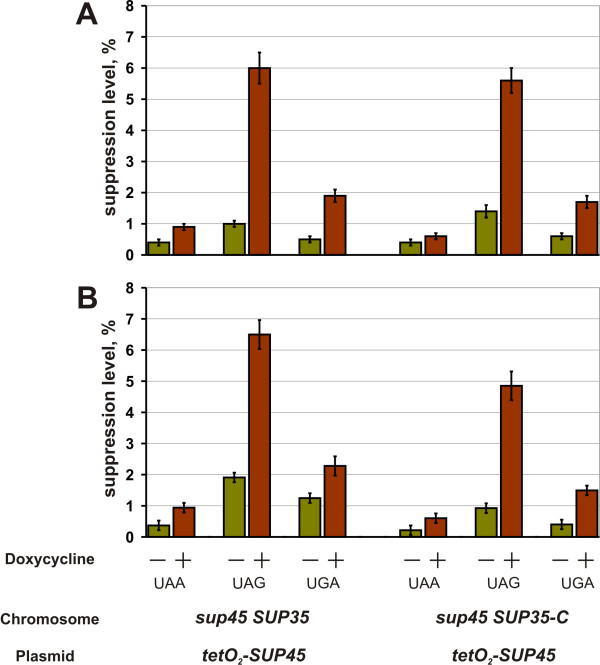
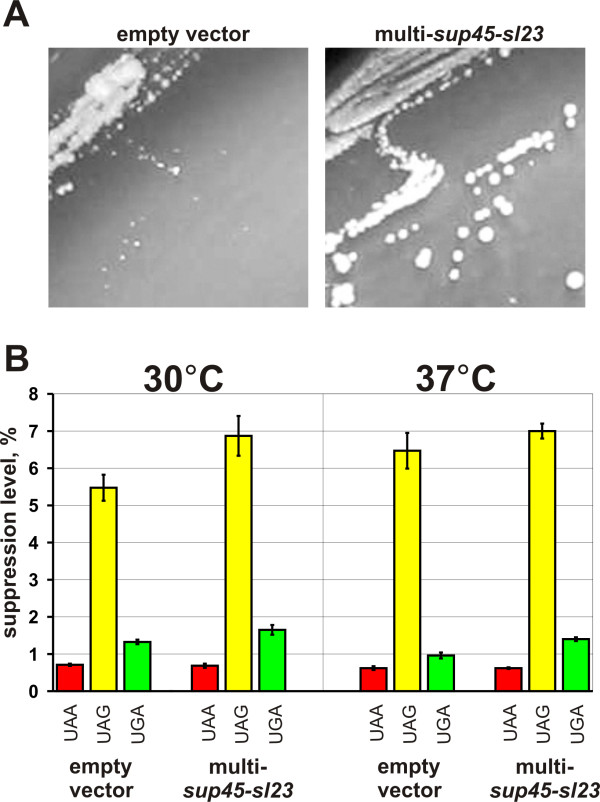
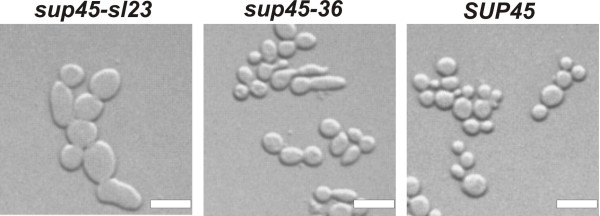
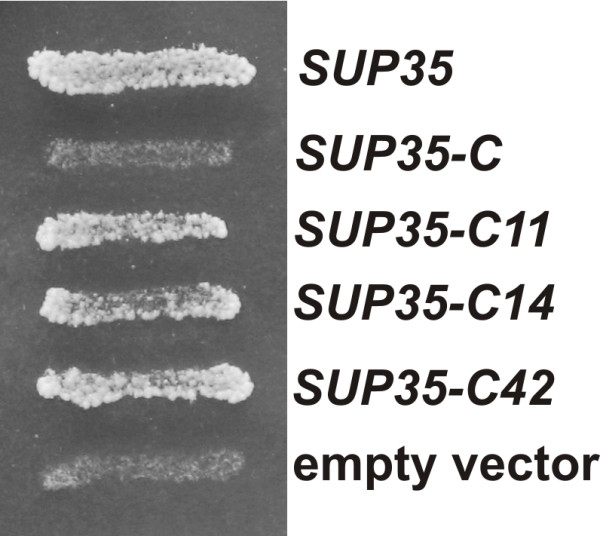
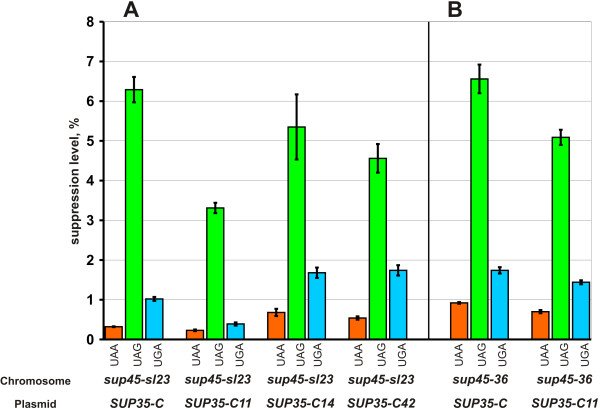
Here, we examined functional importance of the N-terminal region of a non-prion form of yeast eRF3. The screen for mutations which are lethal in combination with the SUP35-C allele encoding eRF3C revealed the sup45 mutations which alter the N-terminal domain of eRF1 and increase nonsense codon readthrough. However, further analysis showed that synthetic lethality was not caused by the increased levels of nonsense codon readthrough. Dominant mutations in SUP35-C were obtained and characterized, which remove its synthetic lethality with the identified sup45 mutations, thus indicating that synthetic lethality was not due to a disruption of interaction with proteins that bind to this eRF3 region.
These and other data demonstrate that the N-terminal region of eRF3 is involved both in modulation of the efficiency of translation termination and functioning of the eRF1/eRF3 complex outside of translation termination.
真核生物中的翻译终止需要两种释放因子,即eRF1,它识别所有三种无义密码子并促进新生多肽链的释放;以及eRF3,它以依赖GTP的方式刺激翻译终止。来自不同生物体的eRF3具有高度保守的C区域(eRF3C),该区域负责翻译终止功能,并且几乎总是包含N端延伸,该延伸是非必需的,在结构和长度上都有所不同。在酿酒酵母中,eRF3的N端区域负责将该蛋白转化为聚集的、功能无活性的朊病毒形式。
在这里,我们研究了酵母eRF3非朊病毒形式的N端区域的功能重要性。对与编码eRF3C的SUP35-C等位基因组合致死的突变进行筛选,发现了sup45突变,这些突变改变了eRF1的N端结构域并增加了无义密码子通读。然而,进一步分析表明,合成致死性不是由无义密码子通读水平的增加引起的。获得并表征了SUP35-C中的显性突变,这些突变消除了其与已鉴定的sup45突变的合成致死性,从而表明合成致死性不是由于与结合该eRF3区域的蛋白质相互作用的破坏。
这些以及其他数据表明,eRF3的N端区域既参与翻译终止效率的调节,也参与翻译终止之外的eRF1/eRF3复合物的功能。