Ionis Pharmaceuticals, Carlsbad, California.
Nucleic Acid Ther. 2019 Aug;29(4):175-186. doi: 10.1089/nat.2019.0779. Epub 2019 May 9.
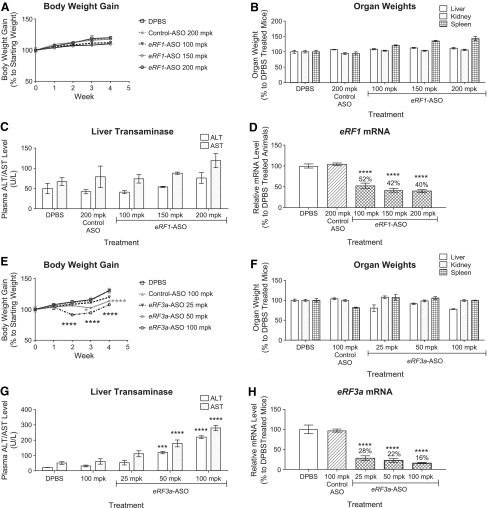
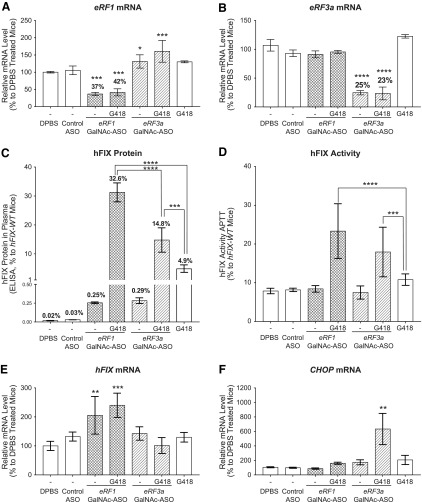
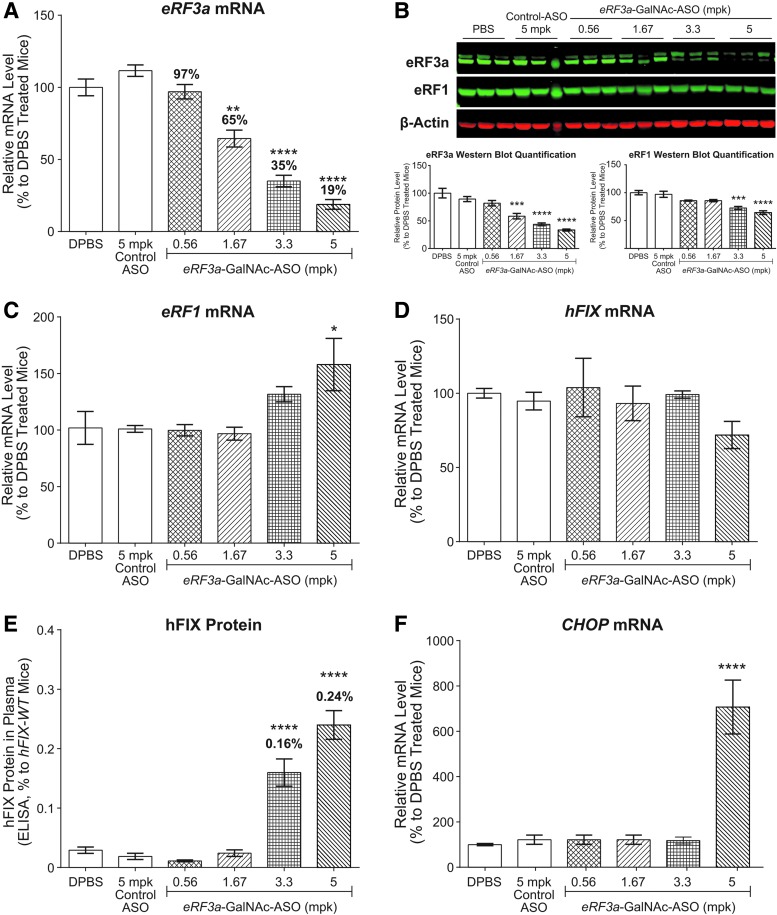
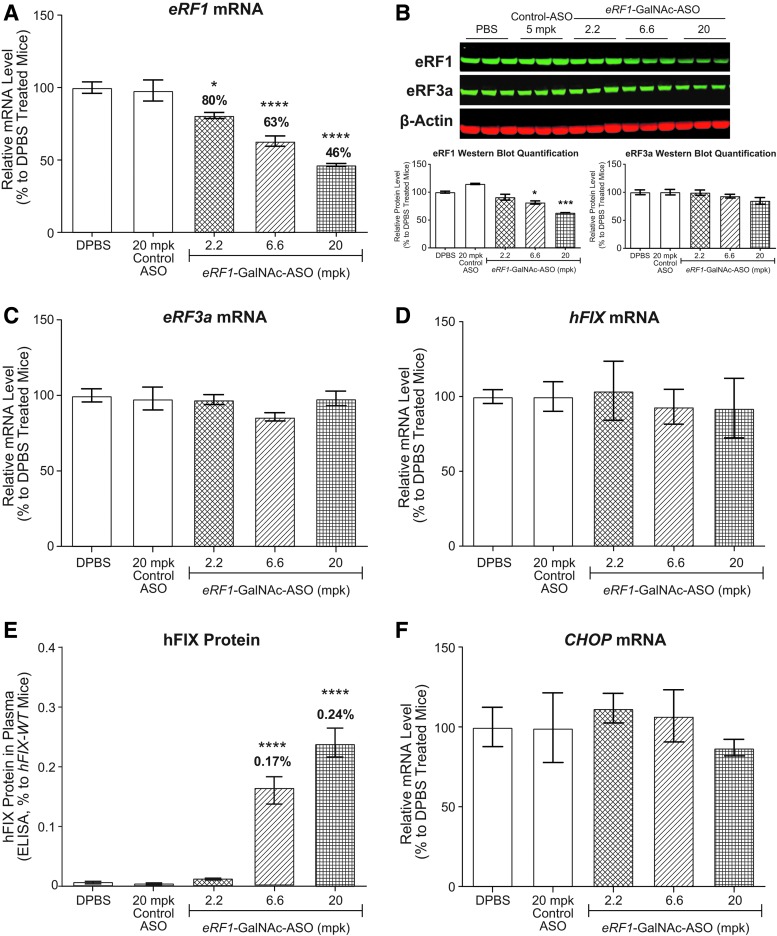
Efforts to develop treatments for diseases caused by nonsense mutations have focused on identification of small molecules that promote translational read-through of messenger RNAs (mRNAs) harboring nonsense stop codons to produce full-length proteins. However, to date, no small molecule read-through drug has received FDA approval, probably because of a lack of balance between efficacy and safety. Depletion of translation termination factors eukaryotic release factor () 1 and in cells was shown to promote translational read-through of a luciferase reporter gene harboring a nonsense mutation. In this study, we identified antisense oligonucleotides (ASOs) targeting translation termination factors and determined if ASO-mediated depletion of these factors could be a potentially effective and safe therapeutic approach for diseases caused by nonsense mutations. We found that ASO-mediated reduction of either or to 30%-40% of normal levels in the mouse liver is well tolerated. Hemophilia mice that express a mutant allele of human coagulation factor IX (FIX) containing nonsense mutation R338X were treated with - or -ASO. We found that although - or -ASO alone only elicited a moderate read-through effect on mRNA, both worked in synergy with geneticin, a small molecule read-through drug, demonstrating significantly increased production of functional full-length hFIX protein to levels that would rescue disease phenotypes in these mice. Overall our results indicate that modulating the translation termination pathway in the liver by ASOs may provide a novel approach to improving the efficacy of small molecule read-through drugs to treat human genetic diseases caused by nonsense mutations.
开发用于治疗无义突变引起的疾病的治疗方法的努力集中在鉴定能够促进携带无义终止密码子的信使 RNA(mRNA)翻译通读以产生全长蛋白质的小分子。然而,迄今为止,没有一种小分子通读药物获得 FDA 批准,这可能是因为疗效和安全性之间缺乏平衡。已经表明,细胞中真核释放因子(eRF1 和 eRF3)的消耗可促进携带无义突变的荧光素酶报告基因的翻译通读。在这项研究中,我们鉴定了针对翻译终止因子的反义寡核苷酸(ASO),并确定 ASO 介导的这些因子的耗竭是否可能成为治疗无义突变引起的疾病的有效且安全的治疗方法。我们发现,在小鼠肝脏中,ASO 介导的 或 减少至正常水平的 30%-40%是可以耐受的。表达含有无义突变 R338X 的人凝血因子 IX (FIX)突变等位基因的血友病小鼠用 - 或 -ASO 治疗。我们发现,尽管 - 或 -ASO 单独仅对 mRNA 产生适度的通读效应,但两者均与遗传霉素(一种小分子通读药物)协同作用,显著增加功能性全长 hFIX 蛋白的产生,使其达到挽救这些小鼠疾病表型的水平。总体而言,我们的结果表明,通过 ASO 调节肝脏中的翻译终止途径可能为提高小分子通读药物治疗无义突变引起的人类遗传疾病的疗效提供一种新方法。