School of Life Sciences, University of Warwick, Coventry, UK.
Mol Syst Biol. 2013;9:635. doi: 10.1038/msb.2012.73.
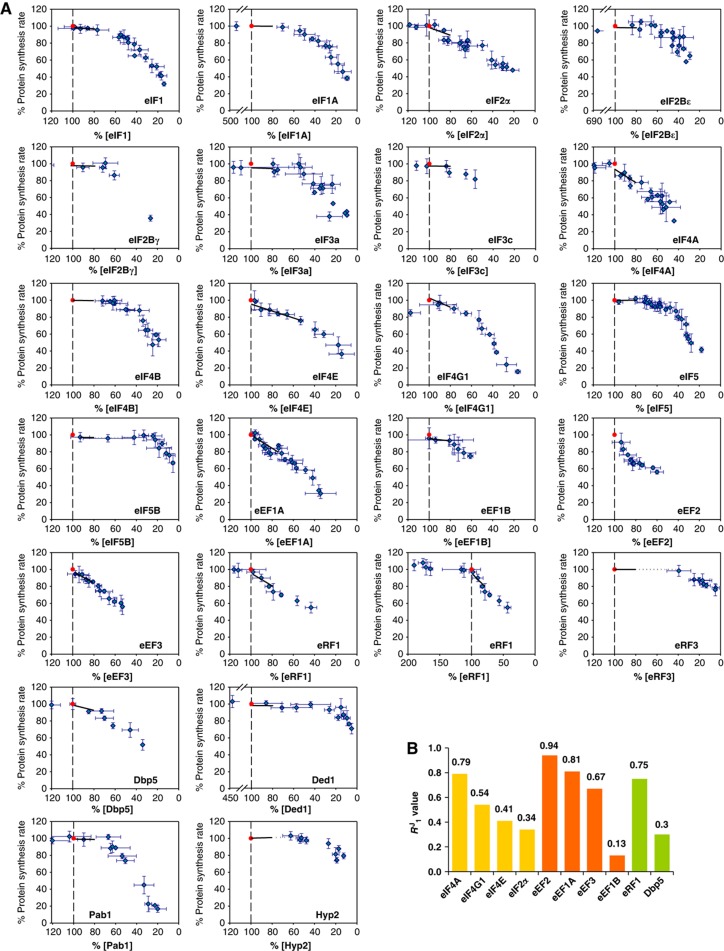
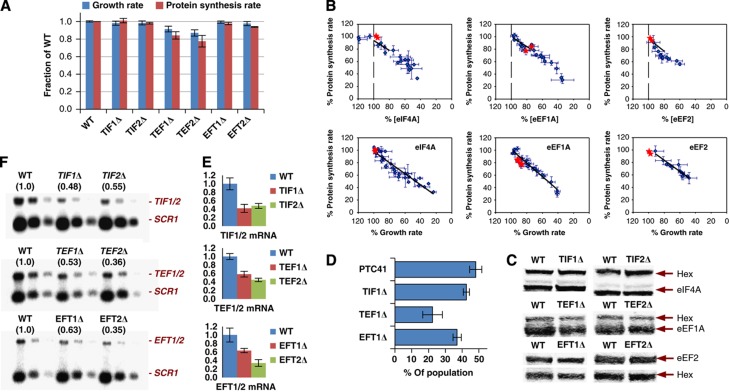
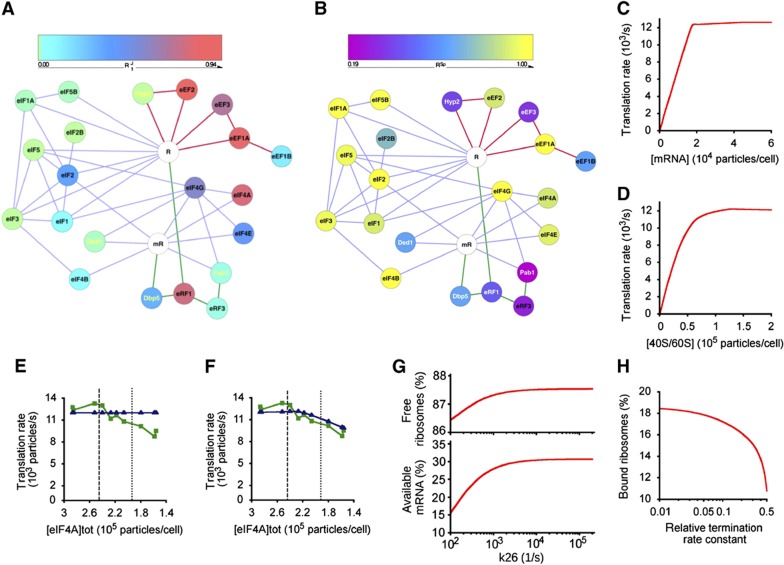
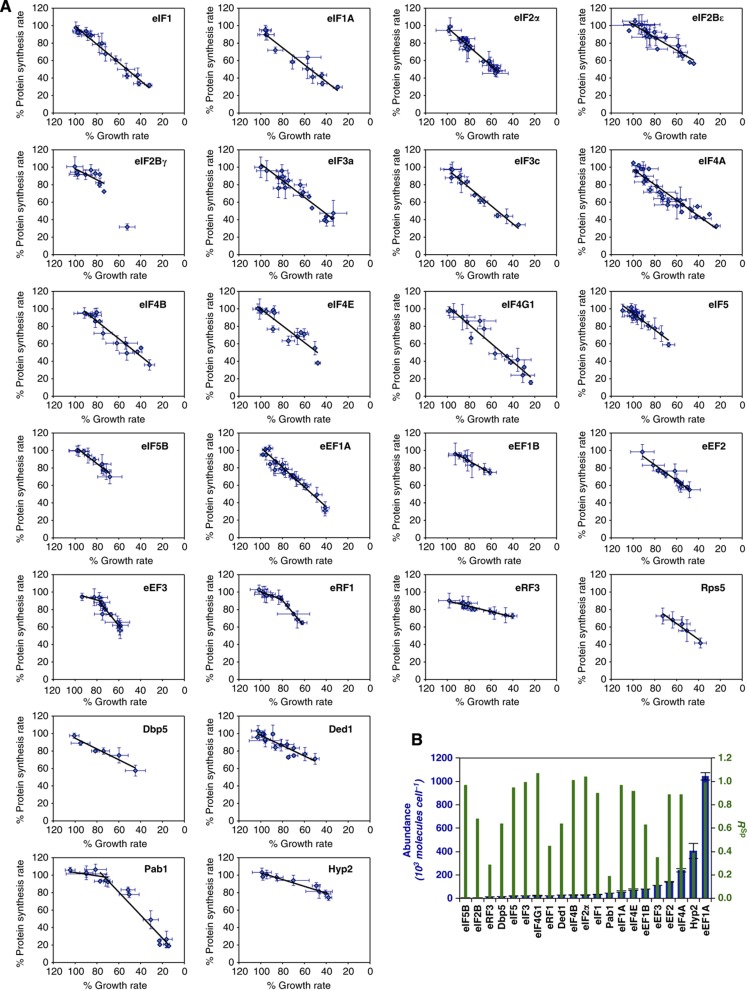
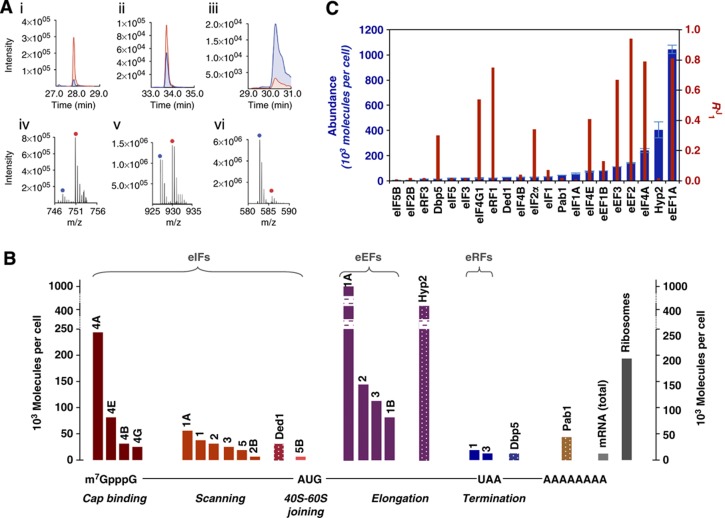
Rate control analysis defines the in vivo control map governing yeast protein synthesis and generates an extensively parameterized digital model of the translation pathway. Among other non-intuitive outcomes, translation demonstrates a high degree of functional modularity and comprises a non-stoichiometric combination of proteins manifesting functional convergence on a shared maximal translation rate. In exponentially growing cells, polypeptide elongation (eEF1A, eEF2, and eEF3) exerts the strongest control. The two other strong control points are recruitment of mRNA and tRNA(i) to the 40S ribosomal subunit (eIF4F and eIF2) and termination (eRF1; Dbp5). In contrast, factors that are found to promote mRNA scanning efficiency on a longer than-average 5'untranslated region (eIF1, eIF1A, Ded1, eIF2B, eIF3, and eIF5) exceed the levels required for maximal control. This is expected to allow the cell to minimize scanning transition times, particularly for longer 5'UTRs. The analysis reveals these and other collective adaptations of control shared across the factors, as well as features that reflect functional modularity and system robustness. Remarkably, gene duplication is implicated in the fine control of cellular protein synthesis.
速率控制分析定义了控制酵母蛋白质合成的体内控制图谱,并生成了一个广泛参数化的翻译途径数字模型。除了其他非直观的结果外,翻译表现出高度的功能模块化,并且包含表现出功能收敛的非化学计量组合的蛋白质,其共同特征是共享最大翻译速率。在指数生长的细胞中,多肽延伸(eEF1A、eEF2 和 eEF3)发挥最强的控制作用。另外两个强控制点是 mRNA 和 tRNA(i)招募到 40S 核糖体亚基(eIF4F 和 eIF2)和终止(eRF1;Dbp5)。相比之下,发现能够促进长于平均长度的 5'非翻译区(eIF1、eIF1A、Ded1、eIF2B、eIF3 和 eIF5)mRNA 扫描效率的因素超过了最大控制所需的水平。这有望使细胞最小化扫描转换时间,特别是对于更长的 5'UTR。该分析揭示了这些和其他因素共同的控制的集体适应性,以及反映功能模块化和系统鲁棒性的特征。值得注意的是,基因复制与细胞蛋白质合成的精细控制有关。