Fässler Caroline, Arrigoni Eva, Venema Koen, Hafner Valeria, Brouns Fred, Amadò Renato
Institute of Food Science and Nutrition, ETH Zurich, LFO D28 Schmelzbergstr. 9, 8092, Zürich, Switzerland.
Eur J Nutr. 2006 Dec;45(8):445-53. doi: 10.1007/s00394-006-0618-7. Epub 2006 Oct 11.
Resistant starch (RS) is known for potential health benefits in the human colon. To investigate these positive effects it is important to be able to predict the amount, and the structure of starch reaching the large intestine.
The aim of this study was to compare two different in vitro models simulating the digestibility of two RS containing preparations.
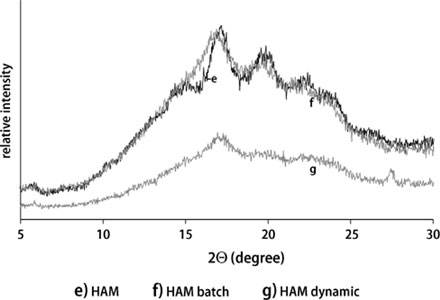
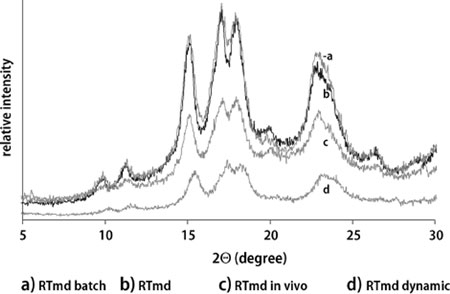
The substrates, high amylose maize (HAM) containing RS type 2, and retrograded long chain tapioca maltodextrins (RTmd) containing RS type 3 were in vitro digested using a batch and a dynamic model, respectively. Both preparations were characterized before and after digestion by using X-Ray and DSC, and by measuring their total starch, RS and protein contents.
Using both digestion models, 60-61 g/100 g of RTmd turned out to be indigestible, which is very well in accordance with 59 g/100 g found in vivo after feeding RTmd to ileostomy patients. In contrast, dynamic and batch in vitro digestion experiments using HAM as a substrate led to 58 g/100 g and 66 g/100 g RS recovery. The degradability of HAM is more affected by differences in experimental parameters compared to RTmd. The main variations between the two in vitro digestion methods are the enzyme preparations used, incubation times and mechanical stress exerted on the substrate. However, for both preparations dynamically digested fractions led to lower amounts of analytically RS and a lower crystallinity.
The two in vitro digestion methods used attacked the starch molecules differently, which influenced starch digestibility of HAM but not of RTmd.
抗性淀粉(RS)因其对人类结肠潜在的健康益处而闻名。为了研究这些积极作用,能够预测到达大肠的淀粉量和结构非常重要。
本研究的目的是比较两种不同的体外模型,以模拟两种含RS制剂的消化率。
分别使用批次模型和动态模型对底物进行体外消化,底物为含2型RS的高直链玉米(HAM)和含3型RS的回生长链木薯麦芽糊精(RTmd)。通过X射线和差示扫描量热法,并测量其总淀粉、RS和蛋白质含量,对两种制剂消化前后进行表征。
使用两种消化模型,结果表明60 - 61 g/100 g的RTmd是不可消化的,这与给回肠造口术患者喂食RTmd后在体内发现的59 g/100 g非常吻合。相比之下,以HAM为底物的动态和批次体外消化实验导致RS回收率分别为58 g/100 g和66 g/100 g。与RTmd相比,HAM的可降解性受实验参数差异的影响更大。两种体外消化方法之间的主要差异在于所使用的酶制剂、孵育时间以及施加在底物上的机械应力。然而,对于两种制剂,动态消化部分导致分析RS含量较低且结晶度较低。
所使用的两种体外消化方法对淀粉分子的攻击方式不同,这影响了HAM的淀粉消化率,但对RTmd没有影响。