Whalley Simon, McManus I C
Department of Psychology, University College London, Gower Street, London WC1E 6BT, UK.
BMC Pulm Med. 2006 Oct 13;6:25. doi: 10.1186/1471-2466-6-25.
Primary ciliary dyskinesia (PCD) is a chronic respiratory disease for which there is little psycho-social research and no qualitative studies of individuals living with the condition. A questionnaire-based survey in 2003 found evidence of stigmatisation in some individuals with PCD. Although the questionnaire had face and construct validity, stigmatisation was not cross-validated against interviews. The present study had the twin aims of carrying out a qualitative study of the adult patients living with PCD, and using a structured design to validate the questionnaire measure of stigma.
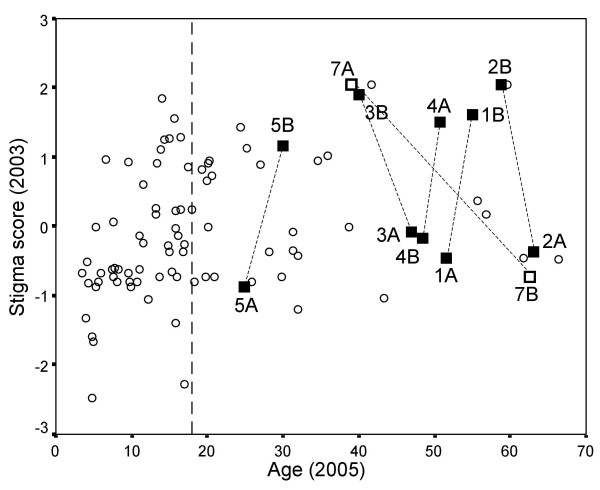
Interviews were carried out with six pairs of individuals with PCD, matched for sex, situs, and age, one with a high stigma score in 2003 and the other with a low stigma score. Depth-qualitative interviews were conducted by one author to explore themes surrounding the psycho-social impact of PCD using a grounded theory analysis. The interviewer was blind to the stigma scores of participants, and after the qualitative analysis was completed, the interviewer made an assessment of which member of each pair seemed the more stigmatised, after which the code was broken.
Interviews revealed a number of themes, including other people's knowledge of PCD, the sharing of knowledge about PCD, the concealment of symptoms of PCD, embarrassment at symptoms, changes of behaviour in response to PCD, mistrust of medical care, in particular in relation to problems in diagnosis, a mistrust of general practitioners who were seen as poorly informed, and the importance of expert care at tertiary referral centres. Although stigmatisation as such was rarely mentioned directly by respondents, when the interviewer's judgement on level of stigmatisation was correlated with stigma scores from 2003, it was found that the more stigmatised member had been correctly identified in all six pairs (p = .016).
Our results suggest that some people with PCD feel isolated through mistrust in medicine, and lack of knowledge surrounding PCD. Many responses to PCD can be explained in terms of stigmatisation, and in particular felt stigma. The correlation between questionnaire used several years previously, and the interviewer's judgements of stigmatisation suggest that the stigma questionnaire had both predictive validity and long-term stability. As in other chronic conditions, stigmatisation occurs only in some individuals with PCD, and the present study explores the basis of stigmatisation, and validate the questionnaire as a measure of difference in stigma.
原发性纤毛运动障碍(PCD)是一种慢性呼吸道疾病,针对该疾病的心理社会研究较少,且尚无对该疾病患者的定性研究。2003年的一项基于问卷的调查发现,一些PCD患者存在被污名化的迹象。尽管该问卷具有表面效度和结构效度,但污名化情况并未通过访谈进行交叉验证。本研究有两个目标,一是对成年PCD患者进行定性研究,二是采用结构化设计验证污名化的问卷测量方法。
对六对PCD患者进行访谈,这些患者在性别、内脏位置和年龄方面相互匹配,一对中一人在2003年的污名化得分较高,另一人得分较低。由一位作者进行深度定性访谈,采用扎根理论分析方法探讨围绕PCD心理社会影响的主题。访谈者对参与者的污名化得分不知情,在定性分析完成后,访谈者评估每对中的哪一位成员似乎更易被污名化,之后再揭开编码。
访谈揭示了一些主题,包括他人对PCD的了解、关于PCD的知识分享、PCD症状的隐瞒、对症状的尴尬、因PCD而产生的行为变化、对医疗护理的不信任,尤其是在诊断问题方面,对被认为信息不足的全科医生的不信任,以及三级转诊中心专家护理的重要性。尽管受访者很少直接提及污名化本身,但当访谈者对污名化程度的判断与2003年的污名化得分相关联时,发现所有六对中被污名化程度较高的成员都被正确识别(p = 0.016)。
我们的结果表明,一些PCD患者因对医学的不信任以及对PCD相关知识的缺乏而感到孤立。许多对PCD的反应可以用污名化来解释,尤其是感知到的污名。几年前使用的问卷与访谈者对污名化的判断之间的相关性表明,污名化问卷具有预测效度和长期稳定性。与其他慢性疾病一样,污名化仅发生在一些PCD患者中,本研究探讨了污名化的基础,并验证了该问卷作为污名差异测量工具的有效性。