Seidler Tristram G, Plotkin Joshua B
Natural Environment Research Council Centre for Population Biology, Imperial College, Ascot, Berkshire, United Kingdom.
PLoS Biol. 2006 Oct;4(11):e344. doi: 10.1371/journal.pbio.0040344.
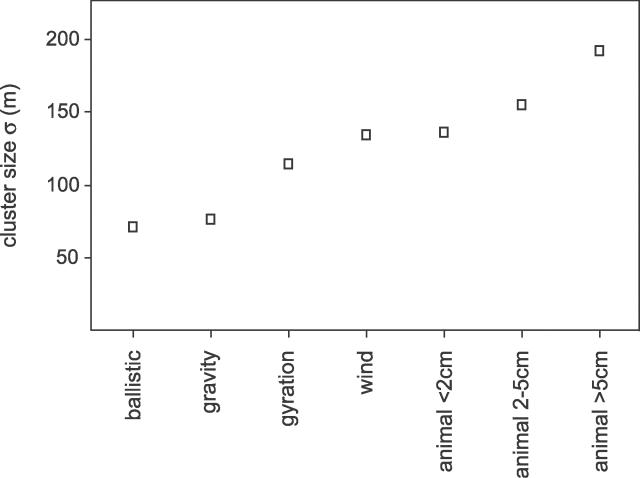
Theories of tropical tree diversity emphasize dispersal limitation as a potential mechanism for separating species in space and reducing competitive exclusion. We compared the dispersal morphologies, fruit sizes, and spatial distributions of 561 tree species within a fully mapped, 50-hectare plot of primary tropical forest in peninsular Malaysia. We demonstrate here that the extent and scale of conspecific spatial aggregation is correlated with the mode of seed dispersal. This relationship holds for saplings as well as for mature trees. Phylogenetically independent contrasts confirm that the relationship between dispersal and spatial pattern is significant even after controlling for common ancestry among species. We found the same qualitative results for a 50-hectare tropical forest plot in Panama. Our results provide broad empirical evidence for the importance of dispersal mode in establishing the long-term community structure of tropical forests.
热带树木多样性理论强调扩散限制是在空间上分离物种并减少竞争排斥的一种潜在机制。我们在马来西亚半岛一片绘制完整的50公顷原始热带森林样地内,比较了561种树木的扩散形态、果实大小和空间分布。我们在此证明,同种个体空间聚集的程度和规模与种子扩散模式相关。这种关系在幼树和成熟树木中均成立。系统发育独立对比分析证实,即使在控制了物种间的共同祖先因素后,扩散与空间格局之间的关系仍然显著。我们在巴拿马一片50公顷的热带森林样地中也得到了相同的定性结果。我们的研究结果为扩散模式在建立热带森林长期群落结构中的重要性提供了广泛的实证依据。