Hess David C, Lu Wenyun, Rabinowitz Joshua D, Botstein David
Lewis-Sigler Institute for Integrative Genomics, Princeton University, Princeton, New Jersey, USA.
PLoS Biol. 2006 Oct;4(11):e351. doi: 10.1371/journal.pbio.0040351.
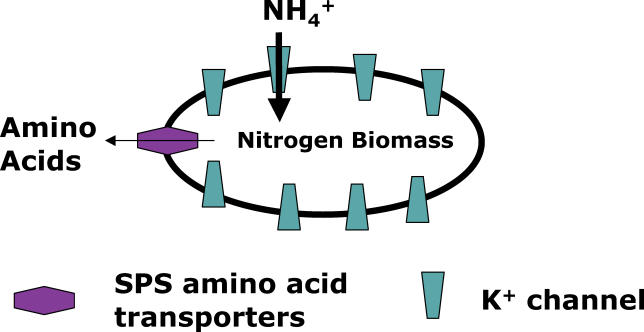
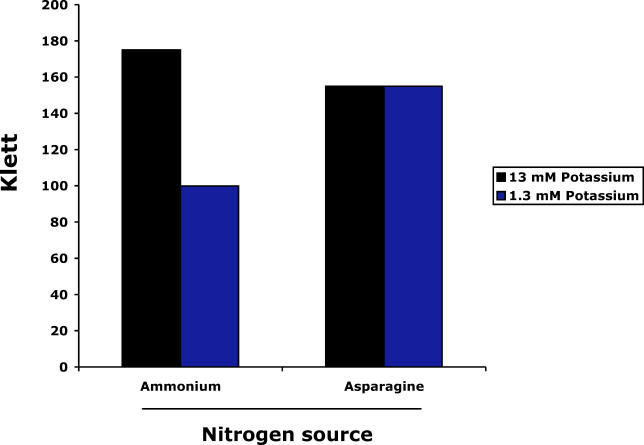
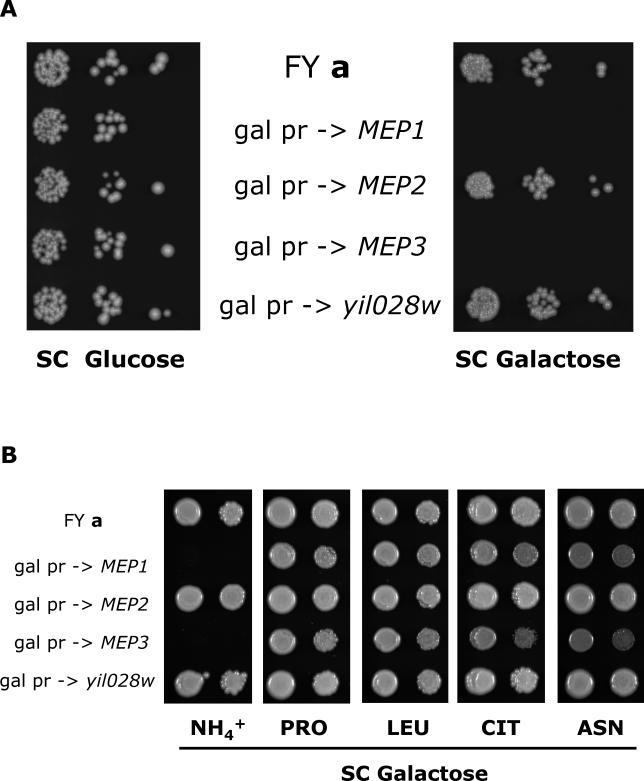
DNA microarray analysis of gene expression in steady-state chemostat cultures limited for potassium revealed a surprising connection between potassium and ammonium: potassium limits growth only when ammonium is the nitrogen source. Under potassium limitation, ammonium appears to be toxic for Saccharomyces cerevisiae. This ammonium toxicity, which appears to occur by leakage of ammonium through potassium channels, is recapitulated under high-potassium conditions by over-expression of ammonium transporters. Although ammonium toxicity is well established in metazoans, it has never been reported for yeast. To characterize the response to ammonium toxicity, we examined the filtrates of these cultures for compounds whose excretion might serve to detoxify the ammonium (such as urea in mammals). Using liquid chromatography-tandem mass spectrometry to assay for a wide array of metabolites, we detected excreted amino acids. The amounts of amino acids excreted increased in relation to the severity of growth impairment by ammonium, suggesting that amino acid excretion is used by yeast for ammonium detoxification.
对钾受限的恒化器稳态培养物中的基因表达进行DNA微阵列分析,揭示了钾与铵之间令人惊讶的联系:只有当铵作为氮源时,钾才会限制生长。在钾受限的情况下,铵对酿酒酵母似乎具有毒性。这种铵毒性似乎是由于铵通过钾通道泄漏而发生的,在高钾条件下通过过表达铵转运蛋白可重现这种毒性。虽然铵毒性在后生动物中已得到充分证实,但从未在酵母中报道过。为了表征对铵毒性的反应,我们检查了这些培养物的滤液中可能用于铵解毒的化合物(如哺乳动物中的尿素)。使用液相色谱-串联质谱法检测多种代谢物,我们检测到了排泄的氨基酸。排泄的氨基酸量随着铵对生长损害的严重程度而增加,这表明酵母利用氨基酸排泄来进行铵解毒。