Förstermann U, Pollock J S, Schmidt H H, Heller M, Murad F
Abbott Laboratories, Abbott Park, IL 60064.
Proc Natl Acad Sci U S A. 1991 Mar 1;88(5):1788-92. doi: 10.1073/pnas.88.5.1788.
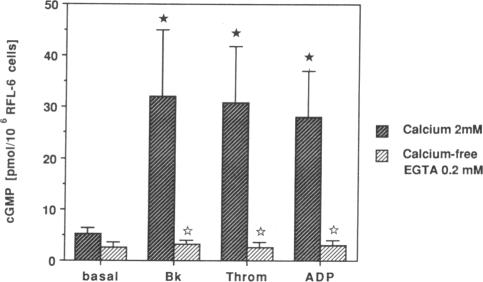
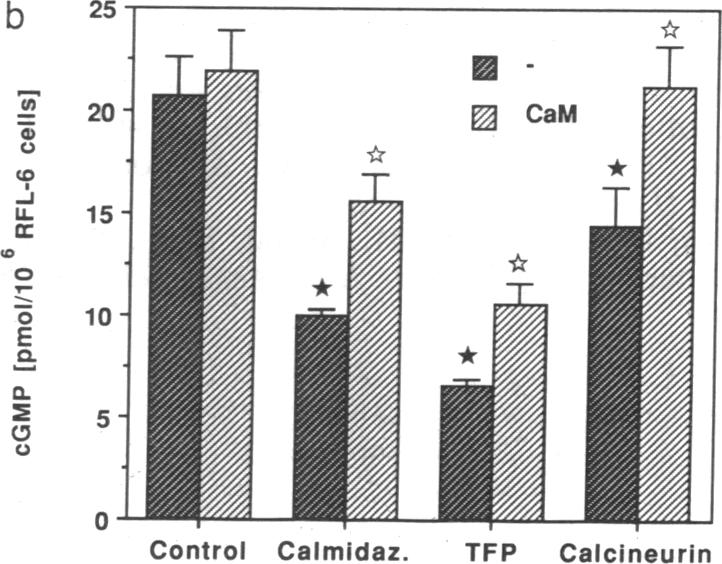
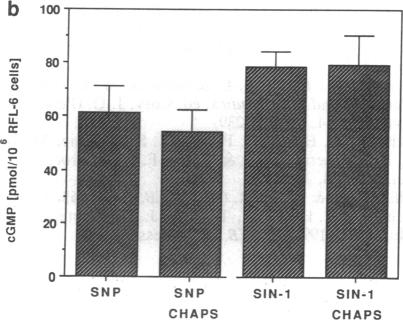
Endothelium-derived relaxing factor/nitric oxide (EDRF/NO) synthesized by bovine aortic endothelial cells and subcellular fractions thereof was assayed by its stimulating effect on soluble guanylyl cyclase of rat fetal lung fibroblasts (RFL-6 cells). The release of EDRF/NO by intact endothelial cells could be stimulated with bradykinin, thrombin, or ADP and was abolished in Ca2(+)-free medium. When subcellular fractions were analyzed, some EDRF/NO-synthesizing activity was found in the cytosolic fraction, but most of the activity was associated with the particulate fraction. Both enzyme activities required L-arginine and NADPH for EDRF/NO synthesis, both were inhibited by NG-nitro-L-arginine and NG-methyl-L-arginine, and hemoglobin or methylene blue abolished the effect of the EDRF/NO produced by both enzymes. Both enzymes were highly sensitive to Ca2+; the major increase in activity occurred between 100 and 500 nM free Ca2+. Exposure of the particulate enzyme activity to 1 M KCl removed 39% of the protein and reduced total activity by 46%, but the activity was restored when exogenous calmodulin (CaM) was added. Further KCl washes caused little further loss of protein or EDRF/NO synthase activity. The KCl-washed particulate enzyme could be solubilized with the detergent 3-[(3-cholamidopropyl)dimethylammonio]-1-propanesulfonate. The CaM antagonists calmidazolium and trifluoperazine as well as the CaM-binding protein calcineurin inhibited the EDRF/NO synthesis by both the cytosolic and the particulate enzyme. These effects were partially reversed with exogenous CaM. Partial purification of the cytosolic and solubilized particulate enzymes by affinity chromatography on adenosine 2',5'-bisphosphate-Sepharose resulted in EDRF/NO synthase activities dependent on exogenous CaM. We conclude that endothelial cells contain both cytosolic and particulate enzymes that synthesize EDRF/NO. Both enzymes are regulated by free Ca2+ and, at least in part, by CaM.
通过牛主动脉内皮细胞及其亚细胞组分合成的内皮源性舒张因子/一氧化氮(EDRF/NO),通过其对大鼠胎儿肺成纤维细胞(RFL-6细胞)可溶性鸟苷酸环化酶的刺激作用来进行测定。完整内皮细胞释放EDRF/NO可被缓激肽、凝血酶或ADP刺激,并在无Ca2+的培养基中被消除。当分析亚细胞组分时,在胞质组分中发现了一些EDRF/NO合成活性,但大部分活性与颗粒组分相关。两种酶活性在EDRF/NO合成过程中都需要L-精氨酸和NADPH,都被NG-硝基-L-精氨酸和NG-甲基-L-精氨酸抑制,血红蛋白或亚甲蓝消除了两种酶产生的EDRF/NO的作用。两种酶对Ca2+都高度敏感;活性的主要增加发生在100至500 nM游离Ca2+之间。颗粒酶活性暴露于1 M KCl会去除39%的蛋白质并使总活性降低46%,但当添加外源性钙调蛋白(CaM)时活性得以恢复。进一步用KCl洗涤导致蛋白质或EDRF/NO合酶活性几乎没有进一步损失。经KCl洗涤的颗粒酶可用去污剂3-[(3-胆酰胺丙基)二甲基铵]-1-丙烷磺酸盐溶解。CaM拮抗剂氯咪达唑和三氟拉嗪以及CaM结合蛋白钙调神经磷酸酶抑制了胞质和颗粒酶的EDRF/NO合成。这些作用可被外源性CaM部分逆转。通过在2',5'-二磷酸腺苷-琼脂糖上进行亲和层析对胞质和溶解的颗粒酶进行部分纯化,得到了依赖外源性CaM的EDRF/NO合酶活性。我们得出结论,内皮细胞含有合成EDRF/NO的胞质和颗粒酶。两种酶都受游离Ca2+调节,并且至少部分受CaM调节。