Li Guiyun, Chen Nanhai, Feng Zehua, Buller R Mark L, Osborne John, Harms Tiara, Damon Inger, Upton Chris, Esteban David J
Department of Biochemistry and Microbiology, University of Victoria, Victoria, Canada.
Virol J. 2006 Oct 25;3:88. doi: 10.1186/1743-422X-3-88.
Vaccinia virus (VACV)-DUKE was isolated from a lesion on a 54 year old female who presented to a doctor at the Duke University Medical Center. She was diagnosed with progressive vaccinia and treated with vaccinia immune globulin. The availability of the VACV-DUKE genome sequence permits a first time genomic comparison of a VACV isolate associated with a smallpox vaccine complication with the sequence of culture-derived clonal isolates of the Dryvax vaccine.
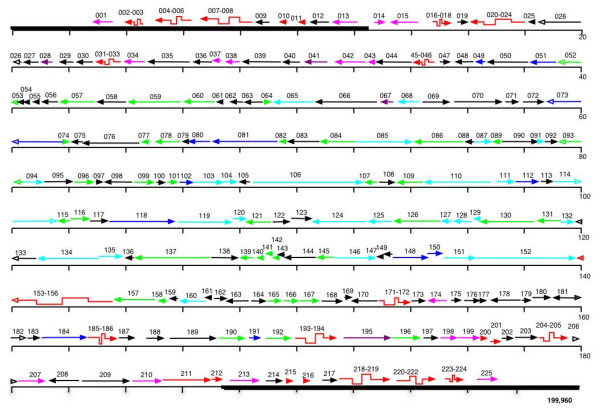
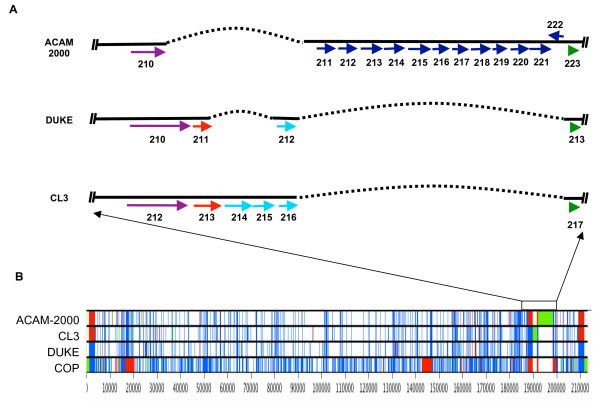
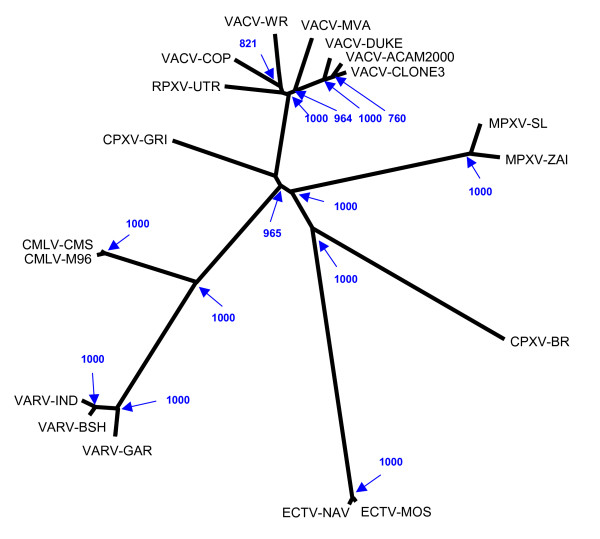
This study showed that VACV-DUKE is most similar to VACV-ACAM2000 and CLONE3, two VACV clones isolated from the Dryvax vaccine stock confirming VACV-DUKE as an isolate from Dryvax. However, VACV-DUKE is unique because it is, to date, the only Dryvax clone isolated from a patient experiencing a vaccine-associated complication. The 199,960 bp VACV-DUKE genome encodes 225 open reading frames, including 178 intact genes and 47 gene fragments. Between VACV-DUKE and the other Dryvax isolates, the major genomic differences are in fragmentation of the ankyrin-like, and kelch-like genes, presence of a full-length Interferon-alpha/beta receptor gene, and the absence of a duplication of 12 ORFs in the inverted terminal repeat. Excluding this region, the DNA sequence of VACV-DUKE differs from the other two Dryvax isolates by less than 0.4%. DNA sequencing also indicated that there was little heterogeneity in the sample, supporting the hypothesis that virus from an individual lesion is clonal in origin despite the fact that the vaccine is a mixed population.
Virus in lesions that result from progressive vaccinia following vaccination with Dryvax are likely clonal in origin. The genomic sequence of VACV-DUKE is overall very similar to that of Dryvax cell culture-derived clonal isolates. Furthermore, with the sequences of multiple clones from Dryvax we can begin to appreciate the diversity of the viral population in the smallpox vaccine.
痘苗病毒(VACV)-DUKE是从一名54岁女性的损伤处分离出来的,该女性前往杜克大学医学中心就医。她被诊断为进行性牛痘,并接受了牛痘免疫球蛋白治疗。VACV-DUKE基因组序列的可得性使得首次能够将与天花疫苗并发症相关的VACV分离株的基因组与Dryvax疫苗的培养衍生克隆分离株的序列进行比较。
本研究表明,VACV-DUKE与VACV-ACAM2000和CLONE3最为相似,这两个VACV克隆是从Dryvax疫苗储备中分离出来的,证实VACV-DUKE是从Dryvax中分离出来的。然而,VACV-DUKE是独特的,因为迄今为止,它是从经历疫苗相关并发症的患者中分离出的唯一Dryvax克隆。199,960 bp的VACV-DUKE基因组编码225个开放阅读框,包括178个完整基因和47个基因片段。在VACV-DUKE与其他Dryvax分离株之间,主要的基因组差异在于锚蛋白样和kelch样基因的片段化、全长干扰素-α/β受体基因的存在以及反向末端重复中12个开放阅读框的缺失。排除该区域后,VACV-DUKE的DNA序列与其他两个Dryvax分离株的差异小于0.4%。DNA测序还表明样本中几乎没有异质性,支持了尽管疫苗是混合群体,但来自单个损伤的病毒在起源上是克隆性的这一假设。
接种Dryvax后发生进行性牛痘的损伤中的病毒可能起源于克隆。VACV-DUKE的基因组序列总体上与Dryvax细胞培养衍生的克隆分离株非常相似。此外,通过Dryvax多个克隆的序列,我们可以开始了解天花疫苗中病毒群体的多样性。