Maguire Jason D, Lederman Edith R, Barcus Mazie J, O'Meara Wendy A Prudhomme, Jordon Robert G, Duong Socheat, Muth Sinuon, Sismadi Priyanto, Bangs Michael J, Prescott W Roy, Baird J Kevin, Wongsrichanalai Chansuda
U.S. Naval Medical Research Unit No.2 (NAMRU-2), Jakarta, Indonesia.
Malar J. 2006 Oct 25;5:92. doi: 10.1186/1475-2875-5-92.
Sets of Giemsa-stained, blood smear slides with systematically verified composite diagnoses would contribute substantially to development of externally validated quality assurance systems for the microscopic diagnosis of malaria.
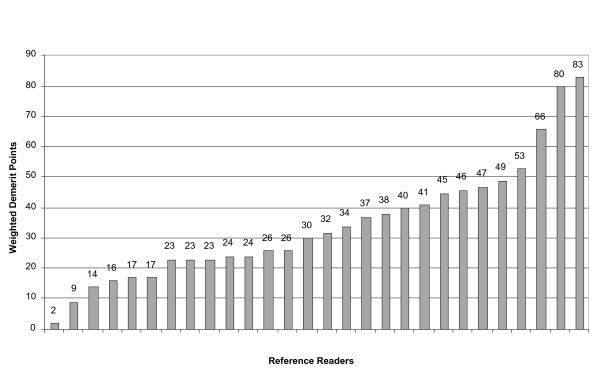
whole blood from Plasmodium-positive donors in Cambodia and Indonesia and individuals with no history of risk for malaria was collected. Using standard operating procedures, technicians prepared Giemsa-stained thick and thin smears from each donor. One slide from each of the first 35 donations was distributed to each of 28 individuals acknowledged by reputation as having expertise in the microscopic diagnosis of malaria. These reference readers recorded presence or absence of Plasmodium species and parasite density. A composite diagnosis for each donation was determined based on microscopic findings and species-specific small subunit ribosomal RNA (ssrRNA) DNA polymerase chain reaction (PCR) amplification.
More than 12,000 slides were generated from 124 donations. Reference readers correctly identified presence of parasites on 85% of slides with densities <100 parasites/microl, which improved to 100% for densities >350 parasites/microl. Percentages of agreement with composite diagnoses were highest for Plasmodium falciparum (99%), followed by Plasmodium vivax (86%).
Herein, a standardized method for producing large numbers of consistently high quality, durable Giemsa-stained blood smears and validating composite diagnoses for the purpose of creating a malaria slide repository in support of initiatives to improve training and competency assessment amidst a background of variability in diagnosis is described.
经过系统验证的复合诊断的吉姆萨染色血涂片集,将极大地有助于开发用于疟疾显微镜诊断的外部验证质量保证系统。
收集来自柬埔寨和印度尼西亚疟原虫阳性献血者以及无疟疾风险史个体的全血。技术人员按照标准操作程序,从每位献血者制备吉姆萨染色的厚涂片和薄涂片。前35份捐赠样本中的每份样本各取一张涂片,分发给28位公认的疟疾显微镜诊断专家。这些参考阅片者记录疟原虫种类的有无及寄生虫密度。根据显微镜检查结果和物种特异性小亚基核糖体RNA(ssrRNA)聚合酶链反应(PCR)扩增确定每份捐赠样本的复合诊断结果。
124份捐赠样本共制作了12000多张涂片。参考阅片者在密度<100个寄生虫/微升的涂片中正确识别出寄生虫存在的比例为85%,密度>350个寄生虫/微升时这一比例提高到100%。与复合诊断结果的一致率,恶性疟原虫最高(99%),其次是间日疟原虫(86%)。
本文描述了一种标准化方法,用于制作大量始终高质量、耐用的吉姆萨染色血涂片,并验证复合诊断结果,目的是创建一个疟疾涂片库,以支持在诊断存在差异的背景下改善培训和能力评估的举措。