Park C S, Hausdorff S F, Miller C
Howard Hughes Medical Institute, Graduate Department of Biochemistry, Brandeis University, Waltham, MA 02254.
Proc Natl Acad Sci U S A. 1991 Mar 15;88(6):2046-50. doi: 10.1073/pnas.88.6.2046.
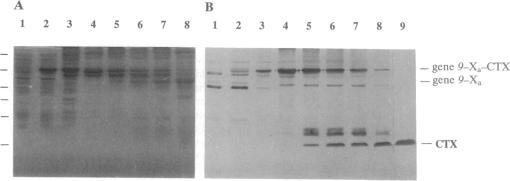
A gene encoding charybdotoxin (CTX), a K+ channel blocker from scorpion venom, was designed, synthesized, and expressed as a cleavable fusion protein in Escherichia coli. A sequence-specific protease, factor Xa, was used to cleave the fusion protein and thus release the toxin peptide. The recombinant toxin was purified, oxidized to form disulfide bonds, and treated to form N-terminal pyroglutamate. Recombinant CTX is identical to the native venom CTX with respect to high-performance liquid chromatography mobility, amino acid composition, and N-terminal modification. With single Ca2(+)-activated K+ channels as an assay system, recombinant CTX shows blocking and dissociation kinetics identical to the native venom toxin. The synthetic gene and high-level expression of functionally active CTX make it possible to study the fundamental mechanism of the toxin-ion channel interaction.
设计、合成了一种编码来自蝎毒的钾离子通道阻滞剂——章鱼毒素(CTX)的基因,并在大肠杆菌中作为可裂解融合蛋白进行表达。使用序列特异性蛋白酶Xa因子裂解融合蛋白,从而释放毒素肽。对重组毒素进行纯化、氧化以形成二硫键,并进行处理以形成N端焦谷氨酸。重组CTX在高效液相色谱迁移率、氨基酸组成和N端修饰方面与天然毒液CTX相同。以单个Ca2(+)-激活的钾离子通道作为检测系统,重组CTX显示出与天然毒液毒素相同的阻断和解离动力学。合成基因和功能活性CTX的高水平表达使得研究毒素-离子通道相互作用的基本机制成为可能。