Zadek Brittany, Nimigean Crina M
Department of Biochemistry and Membrane Biology, University of California, Davis, 95616, USA.
J Gen Physiol. 2006 Jun;127(6):673-85. doi: 10.1085/jgp.200609534.
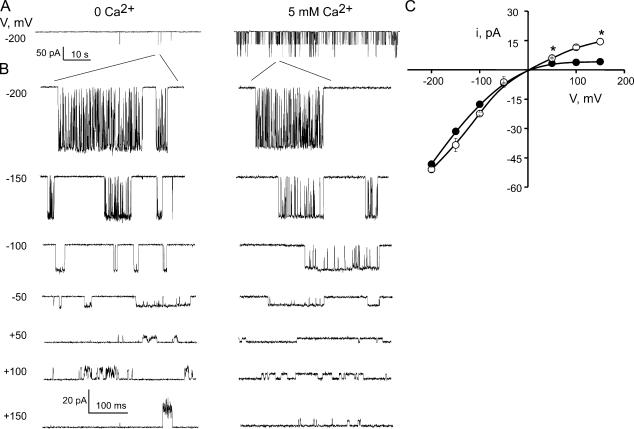
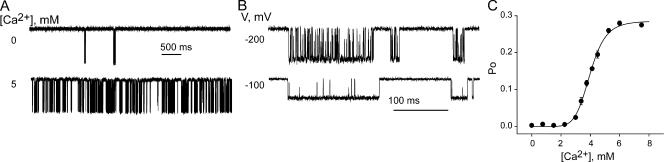
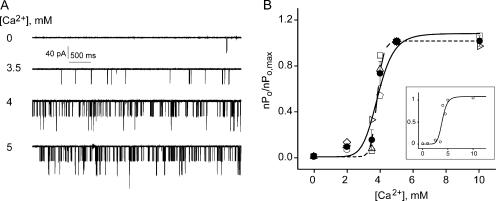
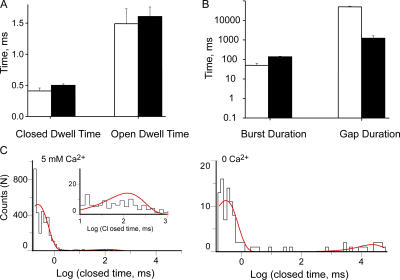
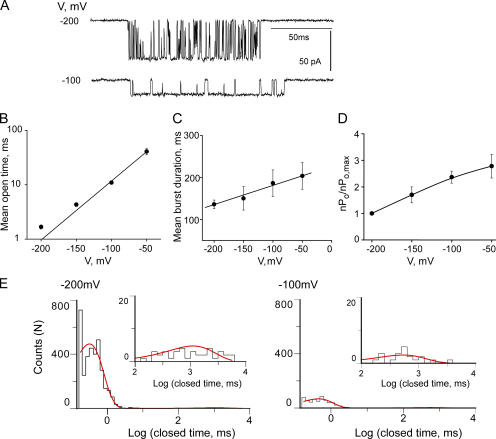
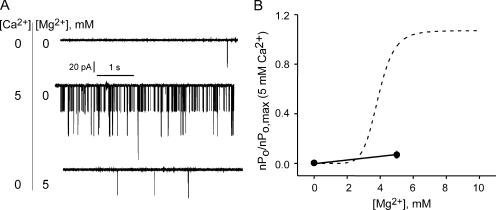
MthK is a calcium-gated, inwardly rectifying, prokaryotic potassium channel. Although little functional information is available for MthK, its high-resolution structure is used as a model for eukaryotic Ca(2+)-dependent potassium channels. Here we characterize in detail the main gating characteristics of MthK at the single-channel level with special focus on the mechanism of Ca(2+) activation. MthK has two distinct gating modes: slow gating affected mainly by Ca(2+) and fast gating affected by voltage. Millimolar Ca(2+) increases MthK open probability over 100-fold by mainly increasing the frequency of channel opening while leaving the opening durations unchanged. The Ca(2+) dose-response curve displays an unusually high Hill coefficient (n = approximately 8), suggesting strong coupling between Ca(2+) binding and channel opening. Depolarization affects both the fast gate by dramatically reducing the fast flickers, and to a lesser extent, the slow gate, by increasing MthK open probability. We were able to capture the mechanistic features of MthK with a modified MWC model.
MthK是一种钙门控、内向整流的原核钾通道。尽管关于MthK的功能信息很少,但其高分辨率结构被用作真核生物钙依赖性钾通道的模型。在这里,我们在单通道水平上详细表征了MthK的主要门控特性,特别关注钙激活机制。MthK有两种不同的门控模式:主要受钙影响的慢门控和受电压影响的快速门控。毫摩尔浓度的钙主要通过增加通道开放频率而使MthK的开放概率提高100倍以上,而开放持续时间不变。钙剂量反应曲线显示出异常高的希尔系数(n约为8),表明钙结合与通道开放之间存在强耦合。去极化通过显著减少快速闪烁影响快速门控,并在较小程度上通过增加MthK开放概率影响慢门控。我们能够用改进的MWC模型捕捉MthK的机制特征。