Yu Xiao, Chen Xiao-Wei, Zhou Peng, Yao Lijun, Liu Tao, Zhang Bo, Li Ying, Zheng Hui, Zheng Liang-Hong, Zhang Claire Xi, Bruce Iain, Ge Jun-Bo, Wang Shi-Qiang, Hu Zhi-An, Yu Han-Gang, Zhou Zhuan
Institute of Molecular Medicine, Peking University, Beijing 100871, China.
Am J Physiol Cell Physiol. 2007 Mar;292(3):C1147-55. doi: 10.1152/ajpcell.00598.2005. Epub 2006 Oct 25.
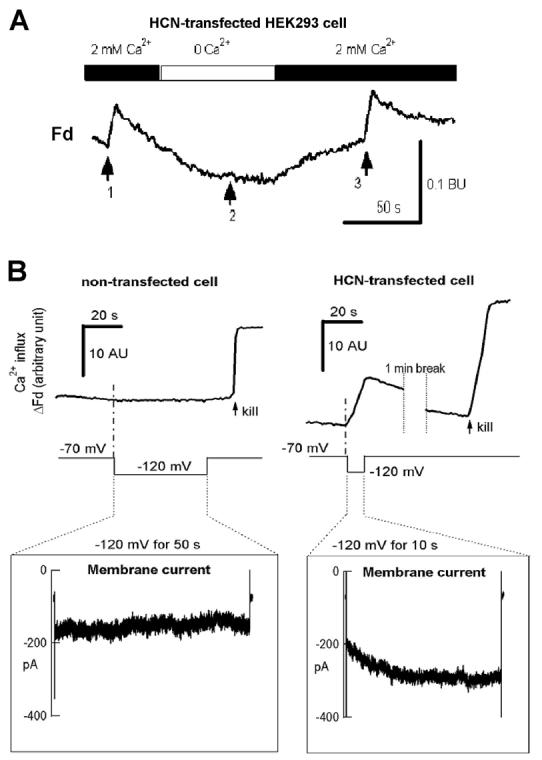
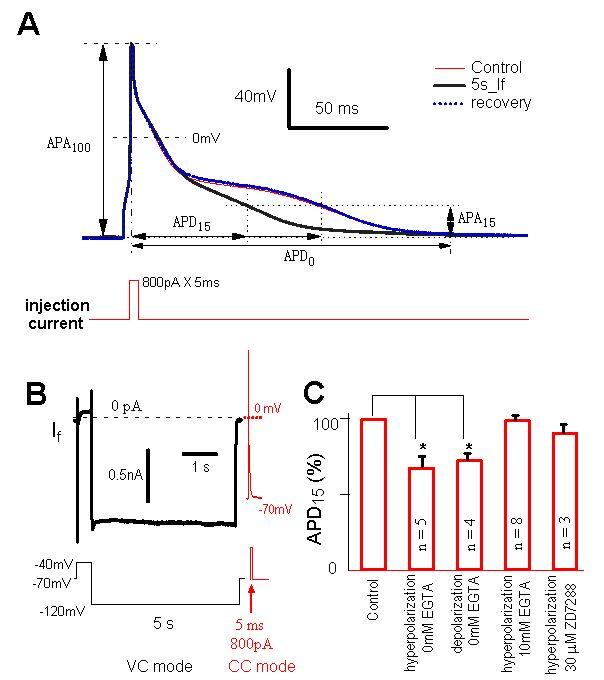
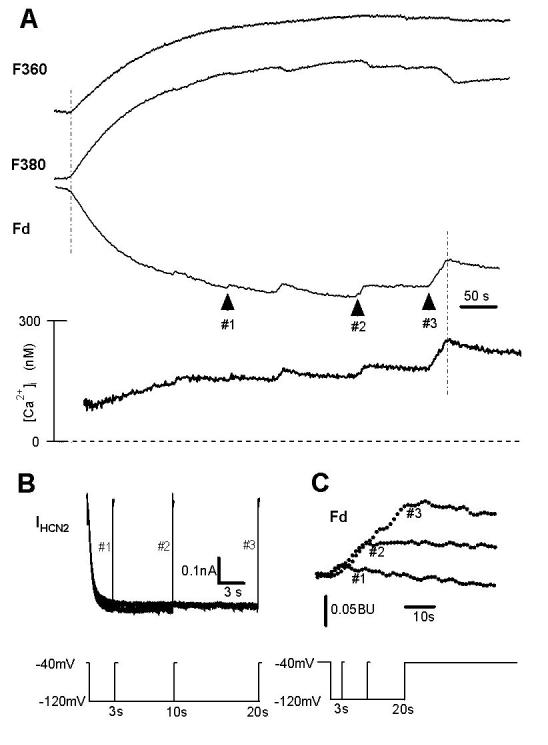
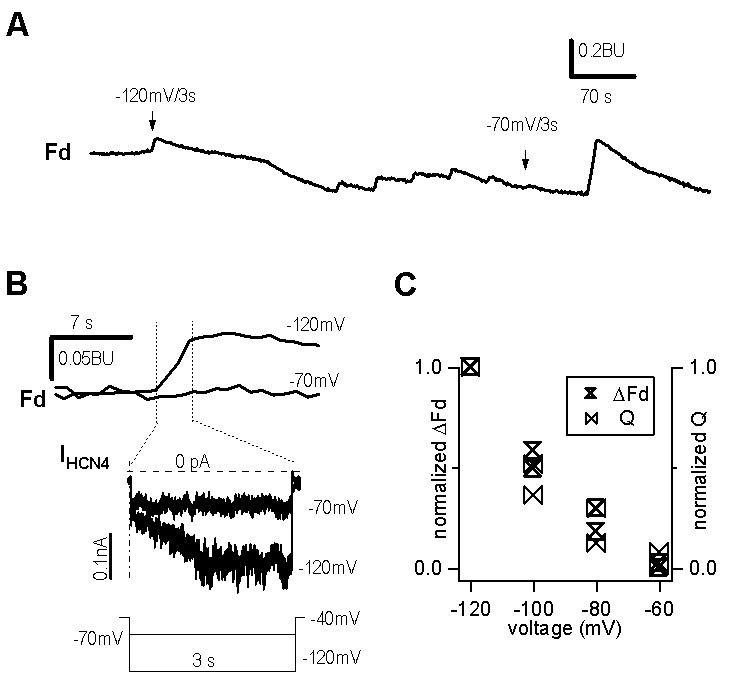
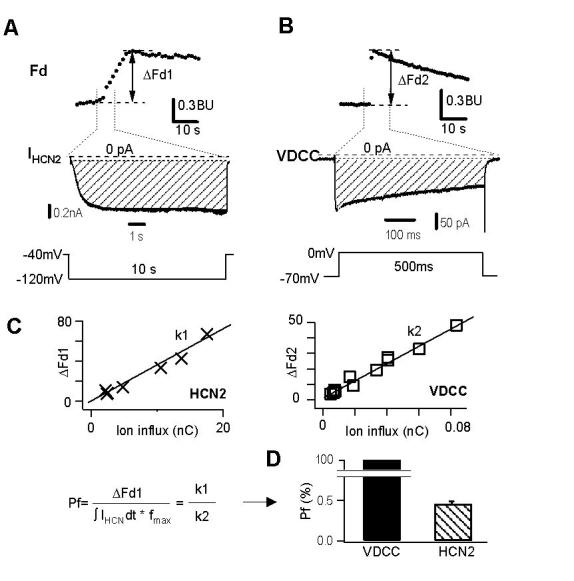
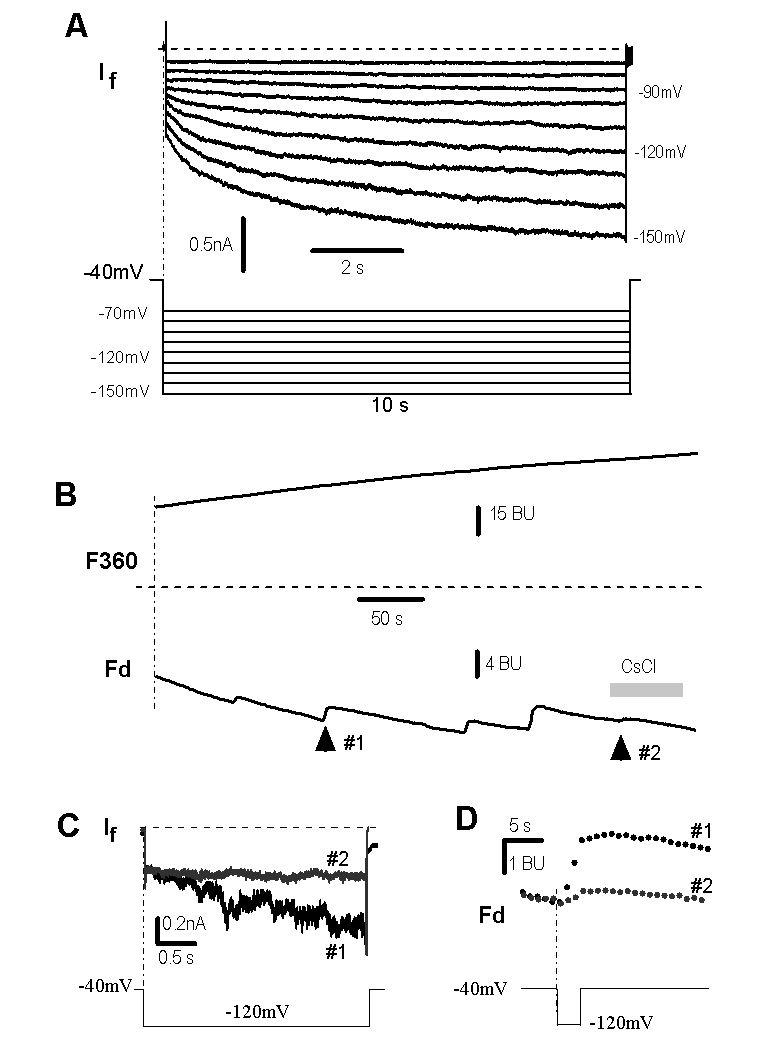
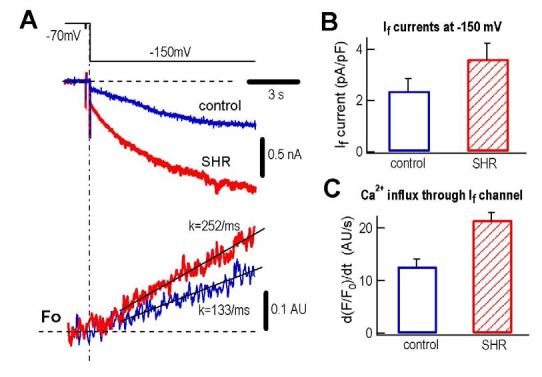
The hyperpolarization-activated, cyclic nucleotide-gated (HCN) channels, or cardiac (I(f))/neuronal (I(h)) time- and voltage-dependent inward cation current channels, are conventionally considered as monovalent-selective channels. Recently we discovered that calcium ions can permeate through HCN4 and I(h) channels in neurons. This raises the possibility of Ca(2+) permeation in I(f), the I(h) counterpart in cardiac myocytes, because of their structural homology. We performed simultaneous measurement of fura-2 Ca(2+) signals and whole cell currents produced by HCN2 and HCN4 channels (the 2 cardiac isoforms present in ventricles) expressed in HEK293 cells and by I(f) in rat ventricular myocytes. We observed Ca(2+) influx when HCN/I(f) channels were activated. Ca(2+) influx was increased with stronger hyperpolarization or longer pulse duration. Cesium, an I(f) channel blocker, inhibited I(f) and Ca(2+) influx at the same time. Quantitative analysis revealed that Ca(2+) flux contributed to approximately 0.5% of current produced by the HCN2 channel or I(f). The associated increase in Ca(2+) influx was also observed in spontaneously hypertensive rat (SHR) myocytes in which I(f) current density is higher than that of normotensive rat ventricle. In the absence of EGTA (a Ca(2+) chelator), preactivation of I(f) channels significantly reduced the action potential duration, and the effect was blocked by another selective I(f) channel blocker, ZD-7288. In the presence of EGTA, however, preactivation of I(f) channels had no effects on action potential duration. Our data extend our previous discovery of Ca(2+) influx in I(h) channels in neurons to I(f) channels in cardiac myocytes.
超极化激活的环核苷酸门控(HCN)通道,即心脏(I(f))/神经元(I(h))时间和电压依赖性内向阳离子电流通道,传统上被认为是单价选择性通道。最近我们发现钙离子可以透过神经元中的HCN4和I(h)通道。由于心肌细胞中的I(f)(I(h)在心肌细胞中的对应物)与它们结构同源,因此存在钙离子透过I(f)通道的可能性。我们同时测量了fura-2钙离子信号以及由HEK293细胞中表达的HCN2和HCN4通道(心室中存在的两种心脏亚型)以及大鼠心室肌细胞中的I(f)产生的全细胞电流。当HCN/I(f)通道被激活时,我们观察到钙离子内流。更强的超极化或更长的脉冲持续时间会使钙离子内流增加。铯,一种I(f)通道阻滞剂,同时抑制I(f)和钙离子内流。定量分析表明,钙离子通量约占HCN2通道或I(f)产生电流的0.5%。在自发性高血压大鼠(SHR)的心肌细胞中也观察到了相关的钙离子内流增加,其I(f)电流密度高于正常血压大鼠心室。在没有EGTA(一种钙离子螯合剂)的情况下,I(f)通道的预激活显著缩短了动作电位持续时间,并且该效应被另一种选择性I(f)通道阻滞剂ZD-7288阻断。然而,在有EGTA存在的情况下,I(f)通道的预激活对动作电位持续时间没有影响。我们的数据将我们之前在神经元I(h)通道中发现的钙离子内流扩展到了心肌细胞的I(f)通道。